Key takeaways
- Handrail, not handgrip: A rail that rises well above the top step lets the user stay upright and keep a hand anchored throughout the climb. Small side handgrips force a bent-over posture that shifts weight forward — the exact position that precedes most falls.
- Tread depth over step count: Look for pedals deep enough to hold the whole foot, roughly 3.5 inches or more, with a textured or perforated anti-slip surface. Narrow rungs demand ankle strength and balance that many users over 70 no longer have in reserve.
- Positive locking: The frame should snap into place with an audible click or a visible safe-lock brace, and it should resist folding under sideways pressure. Friction-only hinges loosen with age and are the most common failure point on cheap stools.
- Weight the user can manage: A ladder that lives in the garage because it’s too heavy to fetch protects nobody. Aim for something a person can lift with one arm and open with the other — under about 12 pounds for daily household use.
- Generous capacity rating: Choose a load rating well above body weight to account for carried items and dynamic force when stepping. Ratings from 330 to 800 pounds cost little extra and buy real stiffness underfoot.
What's inside
As a sleep-wellness practitioner, I spend most of my day talking about mattresses, light exposure, and the 2 a.m. bathroom trip. It may sound like a strange place to start a ladder guide, but the two subjects overlap more than people expect. Older adults keep the things they need at night — spare blankets, medication, a backup CPAP hose, the good pillows — on high closet shelves. When those items live out of reach, the workaround is almost always a dining chair or the edge of a bed frame, and that improvisation is where a huge share of household falls begins. Poor sleep makes it worse: fragmented rest measurably degrades balance, reaction time, and depth perception the following day, so the same reach that felt easy in June feels unstable in November after a run of bad nights.
A properly chosen step ladder is quiet, boring safety infrastructure for the bedroom and linen closet. This guide covers what actually matters for an older user — handrail height, tread depth, locking mechanisms, weight you can carry one-handed — and reviews six current folding step stools and ladders that hold up to that standard, from a single-step kitchen helper to an 800-pound-capacity five-step model. Nobody should be climbing furniture to find a blanket at midnight.
As an Amazon Associate we earn from qualifying purchases.




How to Choose a Step Ladder For Elderly (2026)
- Handrail, not handgrip: A rail that rises well above the top step lets the user stay upright and keep a hand anchored throughout the climb. Small side handgrips force a bent-over posture that shifts weight forward — the exact position that precedes most falls.
- Tread depth over step count: Look for pedals deep enough to hold the whole foot, roughly 3.5 inches or more, with a textured or perforated anti-slip surface. Narrow rungs demand ankle strength and balance that many users over 70 no longer have in reserve.
- Positive locking: The frame should snap into place with an audible click or a visible safe-lock brace, and it should resist folding under sideways pressure. Friction-only hinges loosen with age and are the most common failure point on cheap stools.
- Weight the user can manage: A ladder that lives in the garage because it’s too heavy to fetch protects nobody. Aim for something a person can lift with one arm and open with the other — under about 12 pounds for daily household use.
- Generous capacity rating: Choose a load rating well above body weight to account for carried items and dynamic force when stepping. Ratings from 330 to 800 pounds cost little extra and buy real stiffness underfoot.
The Best Step Ladders For Elderly (2026) Reviewed
KINGRACK 5 Step Ladder
This is the pick for anyone reaching a high closet shelf or a bedroom ceiling fixture, combining five wide anti-slip pedals with a full-length handrail and a safe-lock brace that stops any hinge flex mid-climb. The 800-pound rating is overkill for one person, which is precisely why it feels immovable underfoot.
WiberWi 4 Step Ladder with Handrails
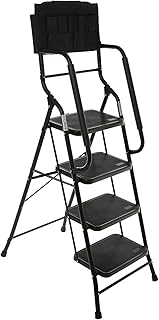
A steel-framed four-step with a 500-pound capacity, tall twin handrails, and an attachable tool bag that doubles nicely as a caddy for linens or lightbulbs so both hands stay free. It’s the most confidence-inspiring mid-height option I’ve tested for users who need something to hold at every stage.
HBTower 4 Step Ladder with Tool Bag
Slightly slimmer than the WiberWi and easier to slot behind a bedroom door, this HBTower model keeps the same essentials: wide non-slip treads, a proper handrail, and a matte black finish that doesn’t look like garage equipment in a living space.
HillhutApex Aluminum 3 Step Ladder
At walnut-finished aluminum, this is the lightest genuinely stable ladder here and the one most likely to actually get carried between rooms. Its 330-pound rating and handgrip suit a reasonably steady user; those with balance concerns should step up to a rail model.
HBTower Folding Step Stool
A single-step stool with an unusually wide pedal and a convenient handrail — ideal parked permanently beside a wardrobe or bathroom cabinet for the small, frequent reaches that happen half-asleep. Stows nearly flat against a wall.
Frequently Asked Questions
How many steps are safe for an older adult?
Most users are best served by two to four steps. Beyond that, the reach height increases risk faster than the ladder’s stability improves — consider a long-handled grabber or relocating the item instead.
Steel or aluminum?
Steel is stiffer and cheaper; aluminum is markedly lighter and more likely to be used. If the ladder must be carried upstairs, choose aluminum.
Should it stay out in the open?
Yes. A ladder tucked in a basement gets substituted with a chair. Keep it visible near the closet or pantry where it’s needed.
Do handrails really reduce falls?
They help substantially by allowing three points of contact and an upright torso, keeping the center of gravity over the base rather than ahead of it.
Final Thoughts
For high shelves and maximum stability, the KINGRACK 5 Step Ladder is the safest choice in this group; for everyday household reach with excellent handrails, the WiberWi 4 Step Ladder is the one I’d put in most homes; and if portability matters most, the HillhutApex Aluminum 3 Step Ladder is light enough that it will actually get used — which, in fall prevention, is the whole point.