Key takeaways
- Voltage and circuit reality: Anything above roughly 1,800W needs a dedicated 240V circuit, and 7,500W units generally require hardwiring by an electrician. Confirm what your panel can actually deliver before you fall in love with a spec sheet — retrofitting a 240V line costs more than the heater.
- Noise character, not just volume: Fan-forced heaters produce broadband whoosh; some also produce a low-frequency drone that travels through framing far better than it travels through air. If the garage shares a wall or ceiling with a sleeping space, radiant quartz or oscillating convection designs are the gentler neighbors.
- Thermostat precision: A digital thermostat that holds within a degree or two will cycle less aggressively than a mechanical dial, which means fewer startup surges and fewer sudden noise events. Steady is more comfortable than powerful.
- Timers and remotes: A 1–12 hour timer lets you pre-warm the space before you use it and guarantee shutoff afterward. That single feature does more for peace of mind than any amount of extra wattage.
- Mounting and clearances: Ceiling and wall mounts free your floor, keep the unit away from sawdust and solvents, and generally improve air distribution. Check required clearance from combustibles and confirm ETL or UL listing plus overheat protection.
What's inside
Most people shop for a garage heater in a panic, sometime around the first hard frost, and they buy on wattage alone. That’s how you end up with a roaring fan-forced unit bolted to the wall shared with a bedroom, running at 2 a.m. while someone on the other side of the drywall stares at the ceiling. I’ve spent years working with clients on thermal comfort and sleep environments, and the garage is the room nobody thinks about until it starts sabotaging the rest of the house — through low-frequency fan hum, through the cold floor plane that pulls heat out of adjacent rooms, through the temperature swings that make a bonus room above the garage unusable after 10 p.m.
This guide looks at garage electric heaters through a slightly unusual lens: not just how fast they warm 500 square feet, but how quietly they do it, how steadily they hold a setpoint overnight, and whether they can run unattended without waking anyone up or worrying you into checking on them. Below you’ll find six units worth considering in 2026, ranging from 1,500W radiant panels for a workbench corner to 7,500W hardwired systems for a genuinely cold three-car space, followed by selection criteria and the questions I get asked most.
As an Amazon Associate we earn from qualifying purchases.


How to Choose a Garage Electric Space Heater (2026)
- Voltage and circuit reality: Anything above roughly 1,800W needs a dedicated 240V circuit, and 7,500W units generally require hardwiring by an electrician. Confirm what your panel can actually deliver before you fall in love with a spec sheet — retrofitting a 240V line costs more than the heater.
- Noise character, not just volume: Fan-forced heaters produce broadband whoosh; some also produce a low-frequency drone that travels through framing far better than it travels through air. If the garage shares a wall or ceiling with a sleeping space, radiant quartz or oscillating convection designs are the gentler neighbors.
- Thermostat precision: A digital thermostat that holds within a degree or two will cycle less aggressively than a mechanical dial, which means fewer startup surges and fewer sudden noise events. Steady is more comfortable than powerful.
- Timers and remotes: A 1–12 hour timer lets you pre-warm the space before you use it and guarantee shutoff afterward. That single feature does more for peace of mind than any amount of extra wattage.
- Mounting and clearances: Ceiling and wall mounts free your floor, keep the unit away from sawdust and solvents, and generally improve air distribution. Check required clearance from combustibles and confirm ETL or UL listing plus overheat protection.
The Best Garage Electric Space Heaters (2026) Reviewed
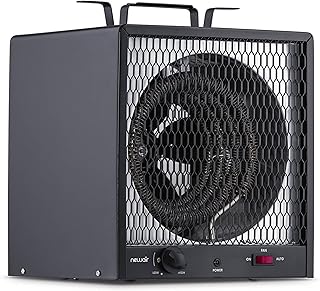
NewAir 240V Portable Garage Heater
A sensible pick if you’d rather not commit to a permanent install: it delivers industrial-grade 240V output while remaining movable between a shop, shed, or warehouse bay. Portability costs you some acoustic isolation, though, so position it away from shared walls if anyone sleeps nearby.
Comfort Zone 5000W Ceiling Mounted Heater
Three heat settings, overheat protection, and an ETL listing make this the straightforward workhorse of the group — mount it, wire it, forget it. The trade-off is manual control, so it’s better suited to spaces you occupy actively than to unattended overnight operation.
5000W Fan-Forced Heater with Remote and Digital Thermostat
This is the best-balanced unit here for a standard 500-square-foot garage: digital thermostat, 1–9 hour timer, remote, and flexible wall or ceiling mounting. The thermostat holds a setpoint well enough that cycling stays predictable rather than startling.
TEMPWARE 7500W Hardwired Garage Heater
Serious output for genuinely cold or oversized spaces, with a 12-hour timer and digital thermostat that make long unattended runs manageable. It’s hardwired and it’s loud at full tilt — budget for an electrician, and don’t install it under a bedroom floor.
Shinic Radiant Quartz Heater with Work Light
My recommendation when noise matters most: radiant quartz warms objects and people directly with almost no fan noise, and the 90° rotation plus integrated work light suit a bench or bay rather than a whole room. At 1,500W it’s a spot heater, not a space heater — set expectations accordingly.
Frequently Asked Questions
Can I leave a garage heater running overnight?
Only with a thermostat, overheat protection, proper clearances, and ideally a timer. Never with an extension cord, and never in a space storing gasoline, solvents, or finishing products.
Will a garage heater keep me awake in the room above?
It can. Fan noise transmits through shared framing, so favor radiant or low-speed convection units, mount them on exterior walls where possible, and run a pre-warming cycle before bedtime rather than continuous night operation.
How many watts do I actually need?
Roughly 10 watts per square foot in an insulated garage, more in an uninsulated one. A 5,000W unit suits about 500 square feet; jump to 7,500W for larger or poorly sealed spaces.
Is electric better than propane for a garage?
For an attached garage, yes — electric produces no combustion byproducts and needs no venting, which matters enormously when that air can migrate into living and sleeping areas.
Final Thoughts
For most attached garages, the 5000W fan-forced heater with remote and digital thermostat offers the best combination of steady output and set-and-forget control. If quiet operation is your priority — especially with bedrooms nearby — the Shinic radiant quartz heater is the smarter choice, and for large or severely cold spaces, the TEMPWARE 7500W hardwired unit is the one with genuine capacity to spare.