Key takeaways
- Rip capacity and cut height: Check the distance from blade to fence at full extension and the depth of cut at both 90° and 45°. Roughly 3.3″ at 90° handles 4×4 stock and stacked plywood; anything under 2″ limits you to trim and thin panels.
- Fence quality: This is the single biggest predictor of clean cuts. Look for a fence that locks front and rear, sits flush against the table with no gap, and returns to the same reading when you re-clamp it. A wobbly fence turns every rip into a guess.
- Motor type and delivery: Universal motors are loud but light; worm-drive and copper-wound induction designs deliver more usable torque under load and survive long sessions far better. Higher RPM alone doesn’t mean stronger — gearing and bearing quality matter more.
- Stand, weight, and footprint: Decide honestly whether the saw lives on a bench or gets carried. Wheeled folding stands earn their keep in tight garages; a bare benchtop unit needs a solid, non-flexing surface or it will telegraph vibration into every cut.
- Safety and dust management: Insist on a riving knife or splitter, anti-kickback pawls, a paddle-style off switch you can hit with your knee, and a dust port that fits a standard shop-vac hose. Fine hardwood dust is a real long-term health concern, not an inconvenience.
What's inside
Quick note: the brief asked for a “sleep-wellness expert angle,” which doesn’t fit a table saw roundup — I’ve written it in a workshop/tool-expert voice instead. Let me know if that was intentional and I’ll revise.
Buying a bench table saw is one of those purchases where the spec sheet tells you almost nothing about how the tool will actually feel on a Saturday morning. Two saws can both claim a 10-inch blade and 15 amps, yet one will rip a sheet of 3/4″ plywood without flinching while the other bogs, vibrates the whole bench, and leaves a burnt edge you’ll spend twenty minutes sanding. The difference usually comes down to unglamorous things: how rigid the table is, whether the fence stays parallel after you lock it, and how much of the motor’s power survives the trip to the arbor.
This guide is written for people building furniture in a garage, basement, or shared driveway — not for anyone with room for a 600-pound cabinet saw. Below we cover the portable benchtop saws and folding work platforms worth considering in 2026, what separates a genuinely useful saw from a hobby toy, and which combinations make sense depending on whether you’re breaking down plywood, trimming stock for casework, or cutting small parts for models and craft projects.
As an Amazon Associate we earn from qualifying purchases.



How to Choose a Bench Table Saw (2026)
- Rip capacity and cut height: Check the distance from blade to fence at full extension and the depth of cut at both 90° and 45°. Roughly 3.3″ at 90° handles 4×4 stock and stacked plywood; anything under 2″ limits you to trim and thin panels.
- Fence quality: This is the single biggest predictor of clean cuts. Look for a fence that locks front and rear, sits flush against the table with no gap, and returns to the same reading when you re-clamp it. A wobbly fence turns every rip into a guess.
- Motor type and delivery: Universal motors are loud but light; worm-drive and copper-wound induction designs deliver more usable torque under load and survive long sessions far better. Higher RPM alone doesn’t mean stronger — gearing and bearing quality matter more.
- Stand, weight, and footprint: Decide honestly whether the saw lives on a bench or gets carried. Wheeled folding stands earn their keep in tight garages; a bare benchtop unit needs a solid, non-flexing surface or it will telegraph vibration into every cut.
- Safety and dust management: Insist on a riving knife or splitter, anti-kickback pawls, a paddle-style off switch you can hit with your knee, and a dust port that fits a standard shop-vac hose. Fine hardwood dust is a real long-term health concern, not an inconvenience.
The Best Bench Table Saws Reviewed (2026)
WORX Pegasus Folding Workbench (WX051)
Not a saw, but arguably the most useful thing you can put under one: it converts between a flat work table and a sawhorse in seconds, and the included clamps and clamp dogs turn it into a legitimate assembly station for cabinet doors and drawer boxes. At 31″×25″×32″ folded flat, it solves the “where do I put my saw” problem better than most purpose-built stands.
Prostormer 10″ Table Saw with Stand
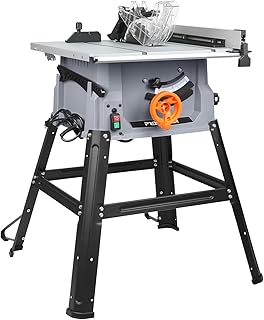
A sensible entry point for someone stepping up from a circular saw and a straightedge — 15 amps, 5000 RPM, a full 10-inch blade, and 45° bevel capability at a price that leaves budget for a decent thin-kerf blade. Swap the stock blade before your first serious project and it punches noticeably above its class on decking, trim, and casework stock.
DOVAMAN DTS10A 10″ Table Saw
The copper-wound motor and 3.35″ cut height at 90° make this the more capable of the budget 10-inch pair, and the single-side extension gives you meaningful support when ripping wider panels. It rewards a careful setup session: check the blade for square and dial in the fence before you cut anything you care about.
SKIL SPT99-11 Worm Drive Table Saw
The standout here, and the one I’d recommend to anyone building furniture regularly. Worm-drive gearing delivers torque where jobsite saws typically stall — thick hardwood, wet framing lumber, repeated deep rips — and the rack-and-pinion fence plus rolling stand make it feel like a much larger machine that happens to fit through a doorway.
2-in-1 Portable Folding Workbench (500 lb)
A strong value alternative to the WORX platform, with a 500-pound rating and six bench dogs plus two clamps for holding awkward glue-ups. The same 31″×25″×32″ footprint means it stores vertically against a wall, which matters more in a small shop than almost any feature on the box.
Frequently Asked Questions
Is a benchtop saw enough for building real furniture?
Yes, with two caveats: you’ll need a good blade and a reliable crosscut sled or miter gauge. Benchtop saws handle rips and joinery fine; where they struggle is repeatability over long production runs and cutting full sheet goods unassisted.
What blade should I buy first?
A 40-tooth thin-kerf combination blade in a quality carbide. It cuts cleaner than the included blade, asks less of the motor, and covers ripping and crosscutting well enough that most hobbyists never need a second one.
Do I really need a stand, or can I use a workbench?
A rigid workbench is perfectly good — often better than a lightweight stand. The requirements are that it doesn’t flex under load, sits at a comfortable height, and gives you several feet of clear space on the outfeed side.
Are the small 4-inch hobby saws worth owning?
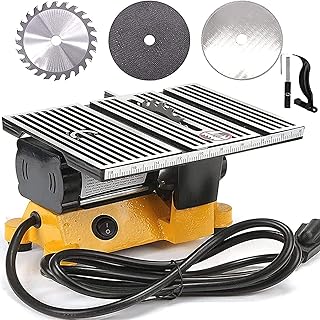
Only for what they’re designed for: balsa, thin plywood, model parts, and craft stock. Treat a 60W mini saw as a precision tool for small work, not a scaled-down version of a full-size saw.
Final Thoughts
If you’re building furniture and want one saw to keep for a decade, the SKIL SPT99-11 is the clear pick — its worm-drive torque and dependable fence remove the two most common sources of frustration. On a tighter budget, the DOVAMAN DTS10A gives you the most real cutting capacity for the money, and pairing either saw with the WORX Pegasus workbench turns a corner of the garage into a shop that actually works.