Key takeaways
- Blade size and cut depth: A 10″ blade cutting roughly 3.3″ at 90° handles doubled 3/4″ stock, 2×4 rails, and thick headboard laminations. Smaller 6.5″ and 8″ saws are lighter and quieter but top out near 1.5–2″, which limits you to sheet goods and thin trim.
- Fence quality above all else: Furniture lives or dies on parallel rips. Rack-and-pinion fences stay square as they travel; simpler clamp-style fences work but need checking with a tape at both ends before every cut.
- Rip capacity: Anything under about 12″ means breaking down plywood with a track or circular saw first. A 24″ rip capacity lets you cut a full-width drawer bottom or bed slat panel in one pass.
- Dust control: A real dust port you can attach a shop vac to matters enormously if the saw shares space with a bedroom. Fine wood dust lingers in soft furnishings for weeks and is a genuine irritant for anyone with allergic rhinitis or asthma — both of which fragment sleep.
- Guarding and noise discipline: Confirm the blade guard, riving knife or splitter, and push stick are included, not optional. And plan cutting for daylight hours: a 5,000 RPM motor in an attached garage is loud enough to wake a household through a shared wall.
What's inside
Most people shopping for a benchtop table saw aren’t building cabinets for a living — they’re building a bed frame that doesn’t creak at 2 a.m., a nightstand sized to an actual mattress height, or a blackout-curtain valance that finally kills the streetlight glare. I spend my working life on sleep environments, and I’ve learned that the bedroom is the room people most want to build themselves, because the fit has to be personal: platform height, drawer depth, the width of a headboard against a specific wall. The obstacle is almost always the same. A circular saw wanders, a miter saw can’t rip a panel, and a full cabinet saw won’t fit in a one-car garage or a spare room.
That’s the gap a benchtop table saw fills. It gives you repeatable straight rips and clean bevels in a footprint you can lift onto a stand, use for an afternoon, and store against a wall. This guide looks at six current portable models through a practical lens: can it handle 3/4″ plywood and solid poplar without bogging, is the fence trustworthy enough for furniture joinery, and how much noise and dust does it dump into a living space you also sleep in? Below are the picks, followed by a buying framework and answers to the questions I get asked most.
As an Amazon Associate we earn from qualifying purchases.


How to Choose a Benchtop Table Saw (2026)
- Blade size and cut depth: A 10″ blade cutting roughly 3.3″ at 90° handles doubled 3/4″ stock, 2×4 rails, and thick headboard laminations. Smaller 6.5″ and 8″ saws are lighter and quieter but top out near 1.5–2″, which limits you to sheet goods and thin trim.
- Fence quality above all else: Furniture lives or dies on parallel rips. Rack-and-pinion fences stay square as they travel; simpler clamp-style fences work but need checking with a tape at both ends before every cut.
- Rip capacity: Anything under about 12″ means breaking down plywood with a track or circular saw first. A 24″ rip capacity lets you cut a full-width drawer bottom or bed slat panel in one pass.
- Dust control: A real dust port you can attach a shop vac to matters enormously if the saw shares space with a bedroom. Fine wood dust lingers in soft furnishings for weeks and is a genuine irritant for anyone with allergic rhinitis or asthma — both of which fragment sleep.
- Guarding and noise discipline: Confirm the blade guard, riving knife or splitter, and push stick are included, not optional. And plan cutting for daylight hours: a 5,000 RPM motor in an attached garage is loud enough to wake a household through a shared wall.
The Best Benchtop Table Saws Reviewed (2026)
10″ Portable Benchtop Table Saw with Stand & Push Stick
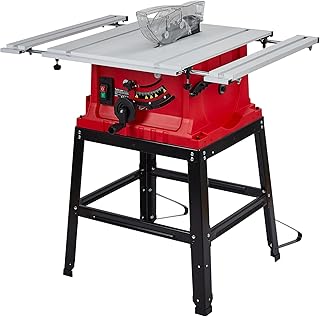
This is the sensible default for bedroom furniture: a 10″ blade, 5,000 RPM, adjustable blade height, 0–45° bevel, and a dust port that actually accepts a vacuum hose. The included stand and push stick mean you can build a full bed frame without buying accessories first.
Table Saw 6.5″ 5300 RPM Portable Benchtop
The lightest, quietest option here, and the one I’d suggest for apartment makers working on nightstand drawers, curtain battens, or thin plywood panels. Accept the shallow cut depth as the trade-off for a saw one person can carry up stairs.
DOVAMAN 10″ 15A Table Saw (DTS10A)
A 15-amp copper motor and 3.35″ cut at 90° give it the muscle for hardwood rails and doubled stock, while the one-side table extension adds useful support for wider panels. A strong all-round choice if you want capacity without jobsite bulk.
FINDBUYTOOL 10″ Portable Jobsite Table Saw
The 24″ rip capacity and rack-and-pinion fence make this the most accurate saw on the list for sheet goods — you can rip a wardrobe side or headboard panel square in one pass. Heavier and pricier, but the fence repeatability is what separates furniture from firewood.
Hoteche 8″ Portable Table Saw
A 720W compact saw with a 20-tooth carbide blade, best understood as a precision trim and small-parts machine rather than a panel breaker. Ideal for slats, cleats, drawer dividers, and shop fixtures in a tight space.
Frequently Asked Questions
Can a benchtop saw cut a full sheet of plywood?
Not safely on its own. Break the sheet down to rough size with a circular saw and straightedge, then use the table saw for final dimensioning where accuracy counts.
Is a 6.5″ or 8″ saw enough for a bed frame?
For a plywood platform bed, usually yes. For solid-wood rails, thick posts, or laminated headboards, choose a 10″ saw with 3″+ cut depth.
How do I keep dust out of the bedroom?
Connect a shop vac to the dust port, cut outside or in a closed garage, and change clothes before entering sleeping areas. Wipe surfaces rather than sweeping, which re-suspends fines.
Should I replace the included blade?
For furniture, yes. A 40–60 tooth carbide blade produces glue-ready edges and far less tearout in veneered plywood than the general-purpose blades most saws ship with.
Final Thoughts
If you’re building bedroom furniture and want one saw to cover it, the FINDBUYTOOL 10″ jobsite saw offers the best accuracy and rip capacity for panel work, while the DOVAMAN DTS10A is the stronger value for mixed hardwood and plywood projects. For small spaces and quieter, lighter work, the 6.5″ portable benchtop saw is the pick that won’t dominate your room — or your household’s sleep.