Key takeaways
- Decibel rating first: Every 10 dB drop is perceived as roughly half as loud. A 60 dB unit sits near conversational speech; a 90 dB unit demands hearing protection and will carry through drywall. If sleep in the house matters, treat 70 dB as your ceiling.
- CFM at your working pressure: Match delivered airflow to your thirstiest tool, not to the box art. Brad nailers sip air; HVLP spray guns and die grinders drink it. Undersized airflow means constant motor cycling, which is the noise pattern most likely to wake someone.
- Tank capacity versus cycling: Bigger tanks don’t produce more air, but they buy longer quiet stretches between motor runs. A 20-gallon tank running intermittently is often less disruptive than a 2-gallon tank restarting every ninety seconds.
- Oil-free and low-maintenance: Oil-free pumps skip the annual oil changes, tolerate being stored cold, and won’t mist lubricant near your finish work. Modern designs have closed most of the old longevity gap.
- Placement and mobility: Wheels, a manageable footprint, and an accessible drain valve determine whether you can roll the unit away from shared walls, put it on a rubber mat, or park it in a corner where structure-borne vibration won’t travel.
What's inside
Most people shop for an air compressor by looking at horsepower and tank size, then discover the real specification that matters after the first weekend project: how loud the thing is. A traditional oil-lubricated pancake unit can hit 90 decibels or more, which is roughly the sound pressure of a gas mower running inside your garage. If that garage shares a wall with a bedroom, or if your shop is directly below a nursery, the compressor stops being a tool and becomes a household negotiation. I spend my working life advising people on protecting sleep architecture, and nighttime and early-morning noise intrusion is one of the most underestimated disruptors I encounter — repeated sound spikes fragment sleep even when the sleeper never fully wakes.
The good news is that the 110-volt category — meaning anything you can plug into an ordinary household outlet without new wiring — has quietly become the best place to find low-noise machines. This guide focuses on models in the 60 to 75 dB range that still deliver usable airflow for finish nailing, spray painting, tire inflation, and light auto work. Below you’ll find selection criteria written with acoustics in mind, honest notes on each recommendation, and answers to the questions I hear most from people trying to run a workshop inside a home where somebody is always sleeping.
As an Amazon Associate we earn from qualifying purchases.



How to Choose a/an 110 Volt Air Compressor (2026)
- Decibel rating first: Every 10 dB drop is perceived as roughly half as loud. A 60 dB unit sits near conversational speech; a 90 dB unit demands hearing protection and will carry through drywall. If sleep in the house matters, treat 70 dB as your ceiling.
- CFM at your working pressure: Match delivered airflow to your thirstiest tool, not to the box art. Brad nailers sip air; HVLP spray guns and die grinders drink it. Undersized airflow means constant motor cycling, which is the noise pattern most likely to wake someone.
- Tank capacity versus cycling: Bigger tanks don’t produce more air, but they buy longer quiet stretches between motor runs. A 20-gallon tank running intermittently is often less disruptive than a 2-gallon tank restarting every ninety seconds.
- Oil-free and low-maintenance: Oil-free pumps skip the annual oil changes, tolerate being stored cold, and won’t mist lubricant near your finish work. Modern designs have closed most of the old longevity gap.
- Placement and mobility: Wheels, a manageable footprint, and an accessible drain valve determine whether you can roll the unit away from shared walls, put it on a rubber mat, or park it in a corner where structure-borne vibration won’t travel.
The Best 110 Volt Air Compressor (2026)s Reviewed
MZB 2.4 Gallon 1.0HP Ultra Quiet Air Compressor
At a claimed 65 dB with 5.65 CFM on tap, this is the sweet spot for indoor and near-bedroom work — quiet enough to run during a nap without startling anyone awake. The compact 2.4-gallon tank means more frequent cycling under sustained spray work, so treat it as a finish-work and inflation machine.
California Air Tools 20020AD 2.0 HP, 20 Gallon
The 20-gallon tank and 70 dB rating make this the best pick for people who want real shop capability without acoustic fallout, since the large reservoir keeps the motor idle for long stretches. The automatic drain valve is a genuinely useful touch that removes the maintenance step most owners forget.
Ultra Quiet 60 dB 2.4 Gallon, 1.5HP
This is the quietest unit here on paper, and 6.71 CFM at 115 PSI is unusually generous for a tank this small — a strong combination for apartment garages and basement shops. Expect the compact tank to refill often, which is precisely why the low decibel figure earns its keep.
9.5 Gallon Ultra Quiet Air Compressor, 2HP
With 8.75 CFM, a 70 dB rating, and wheels, this is the most versatile middle ground in the roundup: enough stored air for continuous spraying, still light enough to reposition away from shared walls. A sensible default if you’re unsure how demanding your projects will become.
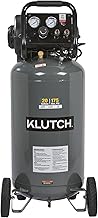
Klutch 20-Gallon, 2 HP, 175 PSI
The 75% duty cycle and 175 PSI ceiling make this the workhorse of the group, recovering quickly for impact wrenches and other high-draw tools. It’s the loudest option here, so reserve it for a detached garage or daytime-only use.
Frequently Asked Questions
Is a 70 dB compressor really quiet enough to run near a bedroom?
For daytime use, yes — 70 dB is comparable to a running shower and won’t penetrate a closed door badly. For someone actively sleeping on the other side of a wall, aim for 60 to 65 dB and add a vibration-damping mat.
Can I plug any of these into a standard household outlet?
All of these run on ordinary 110–120V household power. Use a dedicated circuit where possible and avoid long, thin extension cords, which cause voltage drop and harder motor starts.
Does a larger tank make the compressor quieter?
Not at the source, but it changes the noise pattern. Intermittent bursts separated by long silences are far less disruptive to sleep than short, frequent restarts at the same volume.
How much CFM do I actually need for home projects?
Brad and finish nailing, stapling, and inflation typically need under 2 CFM. HVLP spray guns and air-powered sanders often want 4 to 8 CFM sustained, which is where the 9.5- and 20-gallon models earn their price.
Final Thoughts
If protecting sleep in a shared home is your priority, the 60 dB Ultra Quiet 2.4-gallon model is the least intrusive machine here, and the MZB 2.4 Gallon 1.0HP is a close second with slightly friendlier ergonomics. For anyone who needs genuine shop capacity without turning the garage into a noise source, the California Air Tools 20020AD remains the best-balanced choice in the 110-volt category.