Key takeaways
- Caster quality over caster count: Look for wheels 3 inches or larger with at least two locking swivels. Small, hard casters bind on expansion joints and transmit a loud rattle through the whole cabinet — a real consideration if your workshop shares a wall with a bedroom.
- Drawer slides and depth mix: Ball-bearing slides are the minimum worth buying. Prioritize a layout with shallow drawers for wrenches and sockets plus one or two deep drawers for power tools, rather than six identical mid-depth bins.
- Working height and top surface: A chest between 32 and 38 inches tall lets you work standing without hunching. A detachable top box or cushioned mat adds a staging surface that keeps parts off the floor.
- Real load rating, per drawer: Total capacity claims are marketing; per-drawer ratings tell you whether the box handles a full impact wrench kit. Assume you’ll fill it heavier than you plan to.
- Security and portability trade-off: Keyed central locks matter in shared or rental spaces. Modular stacking systems trade lockable bulk for the ability to carry one module to the job.
What's inside
Most garage frustrations don’t start with a stripped bolt — they start with a drawer. You know the one: overloaded, sticking on its slides, hiding the 10mm socket you owned three of last spring. A rolling tool chest is supposed to solve that, but the category is crowded with cabinets that look identical in photos and feel wildly different once loaded with 300 pounds of steel. The gap between a chest that glides across a concrete slab and one that shudders and wanders is almost never visible on a spec sheet.
This guide focuses on value rather than flagship pricing — the chests that deliver honest capacity, drawers that still open smoothly in year three, and casters that roll quietly enough to use in an attached garage without waking the house. I’ve weighted drawer liners, lock quality, caster diameter, and whether the top surface is genuinely useful as a work platform. Below are the models worth your money in 2026, followed by a buying framework and answers to the questions readers ask most.
As an Amazon Associate we earn from qualifying purchases.




How to Choose a Rolling Tool Chest For The Money (2026)
- Caster quality over caster count: Look for wheels 3 inches or larger with at least two locking swivels. Small, hard casters bind on expansion joints and transmit a loud rattle through the whole cabinet — a real consideration if your workshop shares a wall with a bedroom.
- Drawer slides and depth mix: Ball-bearing slides are the minimum worth buying. Prioritize a layout with shallow drawers for wrenches and sockets plus one or two deep drawers for power tools, rather than six identical mid-depth bins.
- Working height and top surface: A chest between 32 and 38 inches tall lets you work standing without hunching. A detachable top box or cushioned mat adds a staging surface that keeps parts off the floor.
- Real load rating, per drawer: Total capacity claims are marketing; per-drawer ratings tell you whether the box handles a full impact wrench kit. Assume you’ll fill it heavier than you plan to.
- Security and portability trade-off: Keyed central locks matter in shared or rental spaces. Modular stacking systems trade lockable bulk for the ability to carry one module to the job.
The Best Rolling Tool Chest For The Money (2026)s Reviewed
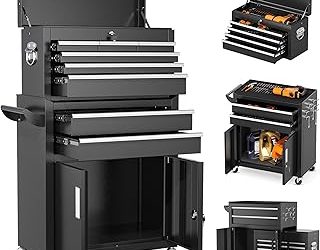
8-Drawer Rolling Tool Chest with Detachable Top
The strongest all-round value here: eight drawers with liners, hooks, and a tray divider mean you can organize by task on day one instead of buying accessories later. The detachable top box is the standout feature — pull it off for detail work at the bench, then reseat it for storage.
CRAFTSMAN VERSASTACK 30-Gallon Rolling Chest
A different philosophy: one large 30-gallon bin with quick-access lid storage, built to integrate with the VERSASTACK ecosystem. Best for the owner who works in bulk — cordless tools, extension cords, larger hand tools — and wants to roll the whole kit out to a driveway or job site.
DEWALT TSTAK Rolling Tool Box (DWST17820)
The most genuinely portable option, with a telescopic handle and a deep base that carries stacked TSTAK modules without wobbling. Choose this if your work moves between locations; it isn’t a substitute for a fixed cabinet, but it’s the best mobile carrier at this price.
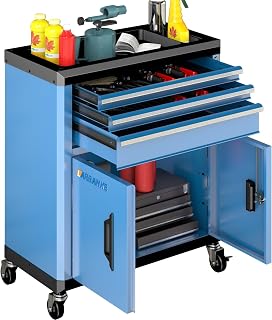
LARBANKE 3-Drawer, 2-Door Rolling Cabinet
The 2-door design is underrated — it swallows awkward items like breaker bars, air hoses, and grinders that no drawer accommodates gracefully. Lockable, on 360° casters, and designed with connecting rods so you can stack matching 5- or 7-drawer chests as your collection grows.
TUFFIOM 5-Drawer Rolling Tool Chest
A tidy middle path: five lined drawers, a keyed lock, lockable wheels, and a cushioned top that doubles as a quiet staging pad for parts. Ideal for a one-bay garage where floor space is the real constraint.
Frequently Asked Questions
How many drawers do I actually need?
Count your tool categories, not your tools. Most home mechanics are well served by five to eight drawers; beyond that, drawers tend to become junk collection points rather than organization.
Will a rolling chest damage my garage floor?
Loaded chests concentrate significant weight on four small contact patches, which can mark sealed or epoxy floors. Larger-diameter casters spread the load, and moving the cabinet only when partially unloaded reduces scuffing.
Are locking drawers worth paying extra for?
Yes, and not only for theft. A central lock keeps drawers from rolling open in transit — the single most common cause of tipped chests and dented tools.
Can I use the top as a workbench?
For light assembly, sorting, and parts staging, absolutely. Avoid hammering or clamping directly on it; the top isn’t structurally braced for impact and the cabinet can shift on its casters.
Final Thoughts
For most buyers, the 8-Drawer Rolling Tool Chest with its detachable top box offers the best organization per dollar in 2026. If your tools travel, the DEWALT TSTAK DWST17820 is the smarter buy, while the LARBANKE 3-drawer, 2-door cabinet is the one to choose when you own more awkwardly shaped equipment than sockets — and plan to expand later.