Key takeaways
- Sliding vs. fixed: A fixed compound saw crosscuts roughly 6 inches of width — fine for bed rails and legs. Choose a slider if you plan to cut wide headboard panels, shelf boards, or 1×12 case sides in a single pass.
- Single vs. dual bevel: Single bevel tilts one direction and asks you to flip your workpiece; dual bevel tilts both ways. For crown molding and mitered furniture corners where flipping introduces error, dual bevel pays for itself in reduced scrap.
- Detent quality over detent count: Nine positive stops that lock crisply beat a dozen that feel vague. Test the miter lock: if the table creeps under lateral pressure, your 45s will never close cleanly.
- Cut-line visibility: Shadow-line systems cast the blade’s actual silhouette on your mark, while lasers project a fixed beam that requires calibration. Shadow lines tend to stay honest longer; lasers work well in dim garages.
- Noise and dust in shared spaces: If your shop is a spare bedroom, garage bay, or anywhere near where people sleep, prioritize a saw with a genuinely functional dust port over a bigger blade. Sawdust and 100-plus decibels both migrate further than you expect.
What's inside
Anyone who has built their own bed frame knows the moment of truth: you set the headboard against the wall, step back, and see a hairline gap that widens toward one corner. Bedroom furniture is unusually unforgiving that way. A nightstand that rocks, a platform slat that sits a millimeter proud, a canopy post that leans — these are the details that turn a restful room into a low-grade irritation, and they almost always trace back to an angle that was close but not correct. From a sleep-wellness standpoint, the bedroom should be the one space in the house where nothing squeaks, shifts, or demands attention at 2 a.m. That standard starts at the cut line.
A 10-inch miter saw is the sweet spot for this kind of work. It handles the 2x lumber in bed rails and platform frames, the 1x poplar in drawer boxes, and the crown or baseboard trim that finishes a room, all without the bulk, weight, or shop-vacuum appetite of a 12-inch machine. This guide covers what actually matters when you are cutting furniture-grade joints rather than framing a deck: bevel range, blade deflection, dust behavior in a lived-in space, and how much noise you are willing to make. Below are the models worth your attention in 2026, along with a short buying framework and answers to the questions we hear most often.
As an Amazon Associate we earn from qualifying purchases.




How to Choose a/an 10 In Miter Saw (2026)
- Sliding vs. fixed: A fixed compound saw crosscuts roughly 6 inches of width — fine for bed rails and legs. Choose a slider if you plan to cut wide headboard panels, shelf boards, or 1×12 case sides in a single pass.
- Single vs. dual bevel: Single bevel tilts one direction and asks you to flip your workpiece; dual bevel tilts both ways. For crown molding and mitered furniture corners where flipping introduces error, dual bevel pays for itself in reduced scrap.
- Detent quality over detent count: Nine positive stops that lock crisply beat a dozen that feel vague. Test the miter lock: if the table creeps under lateral pressure, your 45s will never close cleanly.
- Cut-line visibility: Shadow-line systems cast the blade’s actual silhouette on your mark, while lasers project a fixed beam that requires calibration. Shadow lines tend to stay honest longer; lasers work well in dim garages.
- Noise and dust in shared spaces: If your shop is a spare bedroom, garage bay, or anywhere near where people sleep, prioritize a saw with a genuinely functional dust port over a bigger blade. Sawdust and 100-plus decibels both migrate further than you expect.
The Best 10 In Miter Saw (2026)s Reviewed
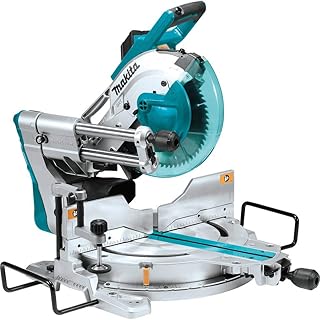
Makita LS1019L Dual-Bevel Slider
The compact rail system lets this saw sit close to a wall while still delivering full crosscut capacity, which is a real advantage in a converted-room workspace. Cut quality is the benchmark here: minimal blade wobble, an accurate laser once dialed in, and the best dust collection in this group when paired with a vacuum.
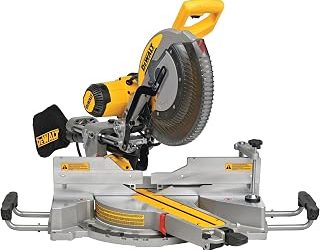
DEWALT DWS713 Single Bevel Compound
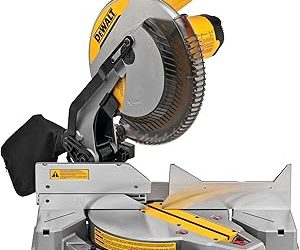
A straightforward 15-amp workhorse with a stout fence and detents that lock with authority, making it a dependable choice for bed rails, table aprons, and repetitive leg cuts. You give up the slide and the second bevel direction, but for straight furniture joinery it rarely matters.
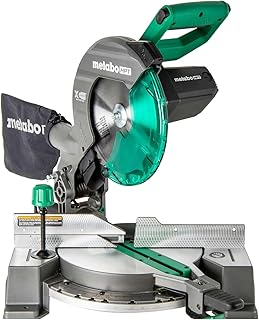
Metabo HPT C10FCG2
The Xact Cut shadow line is the standout feature at this price, showing your blade’s true position without calibration drift. At roughly 24 pounds it is genuinely portable, which suits anyone hauling a saw between a garage and a driveway.
SKIL MS6305-00 Dual Bevel Slider
Dual bevel and sliding capability at an entry-level price point, with a bevel scale that is easy to read from a standing position. Expect to spend twenty minutes squaring the fence and setting stops out of the box; do that once and it holds well.
DOVAMAN Updated 10-Inch Slider
The dual-speed motor and three included blades make this a reasonable pick if you cut aluminum bed hardware or plastic edging alongside hardwood. Ambidextrous controls and nine positive stops are welcome, though the fence benefits from an auxiliary sacrificial face for fine work.
Frequently Asked Questions
Is a 10-inch saw big enough for bedroom furniture?
For nearly all of it, yes. Bed rails, headboard frames, nightstand carcases, and standard trim all fall within a 10-inch slider’s capacity. A 12-inch saw earns its keep mainly on thick timber posts and tall baseboard.
Do I need a sliding saw for a platform bed?
Not strictly. Slats and rails are narrow enough for a fixed compound saw. A slider becomes valuable when you start cutting wide panels for headboards or storage bases.
How do I keep sawdust out of a sleeping area?
Cut outdoors or in a separate room when possible, connect a shop vacuum to the dust port rather than relying on the bag, and let airborne dust settle before re-entering. Fine particulate lingers for hours and is a genuine irritant to airways at night.
Why are my mitered corners still gapping?
Almost always a fence that is not square to the blade, or a workpiece lifting off the table. Verify 90 degrees with a machinist square, check for deflection at full depth, and clamp long stock rather than holding it by hand.
Final Thoughts
If you want the most accurate joints with the least fuss, the Makita LS1019L is the saw to buy and keep. The Metabo HPT C10FCG2 offers the best value for anyone who wants a clear cut line without a premium price, and the DEWALT DWS713 remains the sensible, no-drama choice for straightforward furniture work. Any of the three will let you build a bedroom that stays quiet — which, in the end, is the point.