Key takeaways
- 1–2 people, or a dorm, office, or secondary space: 7–10 cu. ft. The Upstreman 7.1 Cu.Ft with Bottom Freezer covers this well, though note it relies on trays rather than an automatic maker.
- 2–3 people: 14–18 cu. ft., which is where the 16 Cu. Ft. French Door and Antarctic Star live.
- 4–5 people: 20–24 cu. ft. — see the KoolMore Counter Depth 4-Door, 22.5 Cu.Ft.
- Large households or heavy hosts: 25 cu. ft. and up.
What's inside
Most refrigerator guides talk about capacity, finishes, and energy ratings. Almost none mention the thing that quietly matters most in an open-plan home: your fridge is the loudest appliance that runs all night, and its ice maker is the only one that periodically drops solid objects into a plastic bin at 3 a.m. As someone who spends my working hours helping people troubleshoot fragmented sleep, I’ve lost count of the households where the culprit wasn’t caffeine or screens — it was a compressor cycling under a bedroom wall, or an auger harvesting a batch of cubes directly beneath a child’s room.
That’s not an argument against ice makers. Cold water is genuinely useful for evening wind-down routines, and a well-chosen machine is functionally silent. It’s an argument for choosing deliberately. In this guide, I’ll walk you through how ice-making hardware actually works, what decibel figures mean in a real kitchen, how to match capacity to your household without overbuying, where plumbed and unplumbed models diverge, and what to check before you commit. Below are the models I’d point a friend toward, followed by the reasoning that should drive your own decision.
As an Amazon Associate we earn from qualifying purchases.


Understand the Two Kinds of Ice Hardware
A refrigerator’s ice maker is either integrated into the freezer compartment or housed in the fresh-food door. Freezer-based systems — like the setup in the Antarctic Star 17.5 Cu Ft French Door or the 16 Cu. Ft. French Door with Ice Maker — are mechanically simpler, cheaper to repair, and keep the noise source behind an insulated door. Door-mounted systems free up freezer real estate and give you dispensing without opening anything, but they sit closer to your ear and add failure points. The Samsung 26 cu. ft. Mega Capacity Counter Depth takes a third path, offering four ice types (including compressed “ice bites” and cubed) across separate modules, which is genuinely useful if you entertain or drink a lot of iced beverages — and a legitimate complication if you want the simplest possible machine.
Treat Noise as a Specification, Not an Afterthought
Look for a rated sound level in decibels. Anything at or below 40 dBA disappears into ambient household noise; 42–45 dBA is audible in a quiet kitchen; above 47 dBA you’ll notice it at night. Inverter or variable-speed compressors — the Antarctic Star uses one — matter here because they modulate rather than slamming on and off, which is the abrupt transition that actually wakes people. Separately, ask where the ice drops. Harvest cycles are brief but percussive. If your kitchen shares a wall or ceiling with a bedroom, that single detail outweighs most feature comparisons.
Size to Your Actual Consumption
Overbuying costs you floor space, energy, and money. A rough guide:
- 1–2 people, or a dorm, office, or secondary space: 7–10 cu. ft. The Upstreman 7.1 Cu.Ft with Bottom Freezer covers this well, though note it relies on trays rather than an automatic maker.
- 2–3 people: 14–18 cu. ft., which is where the 16 Cu. Ft. French Door and Antarctic Star live.
- 4–5 people: 20–24 cu. ft. — see the KoolMore Counter Depth 4-Door, 22.5 Cu.Ft.
- Large households or heavy hosts: 25 cu. ft. and up.
Decide Whether You’ll Plumb It
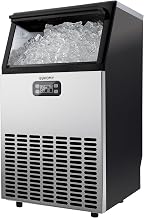
Automatic ice makers need a water line. If you don’t have one near the fridge, you’re looking at a plumber, a saddle valve, or a workaround. That workaround is often a standalone unit: the Commercial Ice Maker Machine 100 Lbs/24H offers dual water inlet options, meaning it can run from a plumbed connection or a manually filled reservoir, and produces 36 cubes in 9–15 minutes. Pairing a simple, reliable fridge with a separate ice machine also lets you park the noisy component away from sleeping areas — a trick I recommend often to shift workers and light sleepers.
Check Depth, Clearance, and Door Swing First
Counter-depth models like the KoolMore and Samsung sit flush with standard 24-inch cabinetry, trading some interior volume for a kitchen that doesn’t feel obstructed. Measure your doorway, hallway turns, and the space needed for doors and freezer drawers to open fully. Leave at least an inch of rear and side clearance for airflow; a cramped fridge runs hotter, longer, and louder.
Tips
- Discard the first two or three batches of ice after installation or after any long idle period — early cubes pick up plastic and stale-water flavors.
- Set the fridge to 37°F and the freezer to 0°F. Colder settings don’t preserve food better; they just increase compressor runtime and noise.
- Replace the water filter on schedule (typically every six months). A clogged filter is the most common cause of slow or hollow ice production.
- If cubes fuse into a block, your maker is likely cycling too slowly for your usage — empty the bin fully once a week rather than topping it off.
Frequently Asked Questions
How much ice should a refrigerator produce per day?
Most built-in makers deliver 2–4 lbs in 24 hours, which suits everyday drinking. Entertaining regularly pushes you toward multi-mode systems like the Samsung or a dedicated machine rated near 100 lbs per day.
Will an ice maker meaningfully raise my energy bill?
Marginally. The maker itself draws little power, but each dispense or door opening admits warm air. Expect a small single-digit percentage increase over the same model without one.
Is a counter-depth fridge worth the lost capacity?
In galley or narrow kitchens, yes — the walkway gain is immediate. In a large kitchen, standard depth gives you more usable volume for the same money.
Can I run an ice maker without a water line?
Not a built-in one. Standalone units with fillable reservoirs, such as the dual-inlet commercial model above, are the practical alternative.
Conclusion
The best refrigerator with an ice maker is the one sized to your household, quiet enough for your floor plan, and configured for the plumbing you actually have. Weigh decibel ratings and compressor type as seriously as capacity, measure twice before ordering, and remember that separating the ice-making function into a standalone unit is a legitimate, often superior solution — especially if anyone in your home sleeps within earshot of the kitchen.