Key takeaways
- Decibel rating, not just “quiet”: Anything at or under 60 dB sits near conversational level and won’t startle a sleeping child through a closed door. Standard compressors run 78–90 dB — a tenfold perceived jump. If you work evenings, treat 60 dB as your ceiling.
- Tank size versus cycle count: A 1-gallon tank refills constantly; a 6-gallon tank stores enough air to sink a run of nails in silence, then recovers once. Fewer startup transients means fewer sleep disruptions, even at identical decibel ratings.
- CFM headroom for your nailer: Framing nailers demand real volume. Match at least 2.0 CFM at 90 PSI per gun, and add margin if a second person is trimming alongside you.
- Collation and nail range: Plastic-collated 21° magazines feed reliably and handle 2″ to 3-1/2″ fasteners for bed rails and platform framing; 15° coil magazines hold far more nails for sheathing and decking marathons.
- Weight you can hold overhead: Around 7.5 lbs is the practical threshold for sustained roof decking or ceiling work. Heavier tools force compensatory posture that reliably shows up as next-morning neck and shoulder pain.
What's inside
Anyone who has framed a wall on a Saturday morning knows the real constraint isn’t horsepower — it’s the household. A pancake compressor cycling at 90 decibels three feet from a nursery door ends a project faster than any warped stud. As someone who spends most days advising people on protecting their sleep architecture, I’ve come to see jobsite noise as a genuine design variable: a single compressor kick-on can pull a light sleeper out of slow-wave sleep and cost them forty minutes of recovery they never get back. If you’re building a bed frame, a bunk loft, or a headboard wall in the same house where people sleep, acoustics belong on your spec sheet next to nail length.
This guide looks at air compressor framing nailer setups through that lens — sound pressure, cycle frequency, tank capacity (bigger tanks kick on less often, which matters more than peak volume), and whether a rig belongs indoors at all. Below you’ll find the pairings I’d recommend for furniture builders and light framing, plus a buyer’s checklist and answers to the questions that come up most.
As an Amazon Associate we earn from qualifying purchases.



How to Choose an Air Compressor Framing Nailer (2026)
- Decibel rating, not just “quiet”: Anything at or under 60 dB sits near conversational level and won’t startle a sleeping child through a closed door. Standard compressors run 78–90 dB — a tenfold perceived jump. If you work evenings, treat 60 dB as your ceiling.
- Tank size versus cycle count: A 1-gallon tank refills constantly; a 6-gallon tank stores enough air to sink a run of nails in silence, then recovers once. Fewer startup transients means fewer sleep disruptions, even at identical decibel ratings.
- CFM headroom for your nailer: Framing nailers demand real volume. Match at least 2.0 CFM at 90 PSI per gun, and add margin if a second person is trimming alongside you.
- Collation and nail range: Plastic-collated 21° magazines feed reliably and handle 2″ to 3-1/2″ fasteners for bed rails and platform framing; 15° coil magazines hold far more nails for sheathing and decking marathons.
- Weight you can hold overhead: Around 7.5 lbs is the practical threshold for sustained roof decking or ceiling work. Heavier tools force compensatory posture that reliably shows up as next-morning neck and shoulder pain.
The Best Air Compressor Framing Nailer (2026)s Reviewed
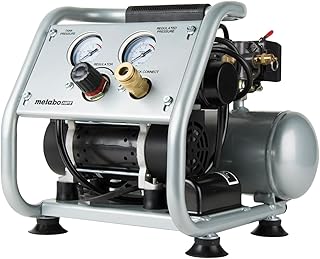
Metabo HPT EC28M Ultra-Quiet 1-Gallon Compressor
At 59 dB this oil-free unit is the only compressor here I’d run inside an occupied home after dinner — it registers closer to a dishwasher than a power tool. The 1-gallon tank means frequent cycling, so pair it with brad and finish work rather than continuous framing.
Metabo HPT EC914S 6-Gallon Pancake Compressor
Six gallons at 200 PSI and 4 CFM will feed a framing nailer without gasping, and the larger reservoir means long quiet stretches between refills. It isn’t a low-noise machine, so plan sessions for waking hours or run the hose from a garage.
Metabo HPT NV83A5 Coil Framing Nailer
The 15° coil magazine swallows enough 2″ to 3-1/4″ nails to finish a subfloor or roof deck without reloading, which is precisely why professionals reach for it. For furniture builders, it’s overkill unless you’re framing platform beds in volume.
Metabo HPT EC2610EA Wheelbarrow Compressor
A Honda GX200 and nine gallons make this the outdoor workhorse — it will drive multiple roofing and framing tools all day. It is emphatically not a residential-hours machine; treat it as exterior-only equipment.
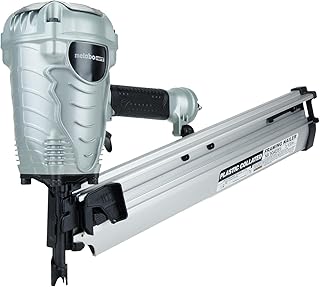
Metabo HPT NR90AES1 Framing Nailer
At 7.5 lbs with a 21° magazine spanning 2″ to 3-1/2″ plastic-collated nails, this is my default recommendation for anyone building beds, benches, or loft structures. The weight savings genuinely matter across a few hundred nails overhead.
Frequently Asked Questions
Can I use a framing nailer at night without waking my family?
The nailer itself is a short impulse — it’s the compressor’s motor and recovery cycles that carry through walls. A 59 dB unit like the EC28M makes evening work plausible; a pancake or gas compressor does not.
Does a quiet compressor sacrifice power?
Not pressure, but usually capacity. Quiet models tend toward smaller tanks and lower CFM, which is fine for finish work and adequate for intermittent framing, less so for continuous production.
Is the Paslode F325R worth considering?
Yes — it’s a well-balanced pneumatic framer with a loyal following, and it runs on any of the compressors above. Choose it if the handle geometry suits your grip better than Metabo’s.
How far should a compressor sit from a bedroom?
Sound pressure drops roughly 6 dB per doubling of distance. Thirty feet plus a closed door will usually keep an 80 dB compressor below the threshold that triggers arousal in most sleepers.
Final Thoughts
For most furniture and light-framing builds, pair the Metabo HPT NR90AES1 with the EC914S 6-gallon pancake compressor — real CFM headroom, sensible weight, and fewer cycles overall. If your shop shares a wall with someone’s bedroom, the EC28M’s 59 dB operation is worth the smaller tank, and the EC2610EA remains the pick when the work moves outside for good.