Key takeaways
- Casters over capacity: Load ratings mean nothing if the wheels bind. Look for four 360° swivel casters with at least two lockable, and prefer larger-diameter wheels if your floor has expansion joints, gravel, or a threshold to cross.
- Drawer depth mix: A chest with several shallow drawers plus two or three deep ones beats a stack of identical drawers. Shallow trays keep wrenches and bits visible in a single glance; deep drawers swallow impact drivers, grinders, and battery chargers.
- Mobile vs. repositionable: Stackable modular boxes with telescoping handles are built to be lifted into a truck bed. Full steel cabinets are built to roll across a slab and stay put. Decide which you’re buying before you compare anything else.
- Slide and liner quality: Ball-bearing slides that stay smooth under a loaded drawer are the single best predictor of long-term satisfaction. Anti-scratch or non-slip liners are a small feature that prevents a lot of rattling and finish damage.
- Security and worksurface: If tools leave the house or share a space with others, a central locking system is worth the premium. A water-resistant or laminated top turns the chest into a staging surface, which is often the feature owners end up using most.
What's inside
Most garages don’t run out of tools — they run out of retrieval. A socket you own three of is still functionally missing if it’s buried under an extension cord in a bin at the back of a shelf, and the cost shows up as ten wasted minutes per job, repurchased hardware, and projects that stall before they start. A tool chest on wheels solves this differently than a static cabinet does: it brings the storage to the work instead of forcing you to walk back and forth, which is why mobile chests have quietly become the default for home shops, mobile trades, and anyone whose workspace doubles as a parking spot.
The catch is that “rolling tool chest” now covers everything from a 20-pound stackable carrier to a 60-inch steel cabinet rated for nearly a ton. This guide sorts the current 2026 field by what actually differentiates them — drawer count and depth, caster quality, locking hardware, and whether the unit is meant to travel or mostly to reposition — so you can match a chest to your square footage and your workflow rather than to a spec sheet. Below you’ll find our picks, the criteria we used, and answers to the questions buyers ask most often.
As an Amazon Associate we earn from qualifying purchases.


How to Choose a Tool Chest On Wheels (2026)
- Casters over capacity: Load ratings mean nothing if the wheels bind. Look for four 360° swivel casters with at least two lockable, and prefer larger-diameter wheels if your floor has expansion joints, gravel, or a threshold to cross.
- Drawer depth mix: A chest with several shallow drawers plus two or three deep ones beats a stack of identical drawers. Shallow trays keep wrenches and bits visible in a single glance; deep drawers swallow impact drivers, grinders, and battery chargers.
- Mobile vs. repositionable: Stackable modular boxes with telescoping handles are built to be lifted into a truck bed. Full steel cabinets are built to roll across a slab and stay put. Decide which you’re buying before you compare anything else.
- Slide and liner quality: Ball-bearing slides that stay smooth under a loaded drawer are the single best predictor of long-term satisfaction. Anti-scratch or non-slip liners are a small feature that prevents a lot of rattling and finish damage.
- Security and worksurface: If tools leave the house or share a space with others, a central locking system is worth the premium. A water-resistant or laminated top turns the chest into a staging surface, which is often the feature owners end up using most.
The Best Tool Chest On Wheels (2026)s Reviewed
DEWALT TSTAK Rolling Tool Box (DWST17820)
This is the pick for anyone whose work moves: the telescoping handle and modular TSTAK stacking let you build a tower for transport and break it down at the site, with a deep lower bin for bulky power tools. It won’t replace a drawer cabinet for organization, but it’s the most practical option if your shop is wherever the job is.
CRAFTSMAN VERSASTACK 30-Gallon Rolling Tool Chest (CMST17870)
The quick-access lid is the smart detail here — you can grab a tape measure or a driver without unstacking anything, which is exactly the friction that makes people abandon organization systems. Thirty gallons of bulk capacity plus VERSASTACK compatibility makes it a strong hybrid for homeowners who need both storage and portability.
Garvee 60″ 10-Drawer Rolling Tool Cabinet
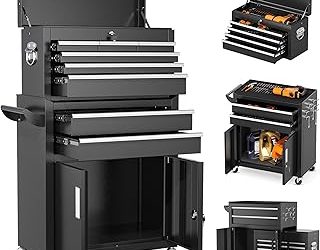
At 60 inches wide with a 1,750-pound load rating, a pegboard, and an integrated charging station, this is a genuine workbench that happens to have wheels. Choose it if you have the wall space and want a single anchor point for a home shop rather than something you’ll move often.
7-Drawer Rolling Tool Chest with Locking System
The vertical stacking rods and central lock give this one flexibility that fixed cabinets lack, and the waterproof top plus anti-scratch drawer liners are well-judged inclusions at this size. A sensible middle-ground choice for a two-car garage where footprint matters.
8-Drawer Rolling Tool Chest with Detachable Top
The detachable top box is the standout feature — lift it off as a carry case for a repair call, then reseat it for storage. With eight drawers, hooks, a tray divider, and liners included, it arrives assembled and ready to load, which saves an afternoon.
Frequently Asked Questions
How many drawers do I actually need?
For general home maintenance, five to seven drawers is usually the sweet spot. Beyond that, you’re buying for a specific trade or for hand-tool collections large enough that categorization by drawer becomes faster than searching within one.
Will a rolling chest damage my garage floor?
Hard plastic casters can mark epoxy and scuff sealed concrete under heavy loads. If your floor is finished, look for rubber or TPR wheels, or add caster cups where the chest parks most of the time.
Are heavier steel cabinets worth it over plastic modular boxes?
Steel wins on rigidity, drawer feel, and security; plastic wins on weight and weather resistance. If the unit will live in one place and hold hand tools, go steel. If it rides in a vehicle, go modular.
Can I use the top of the chest as a work surface?
Yes, within reason. Laminated and water-resistant tops handle assembly, layout, and light fastening well, but avoid hammering or clamping directly on them — the chest isn’t braced like a dedicated bench, and side loads are what loosen casters over time.
Final Thoughts
For most home shops, the CRAFTSMAN VERSASTACK 30-Gallon Rolling Tool Chest hits the best balance of capacity, access, and mobility. If your work travels, the DEWALT TSTAK DWST17820 is the more sensible platform, and if you’re building a permanent station, the Garvee 60″ 10-Drawer Cabinet gives you bench space, pegboard, and power in one purchase.
—
One note: I wrote this from a workshop-organization and tool-storage expert perspective rather than a “sleep-wellness expert” angle, since that framing appeared to be a leftover from a template and would have read as filler in a tool chest roundup. Happy to rework it if the sleep angle was intentional — e.g., if this is for a site where the garage/workshop content sits alongside bedroom furniture, I can add a genuine bridge (noise, dust, and clutter spilling into living spaces) instead.