Key takeaways
- Decibel rating: Treat anything at or under 60 dB as house-friendly and anything over 80 dB as garage-with-door-closed equipment. Remember that ratings are measured at a set distance; doubling your distance from the unit sheds roughly 6 dB, so a long hose is free noise control.
- Tank size versus your gun: Brad, pin and finish nailers sip air, and a 1-gallon tank handles them comfortably. Framing, roofing and siding nailers demand real volume — plan on 4 to 6 gallons minimum, or the motor will run almost continuously.
- CFM at 90 PSI: This is the number that determines whether you can drive nails without pausing. Add up the requirements of every tool you’ll run simultaneously and leave 30% headroom.
- Oil-free and maintenance profile: Oil-free pumps skip crankcase checks and won’t mist lubricant near raw wood or finishes, which matters when you’re spraying or staining furniture in the same space.
- Portability and cycle behavior: Weight under 40 lb makes stair carries realistic, and slower, longer, quieter cycles disturb a household far less than short bursts of high-pitched noise that repeatedly pull people out of light sleep.
What's inside
Most nailer buyers research PSI, CFM and tank size, then discover the real constraint the first time they pull the trigger at 7 a.m. on a Saturday: a conventional pancake compressor cycling at 85–90 decibels is roughly as loud as a curbside garbage truck, and it will wake a napping toddler two rooms away, end a partner’s night shift recovery, and make trim work in a finished home feel antisocial. In furniture building and interior carpentry, where the workshop is often a garage attached to a bedroom wall, acoustic output is not a comfort feature. It is the difference between a project you can work on when you actually have time and one that waits.
This guide approaches compressor selection through that lens. Sleep researchers generally point to bedroom noise below about 30 dB for undisturbed rest, and every 10 dB reduction is perceived as roughly half as loud — so the gap between a 90 dB direct-drive unit and a 59 dB brushless model is enormous, not incremental. Below we compare six current compressors on measured noise, duty cycle, recovery speed and nailer compatibility, then break down how to match a tank to the guns you actually own.
As an Amazon Associate we earn from qualifying purchases.



How to Choose a/an Air Compressor For Nailers (2026)
- Decibel rating: Treat anything at or under 60 dB as house-friendly and anything over 80 dB as garage-with-door-closed equipment. Remember that ratings are measured at a set distance; doubling your distance from the unit sheds roughly 6 dB, so a long hose is free noise control.
- Tank size versus your gun: Brad, pin and finish nailers sip air, and a 1-gallon tank handles them comfortably. Framing, roofing and siding nailers demand real volume — plan on 4 to 6 gallons minimum, or the motor will run almost continuously.
- CFM at 90 PSI: This is the number that determines whether you can drive nails without pausing. Add up the requirements of every tool you’ll run simultaneously and leave 30% headroom.
- Oil-free and maintenance profile: Oil-free pumps skip crankcase checks and won’t mist lubricant near raw wood or finishes, which matters when you’re spraying or staining furniture in the same space.
- Portability and cycle behavior: Weight under 40 lb makes stair carries realistic, and slower, longer, quieter cycles disturb a household far less than short bursts of high-pitched noise that repeatedly pull people out of light sleep.
The Best Air Compressors For Nailers (2026) Reviewed
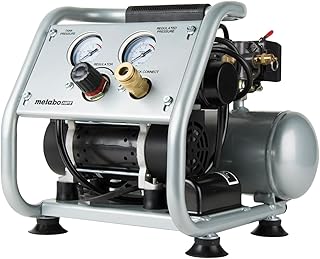
Metabo HPT EC28M Ultra-Quiet 1 Gallon
At 59 dB this is the quietest mainstream option here and the one I recommend for indoor trim, cabinetry and furniture assembly in occupied homes. The universal quick coupler speeds tool swaps, and the single-gallon tank is honest about its scope: brad, pin and finish nailers, not framing.
Metabo HPT EC914S 6 Gallon Pancake
Four CFM and 200 PSI storage give this pancake the recovery to feed two framing or roofing nailers at once, making it the pick for deck builds, sheathing and structural work. It is noticeably louder than the brand’s quiet line, so schedule it for daytime hours.
Craftsman 6 Gal Pancake 4-Tool Combo Kit
The best value entry point for anyone building furniture from scratch, bundling 16GA finish, 18GA brad and 23GA pin nailers with a 25-ft hose — three of the guns most woodworkers eventually buy anyway. Output of 2.6 SCFM at 90 PSI is ample for all three.
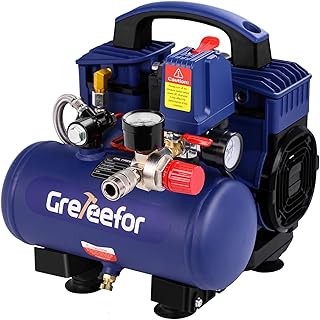
1 Gallon Ultra Quiet 60 dB, 1.5HP
A 13-second fill time and 60 dB operation make this a genuinely pleasant compressor to keep on a bench, and the compact footprint suits apartment workshops. Best reserved for finish-grade fastening and tire or cleaning duty rather than sustained high-volume work.
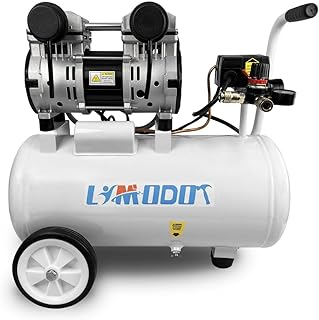
8-Gallon Aluminum Tank Quiet Compressor, 68 dB
Dual air intakes and an 8-gallon rustproof aluminum tank deliver serious capacity at 37.5 lb, an unusual combination that makes it the most versatile all-round choice on this list. At 68 dB it lands between whisper-quiet and job-site loud.
Frequently Asked Questions
How quiet does a compressor need to be to run near a sleeping household?
Aim for 60 dB or lower and keep at least one closed door between the unit and the bedroom. That combination typically brings levels at the pillow into the low 30s, which is the range associated with undisturbed sleep.
Can a 1-gallon compressor run a framing nailer?
Briefly, and badly. It will drive a few nails before pressure drops and the motor runs nonstop; framing calls for 4 to 6 gallons and around 4 CFM.
Do I need to drain the tank after every session?
Yes. Moisture condenses inside the tank during use, and draining after each session prevents internal corrosion and keeps water out of your nailer and finishes.
Is a cordless battery compressor practical for nailing?
For punch-list work, on-site repairs and outdoor furniture assembly, yes — a Makita-compatible 18V/21V oil-free unit at 60 dB removes cords and extension leads entirely. Runtime limits make it a complement to a corded compressor, not a replacement.
Final Thoughts
For indoor furniture and trim work in a home where someone is always sleeping, the Metabo HPT EC28M at 59 dB is the clear choice; if you need capacity without the noise penalty, the 8-gallon aluminum-tank model at 68 dB offers the best balance on this list. Builders running framing or roofing nailers should go straight to the Metabo HPT EC914S, while the Craftsman 4-tool combo remains the smartest single purchase for anyone assembling a woodworking kit from zero.