Key takeaways
- Match the format to the job: Stackable hard cases suit anyone who carries tools to the work; rolling cabinets suit a fixed garage bay. Buying the wrong format is the most common budget mistake, and no amount of drawer count fixes it.
- Test the runners, not the paint: Ball-bearing slides glide quietly and hold load without sag; cheap friction rails stick, rattle, and eventually drop tools. If the chest sits near a sleeping area, quiet hardware is a wellness feature, not a luxury.
- Check the real load rating per drawer: Total capacity figures flatter thin steel. Look for stated per-drawer limits and heavier gauge on the bottom drawers, where wrenches and power tools naturally accumulate.
- Insist on a lock and liners: A lock bar keeps sharp, heavy items away from curious hands and stops drawers from rolling open in transit. Anti-scratch liners cut the metallic clatter that carries through walls at night.
- Look at wheels and handles honestly: Four locking casters beat two fixed wheels on a sloped driveway; all-terrain wheels beat casters on gravel. A telescoping handle only helps if the chest is light enough to steer one-handed.
What's inside
Most buyers don’t go looking for a tool chest because they love storage furniture. They go looking because something has quietly gotten out of hand: a drill on the stairs, sockets rolling loose in a kitchen drawer, a bench so buried that a ten-minute repair turns into a forty-minute search. As someone who spends most of my working life on sleep and recovery, I’d add one more cost that rarely makes it onto the spec sheet — unfinished, visible clutter keeps the mind mildly activated. It’s the same mechanism behind lying awake mentally rehearsing tomorrow’s to-do list. A home where tools have a fixed address is a home that lets you clock off.
The good news is that you don’t need a professional-grade cabinet to get there. Below I’ve pulled together the inexpensive tool chests worth considering in 2026, spanning grab-and-go cases, weatherproof rolling boxes, and multi-drawer cabinets that live permanently in the garage. I’ll cover how to judge build quality on a budget, what each option genuinely does best, and which details — drawer runners, locks, wheel type — matter most if your workspace shares a wall with a bedroom.
As an Amazon Associate we earn from qualifying purchases.


How to Choose a/an Inexpensive Tool Chest (2026)
- Match the format to the job: Stackable hard cases suit anyone who carries tools to the work; rolling cabinets suit a fixed garage bay. Buying the wrong format is the most common budget mistake, and no amount of drawer count fixes it.
- Test the runners, not the paint: Ball-bearing slides glide quietly and hold load without sag; cheap friction rails stick, rattle, and eventually drop tools. If the chest sits near a sleeping area, quiet hardware is a wellness feature, not a luxury.
- Check the real load rating per drawer: Total capacity figures flatter thin steel. Look for stated per-drawer limits and heavier gauge on the bottom drawers, where wrenches and power tools naturally accumulate.
- Insist on a lock and liners: A lock bar keeps sharp, heavy items away from curious hands and stops drawers from rolling open in transit. Anti-scratch liners cut the metallic clatter that carries through walls at night.
- Look at wheels and handles honestly: Four locking casters beat two fixed wheels on a sloped driveway; all-terrain wheels beat casters on gravel. A telescoping handle only helps if the chest is light enough to steer one-handed.
The Best Inexpensive Tool Chest (2026)s Reviewed
Keter Masterloader Rolling Tool Box
The Masterloader is the pick for anyone storing tools in a shed, carport, or damp corner of the garage — the resin body shrugs off moisture that would blister painted steel within a season. Removable bins and all-terrain wheels make it unusually practical for outdoor and yard work, though deep drawers it is not.
Goplus 5-Drawer Rolling Tool Cabinet
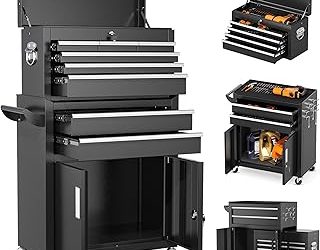
This is the best-balanced budget cabinet here: five lined drawers, a detachable top box for portable jobs, a lock bar, and universal locking wheels that let you park it and forget it. The detachable top is what earns its place, giving you a mobile kit without buying a second case.
7-Drawer Rolling Tool Chest, 40″
If your tool collection has outgrown one cabinet, the 40-inch seven-drawer model offers the most storage per dollar on this list, with side hooks and a tray divider that keep small parts from migrating. At this height it functions as a genuine work surface, so plan for a permanent spot rather than frequent repositioning.
DEWALT TSTAK II Flat Top Case
The TSTAK II is the least chest-like and the most disciplined option: a stackable, latching hard case rated to 66 lbs that clicks together into a tidy tower. Ideal for apartments, closets, and anyone who wants tools genuinely out of sight by the end of the day.
24″ Portable 5-Drawer Metal Tool Box
A compact steel chest with a lockable front, ball-bearing runners, and a top tray, this one sits neatly on a bench or shelf and travels when needed. It’s the sensible entry point for a growing home toolkit that hasn’t earned a full cabinet yet.
Frequently Asked Questions
How many drawers do I actually need?
For general home maintenance, four to five drawers is ample; more than that tends to fill with things you never sort. Buy for the tools you own now plus one spare drawer, not for an imagined future workshop.
Is steel or resin better on a budget?
Steel gives you rigidity and a usable worktop; resin gives you weather resistance and lighter weight. Choose by environment — humid, unheated, or outdoor storage strongly favours resin.
Will a tool chest in the garage disturb sleep?
Only if the hardware is loud or the chest is used late. Lined drawers, ball-bearing slides, and locking casters cut most of the noise, and having a fixed home for tools tends to shorten evening tasks rather than extend them.
Do I need to anchor a rolling chest?
Not usually, but lock the casters and load the heaviest tools in the bottom drawers. Tall seven-drawer models can become top-heavy if you reverse that order.
Final Thoughts
For most households the Goplus 5-Drawer rolling cabinet hits the ideal balance of drawer space, security, and mobility for the money, while the 40-inch 7-Drawer chest is the better buy if you’re consolidating a larger collection into one place. If your tools travel or your storage space is shared with living areas, the DEWALT TSTAK II remains the cleanest, quietest way to put everything away — and getting everything away is, ultimately, what lets the rest of the house rest.