Key takeaways
- Match reach height to your actual ceilings: Standard bedrooms need far less than people buy. A two- to four-step stool handles curtain rods, closet shelves, and most fixtures; save telescoping models for stairwells, exteriors, and vaulted rooms.
- Prioritize tread width over step count: Deep, flat pedals let you stand with your whole foot planted and your weight centered — the single biggest factor in feeling steady. Narrow rungs force you onto the arches of your feet and encourage leaning.
- Insist on a positive locking mechanism: Look for an audible click, a spring latch, or a hinge lock rather than friction alone. A ladder that can partially collapse under shifting weight is not a bargain at any price.
- Check the handrail geometry, not just its presence: A rail should give you something to hold at chest height while your hands are busy, and ideally fold or rotate out of the way for storage. Low, decorative rails do very little.
- Think about where it lives: Measure your storage gap first — the back of a closet, a pantry wall, the side of a dresser. A ladder stored in the garage is a ladder you won’t use for the ten-minute tasks that keep a bedroom in good shape.
What's inside
Most people never connect a wobbly step stool to a bad night’s sleep, but the link is more direct than you’d think. The bedroom is where blackout curtains get hung, where dusty ceiling fans get wiped down, where seasonal blankets live on the highest closet shelf, and where a burnt-out bulb changes the entire quality of your evening light. When reaching those things feels precarious, the jobs get postponed — and a sleep space slowly drifts out of the condition that actually supports rest. Add the adrenaline spike of a stool sliding out from under you at 10 p.m., and you have a nervous system that will not settle for another hour.
This guide looks at folding ladders through that lens: stability you can trust in socks, a footprint that tucks behind a door or under a bed frame, and a weight you can carry one-handed without waking the household. Below are the models worth considering in 2026, followed by the specifications that genuinely matter and the ones that are mostly marketing.
As an Amazon Associate we earn from qualifying purchases.




How to Choose a Folding Ladder (2026)
- Match reach height to your actual ceilings: Standard bedrooms need far less than people buy. A two- to four-step stool handles curtain rods, closet shelves, and most fixtures; save telescoping models for stairwells, exteriors, and vaulted rooms.
- Prioritize tread width over step count: Deep, flat pedals let you stand with your whole foot planted and your weight centered — the single biggest factor in feeling steady. Narrow rungs force you onto the arches of your feet and encourage leaning.
- Insist on a positive locking mechanism: Look for an audible click, a spring latch, or a hinge lock rather than friction alone. A ladder that can partially collapse under shifting weight is not a bargain at any price.
- Check the handrail geometry, not just its presence: A rail should give you something to hold at chest height while your hands are busy, and ideally fold or rotate out of the way for storage. Low, decorative rails do very little.
- Think about where it lives: Measure your storage gap first — the back of a closet, a pantry wall, the side of a dresser. A ladder stored in the garage is a ladder you won’t use for the ten-minute tasks that keep a bedroom in good shape.
The Best Folding Ladders of 2026, Reviewed
LANBITOU 4-Step A-Frame Extension Ladder
This is the multi-position choice for homes with stairwells, tall windows, or a bedroom that opens onto a double-height landing — it converts from an A-frame to a straight 14-foot extension and handles uneven stair treads better than a fixed ladder. At 330 pounds capacity and anti-slip aluminum construction, it’s the one ladder in this group that genuinely replaces two.
KINGRACK 4-Step Folding Ladder with Handrail
An 800-pound rated frame with wide non-skid pedals and a safety lock makes this the most reassuring pick for anyone who dislikes heights, and the white finish disappears against a closet wall instead of looking like garage equipment. It’s our overall recommendation for indoor household use.
Little Giant Jumbo Step 3-Step Aluminum Stool
The build quality here is a clear step above the category: extra-wide stair-like treads, a rotating handrail, and a tool tray that will hold curtain hardware or bulbs while both hands work. At 2.2 feet and 375 pounds capacity, it’s the stool to buy once and keep for twenty years.
8.5 ft EN131 Telescoping Aluminum Ladder
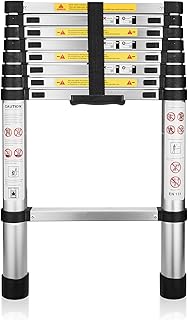
Collapsing to roughly the length of a carry-on, this EN131-certified telescoping model is the right answer for apartments, RVs, and anyone with no real storage to spare. Extend it deliberately and confirm each section has locked before loading it.
5-Step Heavy-Duty Folding Ladder
The extra step buys useful height for taller ceilings, ceiling fans, and upper cabinetry while keeping a stable 330-pound rated frame and wide anti-slip steps. A sensible middle ground if a stool feels too short and an extension ladder feels like overkill.
Frequently Asked Questions
How tall a ladder do I need for standard bedroom ceilings?
With eight-foot ceilings, a two- or three-step stool puts most adults within comfortable arm’s reach of the ceiling plane. Nine- and ten-foot ceilings justify a four- or five-step model.
Is aluminum or steel better?
Aluminum is lighter and won’t rust, which matters if you’ll carry it between floors. Steel typically costs less and feels more planted underfoot, making it a fine choice for a ladder that stays indoors.
Are folding ladders safe on carpet?
Yes, provided the feet are rubber-capped and the surface is firm. Deep plush carpet or a rug over a hard floor can let one leg sink — reposition onto a solid area rather than compensating with balance.
How do I store one in a small bedroom?
Flat against the inside of a closet door, in the gap beside a dresser, or on two wall hooks in a utility closet. Telescoping models fit in a nightstand cabinet or under most bed frames.
Final Thoughts
For everyday indoor work — curtains, closet shelves, light fixtures — the KINGRACK 4-Step is the most confidence-inspiring pick for the money, while the Little Giant Jumbo Step is the heirloom-grade stool for anyone who values a rotating handrail and genuinely wide treads. If your home has a stairwell or tall windows to service, the LANBITOU multi-position ladder is the one purchase that covers everything.