Key takeaways
- Tooth count: For plywood, more teeth means less tearout. Sixty teeth is the practical minimum on a 10-inch blade; 80 teeth is the sweet spot for veneered panels, melamine, and laminate. Below 40 teeth, expect to score your cut line first.
- Grind geometry: Look for an ATB (alternate top bevel) grind, ideally a high-ATB. The steep bevel angles shear the veneer fibers cleanly instead of chiseling through them. Triple-chip grinds excel in melamine but leave a slightly rougher edge in wood plies.
- Hook angle: A low or slightly negative hook angle pulls the workpiece down into the table rather than lifting it, which dramatically reduces exit-side splintering. Aggressive positive-hook rip blades are the wrong tool here.
- Kerf and plate quality: Thin-kerf blades cut faster on underpowered contractor saws and waste less material, but they need a flat, tensioned plate and anti-vibration slots to stay true. A wobbling thin blade will burnish and burn plywood edges.
- Arbor and diameter match: Confirm the arbor — 5/8 inch (16mm) is standard for most 8-1/4 to 10-inch North American saws — and never run a blade larger than your saw’s rated capacity or faster than its stated max RPM.
What's inside
Plywood punishes sloppy blade choices. The face veneer is thin, brittle, and glued cross-grain to the layer beneath it, so the instant a tooth exits the panel with too much force behind it, fibers lift and tear away in ragged crescents. Anyone who has ripped a sheet of birch ply for a bed frame or a bank of nightstand drawers knows the feeling: the cut looks fine from the top, then you flip the piece over and find the underside chewed to fuzz. No amount of sanding brings that veneer back, and edge banding only hides so much.
The fix is rarely a new saw. It is almost always a blade with the right tooth count, the right grind, and a kerf your motor can actually push through nine plies of hardwood veneer without bogging. This guide covers what separates a genuine plywood blade from a general-purpose one, then walks through five blades that earn their place in a furniture shop — including budget crosscut options, a two-blade set that covers ripping and finishing, and small-diameter blades for track saws and compact table saws.
As an Amazon Associate we earn from qualifying purchases.


How to Choose a Table Saw Blades For Plywood (2026)
- Tooth count: For plywood, more teeth means less tearout. Sixty teeth is the practical minimum on a 10-inch blade; 80 teeth is the sweet spot for veneered panels, melamine, and laminate. Below 40 teeth, expect to score your cut line first.
- Grind geometry: Look for an ATB (alternate top bevel) grind, ideally a high-ATB. The steep bevel angles shear the veneer fibers cleanly instead of chiseling through them. Triple-chip grinds excel in melamine but leave a slightly rougher edge in wood plies.
- Hook angle: A low or slightly negative hook angle pulls the workpiece down into the table rather than lifting it, which dramatically reduces exit-side splintering. Aggressive positive-hook rip blades are the wrong tool here.
- Kerf and plate quality: Thin-kerf blades cut faster on underpowered contractor saws and waste less material, but they need a flat, tensioned plate and anti-vibration slots to stay true. A wobbling thin blade will burnish and burn plywood edges.
- Arbor and diameter match: Confirm the arbor — 5/8 inch (16mm) is standard for most 8-1/4 to 10-inch North American saws — and never run a blade larger than your saw’s rated capacity or faster than its stated max RPM.
The Best Table Saw Blades For Plywood (2026)s Reviewed
KENDO 10-Inch Circular Saw Blade Set, 2-Pack 40T/60T
The most sensible starting point for a small furniture shop: the 40-tooth handles fast ripping of solid stock while the 60-tooth ATB delivers clean finish cuts in plywood, MDF, and laminate. Buying both grinds at once removes the temptation to force one general-purpose blade to do everything, which is where most tearout originates.
FOXBC 10-Inch Table Saw Blade, 80-Tooth
An 80-tooth ultra-finish blade with a properly flat plate, this is the one to reach for when the cut edge will be visible — exposed cabinet sides, drawer fronts, floating shelf returns. Feed it slowly and steadily; crowding an 80-tooth blade in thick ply generates heat and burn marks faster than it generates splinters.
10-Inch 80-Tooth Woodworking Blade, Max 7000 RPM
Carbide-tipped, 5/8-inch arbor, and rated to 7000 RPM, which comfortably clears the 3,000–4,000 RPM range of most table saws. It shines in crosscutting and sheet-goods work, and the clearly stated speed rating makes it easy to verify compatibility before you mount it.
Benchmark Abrasives TCT 8-1/2-Inch, 60 Tooth
A strong pick for compact table saws and smaller circular saws where a 10-inch blade simply will not fit. Sixty tungsten-carbide teeth on an 8-1/2-inch plate gives a high effective tooth density, so it slices plywood and MDF panels cleanly without demanding much motor.
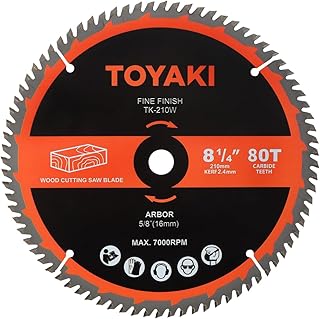
8-1/4-Inch 80-Tooth Ultra-Fine Finish Blade
Purpose-built for the 8-1/4-inch jobsite saws and sliding miters that dominate small shops, this blade brings full 80-tooth finish geometry to a diameter that is usually stuck with 40- and 60-tooth options. Ideal for trim, face frames, and thin veneered panels.
Frequently Asked Questions
How many teeth do I need for plywood?
Sixty teeth is adequate for utility-grade ply; 80 teeth is better for hardwood-veneered panels and laminate. On blades under 10 inches, 60 teeth already delivers high tooth density because of the smaller circumference.
Why is the bottom face still splintering?
Tearout happens where the teeth exit the panel. Add a zero-clearance insert, raise the blade only slightly above the stock, score a shallow first pass, or place a sacrificial backer beneath the cut. Blade height matters more than most people expect.
Thin kerf or full kerf?
Choose thin kerf if your saw is under about 2 HP or you are cutting full sheets alone. Full kerf blades are stiffer and track straighter on cabinet saws with more power behind them.
Can one blade handle plywood and solid hardwood?
A 50-tooth combination blade compromises acceptably, but a dedicated pair — a rip blade and a high-tooth-count finish blade — produces noticeably better results and keeps each blade sharp longer.
Final Thoughts
For most furniture builders, the KENDO 40T/60T set is the best value because it covers both ripping and plywood finishing in one purchase. If your projects live and die by visible edges, step up to the FOXBC 80-tooth for its ultra-clean finish, and choose the Benchmark Abrasives 8-1/2-inch 60T if you are working on a compact saw where diameter, not budget, is the limiting factor.