Key takeaways
- Measure the parking envelope, not the room: Most buyers overbuy. A single mid-size SUV needs roughly 8 to 9 feet of width to allow door clearance and a walking margin; a two-car bay wants 17 to 20 feet of length so the roll runs past the rear bumper where drips collect. Sketch the bay and note where the water heater, shelving, and floor drain interrupt the run.
- Treat thickness as a durability spec, not a comfort spec: At 2.2 mm you get solid stain and moisture protection for a daily driver. At 2.8 to 3 mm you gain meaningful impact resistance for dropped tools, jack stands, and rolling chests — and noticeably better sound dampening if there is living space overhead.
- Match the material to the temperature swing: PVC stays flexible and cleans easily, making it the better pick for attached, semi-conditioned garages. Rubber tolerates hard cold and heavy point loads with less risk of denting, so it earns its place in unheated detached shops and trailers.
- Plan for hot-tire pickup and edge lift: Any roll needs adhesion at the seams and perimeter. Look for kits that include double-sided tape, and let the material relax flat in a warm space for 24 to 48 hours before you commit the adhesive. Rushing this single step causes most of the curling complaints you’ll read online.
- Consider modular tiles if the slab is compromised: Cracked, spalled, or slightly out-of-level concrete telegraphs through thin rolls. Interlocking tiles bridge minor imperfections, allow airflow underneath, and let you replace a single damaged square instead of the whole floor.
What's inside
A garage slab takes more punishment than any other surface in the house. Hot tires soften and pull at coatings, road salt wicks into porous concrete, dropped sockets chip the surface, and every oil weep leaves a shadow that no amount of scrubbing fully lifts. Homeowners who look into epoxy quickly discover the catch: days of grinding, etching, and curing, plus a finish that can peel if the moisture content of the slab was never properly tested. Rolled flooring exists because most people want the protection without surrendering the garage for a week.
There is a second, quieter reason to cover a slab, and it is the one I raise most often with clients whose bedrooms sit directly above an attached garage. Bare concrete reflects sound. A car door closing at 11 p.m., a compressor kicking on, a bike rolling across the floor — all of it travels up through the framing with startling clarity. A thick vinyl or rubber roll won’t turn a garage into a recording booth, but it takes the hard edge off impact noise and makes late arrivals far less likely to wake the house. This guide covers what to look for in 2026, how thickness and material actually behave over a full seasonal cycle, and which specific rolls and tiles are worth your money.
As an Amazon Associate we earn from qualifying purchases.



How to Choose a/an Garage Flooring Rolls (2026)
- Measure the parking envelope, not the room: Most buyers overbuy. A single mid-size SUV needs roughly 8 to 9 feet of width to allow door clearance and a walking margin; a two-car bay wants 17 to 20 feet of length so the roll runs past the rear bumper where drips collect. Sketch the bay and note where the water heater, shelving, and floor drain interrupt the run.
- Treat thickness as a durability spec, not a comfort spec: At 2.2 mm you get solid stain and moisture protection for a daily driver. At 2.8 to 3 mm you gain meaningful impact resistance for dropped tools, jack stands, and rolling chests — and noticeably better sound dampening if there is living space overhead.
- Match the material to the temperature swing: PVC stays flexible and cleans easily, making it the better pick for attached, semi-conditioned garages. Rubber tolerates hard cold and heavy point loads with less risk of denting, so it earns its place in unheated detached shops and trailers.
- Plan for hot-tire pickup and edge lift: Any roll needs adhesion at the seams and perimeter. Look for kits that include double-sided tape, and let the material relax flat in a warm space for 24 to 48 hours before you commit the adhesive. Rushing this single step causes most of the curling complaints you’ll read online.
- Consider modular tiles if the slab is compromised: Cracked, spalled, or slightly out-of-level concrete telegraphs through thin rolls. Interlocking tiles bridge minor imperfections, allow airflow underneath, and let you replace a single damaged square instead of the whole floor.
The Best Garage Flooring Rolls (2026)s Reviewed
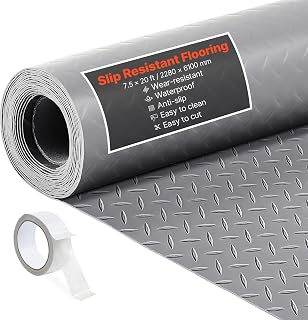
VEVOR 7.5 x 20 ft PVC Diamond Plate Roll
This is the default recommendation for a standard single bay, giving you full front-to-back coverage with room to open a door without stepping onto bare concrete. The 2.2 mm PVC wipes clean with a flat mop, and the included double-sided tape handles seams and threshold edges where curling normally starts.
7.8 x 18 ft Rubber Garage Floor Mat (140.4 sq ft)
At 2.8 mm this is the thicker, heavier option, and the extra mass is what you want under a sports car with low clearance or in a bay you also use as a work area. It absorbs dropped-tool impact convincingly and delivers the best underfloor noise reduction of the group.
VEVOR Interlocking Floor Tiles, 12 in., 50-Pack
Polypropylene tiles are the right answer for imperfect slabs, since they span small cracks and let trapped moisture evaporate rather than pool. Installation is genuinely tool-free, and the double-sided texture means you can flip a scuffed tile before you replace it.
VEVOR 4 x 20 ft Rubber Roll, 3 mm
The narrowest and thickest roll here, purpose-built for runners: a center strip beneath the engine bay, a walkway between vehicles, or a trailer deck. Waterproof rubber at 3 mm shrugs off cold weather and grit better than any PVC in this lineup.
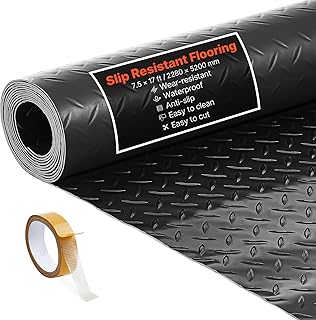
VEVOR 7.5 x 17 ft PVC Roll, Black
Essentially the flagship roll in a shorter length and darker finish, which suits compact garages and hides brake dust far better than silver gray. Choose this over the 20-foot version only after measuring — the three feet you save are not worth an exposed strip behind the tires.
Frequently Asked Questions
Will hot tires damage a vinyl garage roll?
Quality PVC and rubber rolls are formulated to resist hot-tire softening, which is a failure mode specific to thin coatings bonded to concrete. The real risk with rolls is movement, not chemical damage, so secure the perimeter and seams properly.
Does my concrete need preparation first?
No grinding or etching required, but sweep and vacuum thoroughly, then degrease any oil deposits. Grit left underneath will eventually abrade the backing and print through as visible bumps.
How much noise reduction should I realistically expect?
Enough to soften footsteps, dropped items, and rolling equipment — the sharp, high-frequency sounds that carry into rooms above. Structure-borne noise from a garage door opener or compressor mount travels through framing and needs isolation at the source instead.
Can these be used outside the garage?
Rubber rolls handle covered patios, trailers, and gym spaces well. For entry transitions where you want to trap grit before it reaches the floor, a ribbed scraper mat like the Ottomanson Commercial Scrape Rib is the correct tool.
Final Thoughts
For most homeowners covering a single bay, the VEVOR 7.5 x 20 ft PVC roll is the straightforward, well-priced choice. If your garage sits beneath a bedroom or doubles as a workshop, spend up for the 2.8 mm rubber 7.8 x 18 ft mat and enjoy the quieter, tougher floor. And when the slab itself has seen better days, the VEVOR interlocking tiles will give you a level, serviceable surface without any resurfacing work.