Key takeaways
- Match CFM to your gun, not your tank: Check the SCFM rating your spray gun requires at its working PSI, then choose a compressor delivering at least 1.5 times that figure. LVLP guns often run happily on 2–3 CFM; conventional HVLP setups can demand double.
- Treat decibels as a spec, not a footnote: Every 10 dBA roughly doubles perceived loudness. A 60 dBA oil-free unit is conversational; a 90 dBA direct-drive pancake is closer to a garbage disposal and will carry through floor joists into a bedroom above.
- Prioritize duty cycle over peak pressure: Spraying is continuous work, unlike nailing. A pump that can run long stretches without heat-soaking keeps pressure stable, which is what actually prevents orange peel and dry spray.
- Plan for moisture from the start: Tank size buys you recovery time and cooler, drier air. Budget for an inline water separator and a short whip hose regardless — trapped condensation ruins a topcoat faster than any compressor shortcoming.
- Weigh portability honestly: Wheels and a 30-pound frame matter if the machine migrates between garage, patio, and basement. If it lives in one corner permanently, spend that money on quieter operation instead.
What's inside
Anyone who has refinished a dresser in the garage on a Saturday morning knows the tradeoff: you finally have the time and the daylight to lay down a smooth coat of lacquer, and the compressor kicks on like a jackhammer in a tin shed. In a detached shop, that’s an annoyance. In a townhouse garage that shares a wall with a nursery, or a basement bench beneath someone’s bedroom, it’s the difference between a productive afternoon and a household in revolt. I spend most of my working life studying how ambient noise fragments sleep, and the numbers are unforgiving: intrusive sound above roughly 45 dBA at the sleeper’s ear is enough to trigger measurable arousals, even when the person never fully wakes and remembers nothing in the morning.
That’s why this guide weighs acoustics as heavily as airflow. A spray gun needs steady, dry, sufficient CFM — no argument there — but for home furniture work the machine also has to coexist with nap schedules, night-shift partners, and thin drywall. Below you’ll find the compressors I recommend for HVLP and LVLP guns in a residential setting, ranked with an ear toward both finish quality and the sound floor of the rest of the house. I’ve noted where a louder unit still earns its place, and where “ultra quiet” marketing actually holds up under a sound meter.
As an Amazon Associate we earn from qualifying purchases.



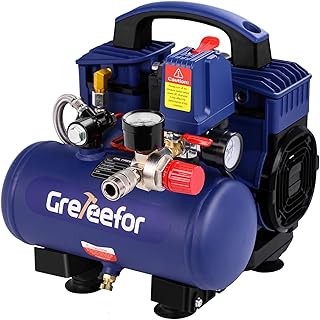
How to Choose a/an Air Compressor For Spray Gun (2026)
- Match CFM to your gun, not your tank: Check the SCFM rating your spray gun requires at its working PSI, then choose a compressor delivering at least 1.5 times that figure. LVLP guns often run happily on 2–3 CFM; conventional HVLP setups can demand double.
- Treat decibels as a spec, not a footnote: Every 10 dBA roughly doubles perceived loudness. A 60 dBA oil-free unit is conversational; a 90 dBA direct-drive pancake is closer to a garbage disposal and will carry through floor joists into a bedroom above.
- Prioritize duty cycle over peak pressure: Spraying is continuous work, unlike nailing. A pump that can run long stretches without heat-soaking keeps pressure stable, which is what actually prevents orange peel and dry spray.
- Plan for moisture from the start: Tank size buys you recovery time and cooler, drier air. Budget for an inline water separator and a short whip hose regardless — trapped condensation ruins a topcoat faster than any compressor shortcoming.
- Weigh portability honestly: Wheels and a 30-pound frame matter if the machine migrates between garage, patio, and basement. If it lives in one corner permanently, spend that money on quieter operation instead.
The Best Air Compressor For Spray Gun (2026)s Reviewed
California Air Tools 8010 PK with LVLP Spray Kit
At 60 dBA with an 8-gallon tank and a bundled LVLP gun, this is the most house-friendly complete package on the list — quiet enough to run while someone sleeps a floor away, with enough stored air to finish a tabletop without chasing the pressure gauge. The oil-free pump keeps maintenance minimal, and the low-RPM motor is the reason it stays civil.
Rolair FC2002 Twin Stack
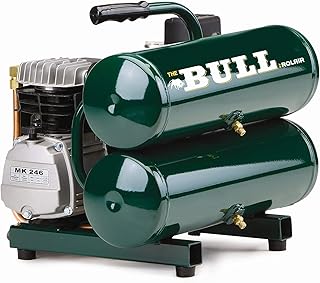
The contractor’s answer: a genuinely robust 2 HP twin-stack that recovers quickly and shrugs off long spray sessions, with overload protection and manual reset for peace of mind. It’s noticeably louder than the ultra-quiet class, so reserve it for detached shops or daytime-only work.
Rolair JC10 Plus
A 2.5-gallon compact that punches well above its footprint, running quieter and cooler than most machines its size thanks to Rolair’s low-speed pump. Ideal for small furniture pieces, touch-ups, and spraying with a low-consumption LVLP gun.
Metabo HPT EC914S Pancake
Six gallons and 4 CFM make this a versatile crossover for anyone alternating between finishing work and framing or trim nailers. It’s the loudest recommendation here, so pair it with hearing protection and a schedule that respects the household.
MZB 2.4 Gallon Ultra Quiet
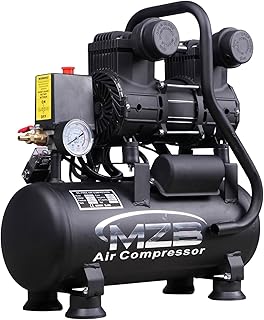
A 70 dB oil-free unit with a strong 5.65 CFM claim and twin steel tanks, making it a sensible middle ground between the whisper-quiet class and full contractor output. Verify actual delivered airflow against your gun’s requirement before committing.
Frequently Asked Questions
Is a small 1-gallon compressor enough for spraying furniture?
For touch-ups, chair spindles, and short passes with a low-CFM gun, a 1-gallon ultra-quiet unit like the 60 dB portable model can work. For full panels you’ll be waiting on recovery constantly, which invites uneven coats.
How quiet does a compressor need to be for indoor use?
Aim for 60 dBA or lower if the machine runs anywhere near occupied living space. That range sits below the threshold where continuous noise reliably disrupts sleep architecture in an adjacent room.
Do I need an oil-lubricated pump for better finishes?
No. Modern oil-free pumps eliminate the risk of oil mist contaminating your finish, and they’re simpler to maintain. Oil-lubricated units mainly win on longevity under heavy commercial duty.
What accessories actually affect finish quality?
A water separator, a regulator at the gun, and a properly sized hose. Undersized hose creates pressure drop that starves the gun and coarsens atomization.
Final Thoughts
For most home furniture builders, the California Air Tools 8010 PK is the pick that solves both problems at once — enough tank and airflow for real spraying, quiet enough not to cost anyone in the house a night’s sleep. Step up to the Rolair FC2002 if you have a detached shop and want contractor-grade recovery, or down to the Rolair JC10 Plus if your projects are small and your space is tight.