Key takeaways
- Usable height, not advertised height: A ladder’s rated length is measured tip to foot, but you should never stand on the top three rungs. For a standard single-story home with a 10-foot eave, plan on a 12.5-foot minimum; two-story access realistically needs 16.5 to 20 feet.
- Setup angle and footing: A straight ladder wants roughly a 75-degree lean — one foot out for every four feet of height. Wide anti-slip feet, an integrated stabilizer bar, or a swiveling base pad matter far more than an extra rung when you’re on soft lawn, gravel, or a sloped driveway.
- Locking mechanism quality: Telescoping ladders live and die by their rung locks. Look for auto-locking or one-touch designs with visible indicators, ANSI or EN 131 certification, and a documented 330-pound duty rating that covers you plus tools and materials.
- Roof hooks and transition safety: Detachable hooks that grab the ridge or eave stop the ladder from shifting during the moment of highest risk — stepping off the top rung onto the shingles. If a model offers them, take them.
- Collapsed footprint: The ladder you actually use is the one you can store. Telescoping models fold to roughly 30–40 inches; multi-position A-frame designs add stair and scaffold versatility at the cost of a little weight.
What's inside
As a sleep-wellness specialist, I spend most of my working hours talking about mattresses, blackout curtains, and circadian rhythm — so a ladder guide may seem like a detour. It isn’t. The two most common “3 a.m. worries” my clients describe are money and the house itself: the drip near the chimney flashing, the gutter sagging under wet leaves, the satellite dish that shifted in the last windstorm. Deferred home maintenance is a genuine sleep disruptor, and the single piece of equipment standing between most homeowners and a resolved worry is a safe, trustworthy way to reach the roofline.
The problem is that roof access is the hardest job you can ask a ladder to do. You need reach without a 20-foot aluminum monster living in your garage, a stable footprint on uneven soil or a stair landing, and enough rigidity that you aren’t white-knuckling the top rung. This guide covers what actually matters when buying a ladder specifically for getting onto a roof in 2026 — extension length versus usable working height, locking mechanisms, stabilizers and roof hooks, storage footprint — and reviews the leading telescoping and multi-position models worth your money. Rest easier, literally.
As an Amazon Associate we earn from qualifying purchases.




How to Choose a/an Ladder For Getting On Roof (2026)
- Usable height, not advertised height: A ladder’s rated length is measured tip to foot, but you should never stand on the top three rungs. For a standard single-story home with a 10-foot eave, plan on a 12.5-foot minimum; two-story access realistically needs 16.5 to 20 feet.
- Setup angle and footing: A straight ladder wants roughly a 75-degree lean — one foot out for every four feet of height. Wide anti-slip feet, an integrated stabilizer bar, or a swiveling base pad matter far more than an extra rung when you’re on soft lawn, gravel, or a sloped driveway.
- Locking mechanism quality: Telescoping ladders live and die by their rung locks. Look for auto-locking or one-touch designs with visible indicators, ANSI or EN 131 certification, and a documented 330-pound duty rating that covers you plus tools and materials.
- Roof hooks and transition safety: Detachable hooks that grab the ridge or eave stop the ladder from shifting during the moment of highest risk — stepping off the top rung onto the shingles. If a model offers them, take them.
- Collapsed footprint: The ladder you actually use is the one you can store. Telescoping models fold to roughly 30–40 inches; multi-position A-frame designs add stair and scaffold versatility at the cost of a little weight.
The Best Ladder For Getting On Roof (2026)s Reviewed
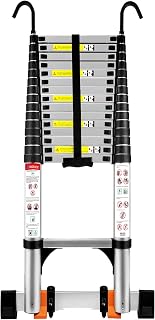
SINMEIRUN 12.5 FT Pro Telescoping Ladder
ANSI certification plus detachable roof hooks makes this the most confidence-inspiring pick for single-story eave access, and the hooks genuinely change how secure the top of the ladder feels. The high-visibility orange finish is a small but smart safety touch when you’re working near a driveway.
LANBITOU 14 FT Multi-Position Folding Ladder
This is the versatility champion: A-frame, extension, and stair-friendly configurations in one 330-pound-rated aluminum package. Choose it if your roof job is one of several chores — the stair-safe geometry is worth the extra bulk over a pure telescoping model.
20.3 FT Telescoping Ladder with Stabilizer & Wheels
The right answer for two-story homes, tall gutters, and exterior wall work, with auto-lock rungs and a stabilizer bar that meaningfully reduces side-to-side flex at full extension. The transport wheels are not a gimmick at this length — you’ll appreciate them.
SocTone 12.5 FT Telescoping Ladder with Stabilizers
A well-balanced everyday performer that pairs a compact collapsed profile with stabilizer feet for uneven ground. Best suited to homeowners handling routine gutter clearing, light roof inspection, and RV maintenance rather than heavy material hauling.
JADDUO 16.5 FT A-Frame Telescoping Ladder
Switching between A-frame and straight configurations gives this model unusual reach-to-storage efficiency, and the 16.5-foot extension handles taller single-story rooflines with margin. The matte black finish hides scuffs, though it does run warm in direct summer sun.
Frequently Asked Questions
What ladder height do I need to get on my roof?
Your ladder should extend roughly three feet above the eave so you have a stable handhold during the transition. For a typical single-story home that means 12.5 to 14 feet; for two stories, 20 feet.
Are telescoping ladders safe for roof access?
Yes, provided the model is ANSI or EN 131 certified, every rung is fully locked before you climb, and the base is on firm, level footing. Check the locking indicators each time — not just on the first use.
Do I really need roof hooks or a stabilizer?
They address different risks: hooks secure the top against lateral slip, while stabilizers widen the base against tipping. If you’re routinely working at the roofline, both are worthwhile.
How do I care for an aluminum telescoping ladder?
Keep the rungs clean and dry, wipe grit from the tubes before collapsing, store it indoors or under cover, and never lubricate the locking mechanisms with heavy grease — dirt binds to it and jams the latches.
Final Thoughts
For most homeowners, the SINMEIRUN 12.5 FT Pro is the smartest buy — certified, compact, and hook-equipped for the part of the job that actually causes accidents. Choose the 20.3 FT stabilizer-and-wheels model if you have two stories to reach, or the LANBITOU 14 FT multi-position ladder if you want one tool that handles stairs, interior work, and the roof alike. Buy the ladder that matches your house, use it properly, and cross one more item off the list that keeps you up at night.