Key takeaways
- Working height, not total height: Subtract roughly four feet from the advertised length to find where your hands comfortably land. A 17 ft ladder suits a single-story eave; two-story gutters generally want the 20 ft class.
- Stabilizer and standoff hardware: A wide stabilizer bar resists side-to-side sway on lawn or gravel, while a wall standoff holds the top rails off fragile gutters so your weight transfers into the fascia instead of crushing aluminum.
- Locking mechanism you can hear: Auto-locking rungs and hinge pins should engage with a clean, audible click. Test every section on level ground before the first climb, and re-test after any drop or transport.
- Certified load rating with margin: A 330 lb capacity is not just your body weight — add tools, a shingle bundle, and dynamic force from movement. Look for EN 131 or comparable certification rather than an unsourced number.
- Retracted footprint and weight: Telescoping designs collapse to roughly three feet, which decides whether the ladder lives in a hall closet or gets abandoned behind the shed. Anything you dread carrying is a ladder you’ll eventually substitute with a chair.
What's inside
Ask any homeowner what keeps them staring at the ceiling at 2 a.m., and roof work lands surprisingly high on the list. A sagging gutter, a shingle that lifted in the last storm, a satellite dish knocked out of alignment — none of it is urgent enough to call a contractor, all of it is nagging enough to steal an hour of sleep. Then comes the second worry: the ladder in the garage. Too short, too heavy, too wobbly on the flowerbed slope, and borrowed from a neighbor who wants it back Saturday. As someone who spends most of my professional life talking about rest and recovery, I’ll say the obvious thing: physical safety and mental quiet are the same subject viewed from two angles. You do not sleep well on top of an unresolved risk.
This guide looks at ladders built specifically for roof access in 2026 — telescoping and multi-position models that reach eaves on a typical two-story home, lock positively, and store in a closet rather than dominating a wall. I’ve prioritized the details that matter when you’re actually stepping from rung to roofline: stabilizer bars, standoff geometry, hook attachments, foot grip, and honest load ratings. Nothing here requires a truck to transport, and everything here is chosen so the job gets finished before dark and stays finished in your head afterward.
As an Amazon Associate we earn from qualifying purchases.


How to Choose a Ladder To Get On Roof (2026)
- Working height, not total height: Subtract roughly four feet from the advertised length to find where your hands comfortably land. A 17 ft ladder suits a single-story eave; two-story gutters generally want the 20 ft class.
- Stabilizer and standoff hardware: A wide stabilizer bar resists side-to-side sway on lawn or gravel, while a wall standoff holds the top rails off fragile gutters so your weight transfers into the fascia instead of crushing aluminum.
- Locking mechanism you can hear: Auto-locking rungs and hinge pins should engage with a clean, audible click. Test every section on level ground before the first climb, and re-test after any drop or transport.
- Certified load rating with margin: A 330 lb capacity is not just your body weight — add tools, a shingle bundle, and dynamic force from movement. Look for EN 131 or comparable certification rather than an unsourced number.
- Retracted footprint and weight: Telescoping designs collapse to roughly three feet, which decides whether the ladder lives in a hall closet or gets abandoned behind the shed. Anything you dread carrying is a ladder you’ll eventually substitute with a chair.
The Best Ladder To Get On Roof (2026)s Reviewed
Multi-Position Telescoping Ladder with Wheels, 17 FT
The five-mode layout — A-frame, extension, staircase, and two scaffold-adjacent configurations — makes this the most versatile pick for owners who need one ladder for interior painting and exterior gutter runs alike. The wheels sound like a gimmick until you’ve walked a fully extended aluminum ladder across a gravel driveway, at which point they become the feature you brag about.
Telescoping A Frame Ladder, 17FT with Stabilizer Bar
A cleaner, more focused take on the same 17 ft platform, with the stabilizer bar doing genuine work on soft or uneven ground. Its staircase mode is the standout: if you’ve ever tried to reach a two-story stairwell light fitting from a step stool, this alone justifies the purchase.
Telescoping Ladder, 20.3 FT Pro with Hooks
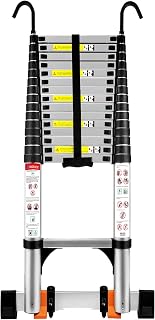
This is the one I’d point most two-story homeowners toward. EN 131 certification, integrated hooks, and a wall standoff stabilizer combine into a straight-ladder setup that reaches typical second-floor eaves with margin, and the 330 lb rating leaves headroom for a tool belt and a bundle of materials.
Telescoping Ladder with Hooks, 20.3 FT, Stabilizer & Wheels
Effectively the touring version of the Pro — same reach and capacity, plus wheels and auto-lock rungs that speed up setup when you’re moving around the perimeter of a house. Best suited to gutter cleaning, RV work, and anyone repositioning the ladder a dozen times in an afternoon.
LANBITOU A Frame 4 Step Ladder Extension, 14 FT
The right answer for single-story homes, garages, carports, and porch roofs, where 20 feet is simply awkward to manage alone. Anti-slip feet and a tight folded profile make it the most storage-friendly option here, and the 330 lb rating matches ladders twice its length.
Frequently Asked Questions
What length ladder do I need to reach my roof?
Measure to the eave, then add three to four feet so the top extends past the roofline for a safe transition. Single-story homes usually need 14–17 ft; two-story homes typically need 20 ft or more.
Are telescoping ladders safe for roof access?
Yes, provided the rungs are certified, fully locked, and inspected before each use. Extend one section at a time, confirm the lock, and never climb a partially seated rung.
Should the ladder rest on my gutter?
Avoid it. Use a standoff stabilizer or roof hooks so the load bypasses the gutter, which is thin aluminum designed for water, not for a person.
How do I set up on uneven ground?
Dig in the low-side foot or use a levelling accessory rather than stacking bricks or boards. Maintain the four-to-one angle rule, and have someone foot the ladder if wind is picking up.
Final Thoughts
For most two-story homes, the 20.3 FT Pro is the sensible default — certified, standoff-equipped, and tall enough to clear the eave without improvisation — with the 20.3 FT Telescoping Ladder with Hooks & Wheels worth the small premium if you’ll be repositioning frequently. If your work stays at porch and garage height, the LANBITOU 14 FT covers it for less money and far less storage space. Pick the one that matches your actual roofline, set it up properly, and reclaim the mental bandwidth that the job has been quietly occupying.