Key takeaways
- Dimming range, not just dimmability: A fixture that only drops to 30% brightness is nearly useless after dark. Look for smooth low-end dimming — ideally down to 5–10% — so late-night snack runs don’t flood your retinas with alerting light. Pair with a quality trailing-edge LED dimmer to avoid flicker, which contributes to eye strain and headaches.
- Color temperature control: Cooler light (4000K+) supports alertness and detailed prep work; warmer light (2200–2700K) signals wind-down. Tunable fixtures let you have both. If your fixture is fixed-temperature, choose warm and add task lighting elsewhere for chopping and reading recipes.
- Glare and shade geometry: Bare bulbs at eye level are the single biggest offender in island lighting. Deeper shades, opal or seeded glass, and downward-facing domes keep the light source out of your direct line of sight while you’re seated — less visual fatigue, more comfort.
- Hanging height and scale: Aim for 30–36 inches between the countertop and the bottom of the shade, and size your fixture to roughly two-thirds of the island’s length. Adjustable rods or chains are non-negotiable if your ceilings deviate from a standard eight feet.
- Bulb replaceability: Integrated LED arrays are sleek but lock you into one light quality for the fixture’s life. Socketed E26 designs let you swap in warmer, higher-CRI, or dim-to-warm bulbs as your needs — and the science — evolve.
What's inside
Kitchen islands have quietly become the busiest surface in the modern home — homework station, coffee bar, dinner prep zone, and the last place anyone stands before heading upstairs to bed. That final detail matters more than most buyers realize. As someone who spends their working life studying how light shapes human sleep, I see the same mistake repeated in beautiful kitchens everywhere: a fixture chosen purely on looks, blasting cool, undimmable brightness downward at 10 p.m. and quietly pushing melatonin onset later and later. The result is a room that photographs well and sleeps badly.
This guide approaches island lighting from both angles at once — design credibility and circadian common sense. Below you’ll find the fixtures worth your money in 2026, evaluated on shade geometry, glare control, dimming behavior, color temperature flexibility, and how well each one adapts from bright morning task light to warm, low-level evening light. I’ve also included a short buying framework and answers to the questions I get asked most by clients renovating open-plan spaces.
As an Amazon Associate we earn from qualifying purchases.


How to Choose a Kitchen Island Lighting (2026)
- Dimming range, not just dimmability: A fixture that only drops to 30% brightness is nearly useless after dark. Look for smooth low-end dimming — ideally down to 5–10% — so late-night snack runs don’t flood your retinas with alerting light. Pair with a quality trailing-edge LED dimmer to avoid flicker, which contributes to eye strain and headaches.
- Color temperature control: Cooler light (4000K+) supports alertness and detailed prep work; warmer light (2200–2700K) signals wind-down. Tunable fixtures let you have both. If your fixture is fixed-temperature, choose warm and add task lighting elsewhere for chopping and reading recipes.
- Glare and shade geometry: Bare bulbs at eye level are the single biggest offender in island lighting. Deeper shades, opal or seeded glass, and downward-facing domes keep the light source out of your direct line of sight while you’re seated — less visual fatigue, more comfort.
- Hanging height and scale: Aim for 30–36 inches between the countertop and the bottom of the shade, and size your fixture to roughly two-thirds of the island’s length. Adjustable rods or chains are non-negotiable if your ceilings deviate from a standard eight feet.
- Bulb replaceability: Integrated LED arrays are sleek but lock you into one light quality for the fixture’s life. Socketed E26 designs let you swap in warmer, higher-CRI, or dim-to-warm bulbs as your needs — and the science — evolve.
The Best Kitchen Island Lighting (2026)s Reviewed
MELUCEE 7-Light 43.3″ Linear LED Pendant
This is the standout for anyone who takes circadian hygiene seriously: five selectable color temperatures spanning 3000K to 6000K mean you can run crisp light through breakfast and prep, then shift to warm tones as the evening progresses. At 35W across a 43-inch span it delivers genuinely usable task illumination without needing to be run at full output.
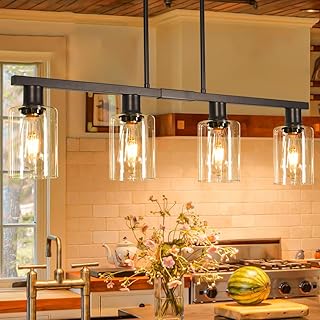
DSMJFU 4-Light Black Bar Island Light
A clean, restrained linear silhouette with clear glass shades and adjustable height — the practical choice for kitchens where the fixture should recede rather than announce itself. Because the glass is clear, I’d strongly recommend frosted or dim-to-warm filament bulbs to soften the point-source glare for anyone seated at the island.
35.4″ Wood and Matte Black 4-Light Chandelier
The wood-and-metal pairing brings warmth that cool black-only fixtures can’t match, and it visually anchors an island without dominating a sightline in open-plan rooms. Excellent value for mid-size islands in the 5 to 7 foot range.
2-Pack 10.2″ Black and Gold Dome Pendants
My favorite option for glare control: the opaque dome directs light straight down onto the work surface and keeps the bulb entirely hidden from seated eye level. The E26 sockets are a real advantage — swap in warm high-CRI bulbs and this becomes one of the most sleep-friendly setups on this list.
CH9176BK-4IS Farmhouse Industrial Linear Chandelier
A well-built take on the industrial-farmhouse linear pendant, with an adjustable chain that handles vaulted and sloped ceilings gracefully. The clear glass and open frame suit rooms where daylight does most of the heavy lifting and the fixture is primarily an evening accent.
Frequently Asked Questions
What color temperature is best for a kitchen island?
There isn’t one correct answer — there’s a correct schedule. Around 3500–4000K serves daytime prep well, while 2700K or lower is far better after sunset. Tunable or dim-to-warm bulbs let a single fixture do both jobs.
How high should I hang my island fixture?
Thirty to thirty-six inches above the countertop suits most homes. Higher spreads light more broadly; lower concentrates it and increases glare risk for anyone seated nearby.
Do I need one linear fixture or multiple pendants?
Linear fixtures give even, continuous coverage and a tidier ceiling. Multiple pendants create rhythm and let you light specific zones, but require careful spacing — roughly 24 to 30 inches apart, with at least 6 inches from each island end.
Will brighter island lighting really affect my sleep?
Evening light exposure measurably delays melatonin release, and overhead kitchen lighting is often the brightest, coolest light people encounter after dark. Dimming and warming that light in the two hours before bed is one of the cheapest sleep upgrades available.
Final Thoughts
If you want one fixture that adapts to your body clock rather than fighting it, the MELUCEE 7-Light linear pendant is the clear winner in 2026 thanks to its five-step color temperature range. For glare-sensitive households and anyone who wants control over bulb quality, the 2-pack dome pendants are the smarter buy, while the 35.4″ wood and matte black chandelier offers the best balance of warmth, scale, and price for a standard island.