Key takeaways
- Drawer glide quality: Ball-bearing runners cost a little more than friction slides and they’re the single biggest factor in whether a drawer closes softly or announces itself through the wall. Look for bearings on every drawer, not just the deep ones.
- Locking casters: Two locking wheels is the minimum. A chest that shifts while you’re pulling a loaded drawer is both a safety issue and a source of the kind of clattering that carries upstairs.
- Modularity over raw volume: A detachable top box lets you carry a small kit to the job instead of dragging everything, which means fewer trips and less late-night rummaging.
- Liners and dampening: Foam or rubber drawer liners cut metal-on-metal noise dramatically and stop tools sliding into a heap. If a chest doesn’t include them, budget for a roll separately.
- Honest weight ratings: Check per-drawer capacity rather than total load. Overloaded drawers sag, bind, and require the sort of yanking that wakes people up.
What's inside
Ask most people what wrecks their sleep and they’ll blame caffeine or their phone. In practice, the culprit is often the room next door. A garage or basement workshop where hand tools live loose in a bucket becomes a low-grade stressor: the 9 p.m. hunt for a socket that ends in slammed lids and rattling metal, the unfinished project that sits in your peripheral vision every time you walk past. Environmental psychologists have a name for the effect of visible disorder on the nervous system, and the short version is that your body reads clutter as unfinished business. Unfinished business keeps cortisol elevated long past the point where it should be tapering off.
This guide approaches tool storage the way I’d approach a bedroom audit: quietly, and with attention to friction. Below you’ll find rolling chests and portable boxes evaluated for the things that actually matter after dark — how smoothly the drawers close, whether the casters lock instead of drifting, how much noise the hardware makes, and whether the layout lets you put a tool away in two seconds rather than deferring it to tomorrow. Everything here sits in the value tier rather than the professional-mechanic tier, because a chest you can afford today does more for your evenings than one you’re still saving for.
As an Amazon Associate we earn from qualifying purchases.


How to Choose a Price On Tool Chest (2026)
- Drawer glide quality: Ball-bearing runners cost a little more than friction slides and they’re the single biggest factor in whether a drawer closes softly or announces itself through the wall. Look for bearings on every drawer, not just the deep ones.
- Locking casters: Two locking wheels is the minimum. A chest that shifts while you’re pulling a loaded drawer is both a safety issue and a source of the kind of clattering that carries upstairs.
- Modularity over raw volume: A detachable top box lets you carry a small kit to the job instead of dragging everything, which means fewer trips and less late-night rummaging.
- Liners and dampening: Foam or rubber drawer liners cut metal-on-metal noise dramatically and stop tools sliding into a heap. If a chest doesn’t include them, budget for a roll separately.
- Honest weight ratings: Check per-drawer capacity rather than total load. Overloaded drawers sag, bind, and require the sort of yanking that wakes people up.
The Best Price On Tool Chest (2026)s Reviewed
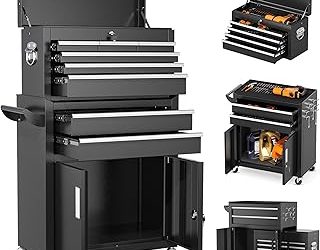
Goplus 5-Drawer Rolling Cabinet
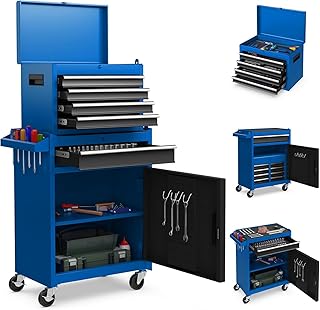
This is the most complete package at its price: five drawers, a detachable top box, protective liners, a lock bar, and casters that genuinely lock rather than merely resisting. The liners are the quiet hero here — they take the ring out of dropped wrenches, which matters more than you’d expect if your workshop shares a wall with living space.
DEWALT TSTAK Rolling Tool Box (DWST17820)
Less a chest than a system, and the right choice if your work moves around the house rather than staying put. The telescopic handle and stackable TSTAK units let you take one module to the task and leave the rest closed, which keeps a single repair from spreading across a room.
8-Drawer 3-in-1 Rolling Tool Chest
The most storage on this list, and the best fit for anyone whose tools have outgrown a single cabinet. The added lower cart and side cabinet mean every category gets its own home, and a defined home is what turns “put it away later” into “put it away now.”
24″ Portable 5-Drawer Metal Tool Box
A compact, lockable box with ball-bearing runners and a top tray — ideal for apartments, sheds, or anyone who wants order without surrendering floor space. It also makes a sensible household chest kept in a utility closet, well away from where you sleep.
4-Drawer 2-in-1 Rolling Tool Chest (Red)
A clean middle option: four drawers, a detachable top cabinet, locking wheels, and side hooks for the awkward long-handled items that never fit anywhere. The hooks are worth noting, since tools left leaning in a corner are exactly the visual loose ends that keep a room feeling unresolved.
Frequently Asked Questions
Can I really keep a tool chest near a bedroom?
Yes, provided the drawers are dampened and the casters lock. Position it against an interior wall rather than a shared one, and add felt pads under the frame if it sits on a hard floor.
How many drawers do I actually need?
Four to five suits most homeowners. Eight makes sense once you’re storing multiple tool categories, since half-empty drawers are just louder, heavier air.
Is a lock worth paying for?
If children share the space, yes — and there’s a secondary benefit in not lying awake mentally auditing what’s within reach of small hands.
Steel or plastic?
Steel for anything stationary, given its rigidity and load capacity. Resin systems like TSTAK win on portability and are naturally quieter.
Final Thoughts
For most homes, the Goplus 5-Drawer Rolling Cabinet offers the best balance of capacity, included liners, and quiet hardware for the money. Choose the DEWALT DWST17820 if your work travels between rooms, or the 8-Drawer 3-in-1 chest if you need every tool to finally have a fixed address — the fastest route to a workshop you can walk past at bedtime without a second thought.