Key takeaways
- Rated clean cut, not max cut: Manufacturers quote two numbers. The “clean cut” figure — typically 3/8″ to 1/2″ on these machines — is what you can expect to cut repeatedly with a square edge and minimal dross. Treat the “max cut” (or severance) rating as an emergency capability, not a working spec, and buy roughly double the capacity of your usual material.
- Voltage flexibility: A dual-voltage 120V/240V unit lets you run light sheet metal off a household circuit and step up to 240V for full amperage when a dryer outlet or subpanel is available. Single-voltage 240V machines like the FLARING deliver more consistent output but tie you to one location.
- Duty cycle and thermal headroom: Internal compressors generate heat inside an already-warm inverter case. Look for stated duty cycle at rated amps plus explicit overheat and overload protection — the YESWELDER’s protection circuitry and IP21 rating are the kind of specifics worth confirming before purchase.
- Pilot arc type: Non-touch pilot arc lets you start on painted, rusty, or expanded metal without shorting the tip, and it’s gentler on consumables. Non-HF designs additionally reduce electrical interference — relevant if you’re working near a router, hearing aid, or CPAP in the same circuit area.
- Air handling and noise: Ask whether the machine includes a rear air filter or moisture separator, since humid internal air shortens consumable life dramatically. On noise: integrated pumps run only while the trigger is pulled, which is a meaningfully quieter, more intermittent sound signature than a tank compressor cycling on its own schedule — the difference between a two-second hiss and a household disturbance.
What's inside
Anyone who has tried to cut steel in a home shop knows the real bottleneck isn’t the arc — it’s the air. A conventional plasma torch needs clean, dry, pressure-stable compressed air, which historically meant buying a pancake or twin-tank compressor, plumbing it, draining it, filtering it, and then listening to it hammer away every ninety seconds. In an attached garage or a basement workspace under bedrooms, that cycling roar is often what ends a project early. It’s also why so many first-time buyers abandon plasma altogether and go back to a cutoff wheel.
Plasma cutters with an integrated air compressor solve that problem by putting a small, purpose-matched pump inside the case. You plug into a wall outlet, hold the trigger, and cut — no hoses, no tank, no 4 a.m. compressor startup echoing through the house. This guide covers the units worth considering in 2026, what the internal-air design gives up in exchange for that convenience, and how to match amperage, duty cycle, and voltage to the thickness you actually cut. Below are our current picks, followed by a buying framework and answers to the questions we get most.
As an Amazon Associate we earn from qualifying purchases.


How to Choose a Plasma Cutter With Built In Air Compressor (2026)
- Rated clean cut, not max cut: Manufacturers quote two numbers. The “clean cut” figure — typically 3/8″ to 1/2″ on these machines — is what you can expect to cut repeatedly with a square edge and minimal dross. Treat the “max cut” (or severance) rating as an emergency capability, not a working spec, and buy roughly double the capacity of your usual material.
- Voltage flexibility: A dual-voltage 120V/240V unit lets you run light sheet metal off a household circuit and step up to 240V for full amperage when a dryer outlet or subpanel is available. Single-voltage 240V machines like the FLARING deliver more consistent output but tie you to one location.
- Duty cycle and thermal headroom: Internal compressors generate heat inside an already-warm inverter case. Look for stated duty cycle at rated amps plus explicit overheat and overload protection — the YESWELDER’s protection circuitry and IP21 rating are the kind of specifics worth confirming before purchase.
- Pilot arc type: Non-touch pilot arc lets you start on painted, rusty, or expanded metal without shorting the tip, and it’s gentler on consumables. Non-HF designs additionally reduce electrical interference — relevant if you’re working near a router, hearing aid, or CPAP in the same circuit area.
- Air handling and noise: Ask whether the machine includes a rear air filter or moisture separator, since humid internal air shortens consumable life dramatically. On noise: integrated pumps run only while the trigger is pulled, which is a meaningfully quieter, more intermittent sound signature than a tank compressor cycling on its own schedule — the difference between a two-second hiss and a household disturbance.
The Best Plasma Cutter With Built In Air Compressor (2026)s Reviewed
FLARING 240V 45A Plasma Cutter
The most straightforward execution of the concept: 240V-only, 45 amps, IGBT inverter, and a genuine 3/8″ clean cut with 5/8″ severance. Because it isn’t compromising to run on a 120V circuit, arc stability at the top of its range is noticeably better than dual-voltage competitors, making it our pick for a fixed shop bench.
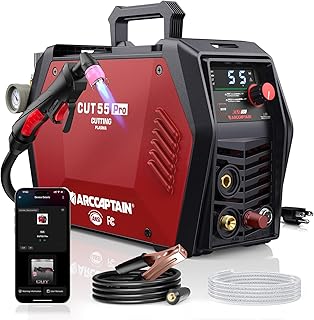
ARCCAPTAIN iControl CUT55 Pro
At 55 amps with a 1/2″ clean cut and app-based parameter control, this is the most capable and most modern-feeling machine here, and the large LED display plus 2T/4T trigger modes make long seams far less fatiguing. The best all-rounder if you want one cutter to handle both sheet and 1/2″ plate.
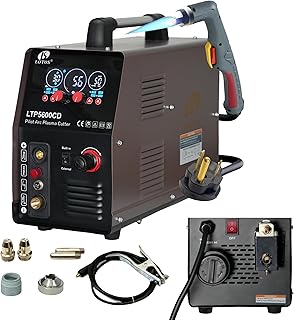
LTP5600CD 56A Drag-Cut
Built for drag cutting — you rest the tip on the work and track a line, which is dramatically easier for HVAC ductwork, brackets, and metal art than freehanding a standoff. It handles rusty, mill-scaled sheet without fuss and cuts 5/8″ cleanly for a machine in this class.
YESWELDER CUT-55DS PRO
The non-HF, non-touch pilot arc design is the reason to choose this one: reliable starts on rough material with minimal electromagnetic noise, plus a built-in rear air filter that meaningfully extends consumable life. The IPT40 torch is widely supported, so replacement tips and shields are cheap and easy to source.
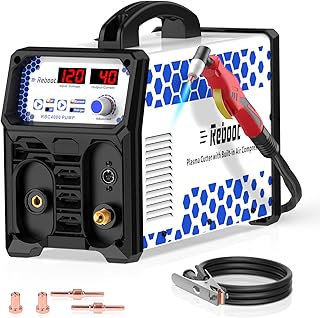
Reboot 40A 120V
The entry point. Forty amps on standard household power will handle 3/8″ clean cuts in mild steel, which covers most furniture frames, shelf brackets, and light fabrication. Buy it knowing its ceiling, and it’s an excellent first plasma cutter.
Frequently Asked Questions
Are built-in compressors powerful enough for real cutting?
Yes, within their rated range. The internal pump is sized precisely for the torch’s consumption, so it delivers adequate CFM at pressure for the amperage on offer. What you lose is reserve capacity for extended, continuous cutting — long production runs still favor an external tank.
How loud are these machines?
Considerably quieter overall than a plasma cutter paired with a tank compressor, largely because the pump runs only under trigger. Expect a compressor whine plus the arc itself while cutting, and silence between cuts. Hearing protection is still required.
Do I need to drain or maintain the internal air system?
Most units have a small drain or moisture trap that should be checked periodically, especially in humid climates. Water in the air line is the single fastest way to destroy tips and shield cups, so make it part of your routine.
Can I cut aluminum and stainless?
Both, since plasma cuts any electrically conductive metal. Expect a rougher edge than on mild steel and plan on light cleanup, and reduce thickness expectations by roughly a third compared to the steel rating.
Final Thoughts
For most home shops, the ARCCAPTAIN iControl CUT55 Pro is the best balance of capacity, control, and dual-voltage flexibility, while the FLARING 240V 45A is the more focused choice if you have a dedicated 240V outlet and want maximum arc stability. If you’re cutting mostly sheet on household power and want to spend the least, the Reboot 40A will do the job without disappointing you.