Key takeaways
- Anchor tall furniture. Tip-over injuries involving wardrobes and chests are a recognised hazard, especially for young children. Makers include wall-fixing hardware with most tall units; use it, and use fixings suited to your wall type (plasterboard needs different plugs from masonry).
- Do not exceed rail and shelf limits listed in the assembly instructions.
- Keep sliding and hinged doors adjusted. Re-tighten hinges after the first weeks of use.
- Leave a small ventilation gap from walls with condensation risk; damp cupboards develop mildew regardless of price.
- Mind heat sources. Do not place cabinets directly against radiators or heaters, and do not drape fabric covers over heating appliances.
A narrow modular system such as IKEA PAX suits most buyers who want a small wardrobe that looks built-in, a freestanding single-door or fabric-covered unit suits renters and kids’ rooms, and an open rail suits anyone who would rather see everything at a glance. The right pick depends on three things: how many centimetres of floor you can give up, whether you need hanging length or shelf space, and whether the piece has to travel with you to the next home.
Our top picks


As an Amazon Associate we earn from qualifying purchases at no extra cost to you.
Small Wardrobes at a Glance
| Type / example | Best for | Key stated specs | Limits |
|---|---|---|---|
| IKEA PAX single frame | Bedrooms where a neat, built-in look matters | The maker sells frames in several widths (50, 75 and 100 cm), two depths (35 and 58 cm) and heights up to 236 cm | Needs assembly and wall fixing; interior fittings are bought separately |
| IKEA BRIMNES-style wardrobe with doors | Budget to mid-range rooms that need a simple, boxy piece | Two-door freestanding cabinet with an internal rail, as listed by the maker | Basic fittings; limited shelf flexibility |
| VASAGLE or SONGMICS-style small wardrobe | Kids’ rooms, guest rooms, studios | Makers list engineered wood panels, a hanging rail and a few shelves in a compact footprint | Panels are lighter than solid wood; weight limits per rail are stated by the maker |
| Fabric wardrobe closet (WHITMOR, SONGMICS and similar) | Temporary housing, dorms, spare rooms | Metal or plastic frame with a non-woven fabric cover; rail and shelf loads are listed by each maker | Not rigid; tips or sags if overloaded |
| Open clothes rail with shelf | Capsule wardrobes, tidy owners, hallways | Steel or wood frame, rail plus lower shelf | No dust protection; everything is visible |
| Over-door hanging rack | Adding hanging space with zero floor use | Hooks over a standard door edge | Light loads only; may stop the door closing fully |
What “Small” Really Means for a Wardrobe
Retail listings label a piece small when it is anywhere from roughly 50 cm to about 100 cm wide. That range matters because a clothes hanger is typically around 40 to 45 cm across, so a cabinet narrower than about 50 cm inside cannot hold a standard hanger facing forward without turning it sideways. Many very narrow wardrobes therefore ship with a rail rotated 90 degrees or with shelves only. Read the interior width, not just the outer width, and compare it with the garments you hang most often.
Depth is the second trap. A 35 cm deep frame, such as the shallower PAX option listed by the maker, suits folded clothes, shirts and shoes but will not hold hanging coats comfortably. A depth near 58 cm is the standard for hanging garments. If your room only allows the shallow depth, plan for folded storage plus a separate coat solution by the front door.
Height is where small rooms gain capacity for free. Choosing a taller unit, within ceiling height and any slanted-roof limits, adds a top shelf for off-season bedding and luggage. Measure the room’s lowest ceiling point along the wall and leave a small gap, as most manufacturers’ assembly guides recommend, so that a tall frame can be tilted upright during assembly.
Modular Frames: IKEA PAX
PAX remains one of the most commonly recommended modular systems in furniture guides because you can build it to the exact width the room allows and add drawers, shelves, rails and pull-out inserts later. The maker lists multiple frame widths and finishes, with hinged doors in standard ranges and sliding doors sold separately for some widths. For a small bedroom, a single 75 cm or 100 cm frame with one rail and two shelves is a common starting point.
The trade-offs are practical rather than quality-related. You must plan the interior before you order, because frame, doors and inner fittings are separate purchases. Assembly takes time and a second person, and the system is designed to be fixed to the wall. If you rent, ask before drilling.
Freestanding Cabinets with Doors
Retail brands such as IKEA, VASAGLE and SONGMICS sell compact wardrobes in the 70 to 100 cm width range with a hanging rail, one or two shelves and sometimes a drawer. They suit kids’ rooms and guest rooms because they arrive flat, go together with simple tools, and can be moved later. Makers typically use particleboard or MDF with a laminate or foil finish; confirm the stated emissions class or formaldehyde certification on the product page if indoor air quality matters to you, particularly in a nursery.
Look at the stated rail weight limit. A rail rated for light loads will bow if filled with winter coats. Check also whether the back panel is a thin fibreboard sheet: it is normal at this level, but it adds little rigidity, so wall anchoring matters more.
Fabric Wardrobes
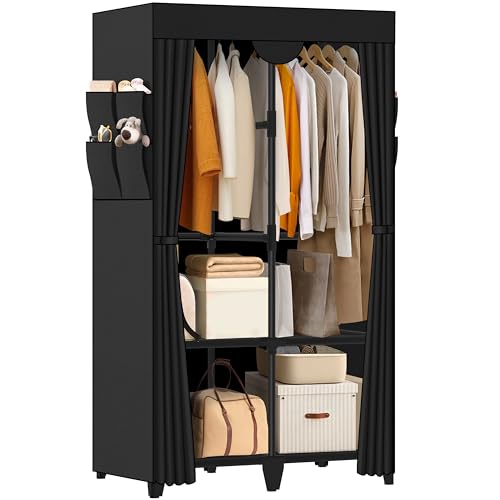
A fabric wardrobe is the lowest-commitment option. A steel tube frame holds a rail and a few fabric shelves, covered by a zipped or roll-up front. It suits dorm rooms, short lets and temporary storage, and it can be folded away when you move. The downsides are consistent across makers: limited weight capacity, no protection against crushing, and a tendency to lean if the floor is uneven. Use it for lighter clothing and accessories, and keep heavy coats elsewhere.
Open Rails and Capsule Setups
If your wardrobe is small by choice, an open rail with a shelf and a couple of baskets can replace a cabinet entirely. IKEA’s MULIG-type rails and many similar steel racks are listed by their makers with rail loads and shelf loads, and they take almost no floor space. They work best with a capsule approach: fewer garments, hung neatly. Add a fabric cover or a curtain if dust or sunlight is a problem.
Safety and Installation Notes
- Anchor tall furniture. Tip-over injuries involving wardrobes and chests are a recognised hazard, especially for young children. Makers include wall-fixing hardware with most tall units; use it, and use fixings suited to your wall type (plasterboard needs different plugs from masonry).
- Do not exceed rail and shelf limits listed in the assembly instructions.
- Keep sliding and hinged doors adjusted. Re-tighten hinges after the first weeks of use.
- Leave a small ventilation gap from walls with condensation risk; damp cupboards develop mildew regardless of price.
- Mind heat sources. Do not place cabinets directly against radiators or heaters, and do not drape fabric covers over heating appliances.
Pick X If …
| Pick this | If you … |
|---|---|
| Modular frame (PAX-type) | want a built-in look, can anchor to the wall and will use the room for years |
| Freestanding door cabinet | need something quick to assemble that can move house with you |
| Fabric wardrobe | rent short term or need overflow storage and mostly hang light clothes |
| Open rail with shelf | have a small, curated wardrobe and like visible storage |
| Over-door rack | only need a little extra hanging space for daily outfits |
| Shallow (35 cm-class) frame | mostly store folded clothes or work with a narrow hallway |
Budget Tiers
Budget: fabric wardrobes, open rails and over-door racks. They deliver hanging space quickly but rely on light loads. Mid-range: boxed engineered-wood cabinets and single PAX frames with basic fittings. These offer the best balance of rigidity, appearance and flexibility. Premium: custom or made-to-measure fitted units, solid-wood pieces and designer systems. They are worth considering only if the room has awkward alcoves or sloping ceilings that off-the-shelf sizes cannot use.
Alternatives to a Standard Wardrobe
- Under-bed storage: low drawers or wheeled boxes hold folded knitwear, linens and out-of-season garments, freeing wardrobe space for hanging items.
- A tall chest of drawers: if most of your clothing is folded, it can replace a wardrobe and is easier to fit in tight spots. Anchor it as well.
- Wall-mounted rails and shelves: use the dead space above a door or bed. Fit them into studs or with suitable anchors for the load.
Care Notes
Wipe laminate and foil surfaces with a slightly damp cloth, and avoid abrasive cleaners that dull the finish. Tighten cam locks and screws once after assembly and then seasonally. Place moisture absorbers or a few cedar blocks in the cabinet if your home runs humid, and avoid overpacking, which restricts airflow and stresses hinges.
Frequently Asked Questions
What is the smallest wardrobe width that still holds hanging clothes?
Interior width of around 50 cm is the practical minimum for standard hangers facing forward. Narrower units often use a rotated rail or shelves only. Always compare the stated internal dimensions rather than the outer width.
Do small wardrobes need to be fixed to the wall?
Makers generally include wall-fixing hardware for tall units and instruct buyers to use it. This reduces the risk of tipping, especially when children are in the home. If you cannot drill, consider a lower piece or a rail system with a stable base, and read the manual for guidance.
Is a fabric wardrobe good enough for everyday use?
It works for lighter garments and short-term setups. Heavier coats and loaded shelves can cause sagging, so many owners treat it as supplementary storage. Check the maker’s stated rail and shelf limits before loading it.
How deep should a wardrobe be for hanging clothes?
Around 55 to 60 cm is the common depth for standard hangers. Shallower units near 35 to 40 cm suit folded items and narrow spaces but will not hold coats facing front without a rotated rail.
Should I choose hinged or sliding doors in a small room?
Sliding doors save the swing space in front of the wardrobe, which is valuable in narrow rooms. Hinged doors give full access to the interior at once and often cost less. Measure the clearance in front of the unit before deciding.
Can I use a small wardrobe in a child’s bedroom?
Yes, with precautions. Anchor it to the wall, choose rounded edges where possible, keep heavy items low, and follow the manufacturer’s age and load guidance. If the unit has doors with magnetic or soft-close features, read the manual about small parts.