Key takeaways
- Clearance above the unit: Covered patios trap heat and combustion byproducts. Propane towers typically need 24–36 inches of overhead clearance and open sides; if your ceiling is low or fully enclosed, an electric infrared unit is the safer specification.
- Warmth delivery, not raw BTU: Infrared warms skin and objects directly, which is what triggers the peripheral vasodilation your body uses to shed core heat before sleep. A 1500W electric unit aimed at seating can outperform a 50,000 BTU tower placed across the deck.
- Light temperature and glare: A bright, high-mounted element in your peripheral vision suppresses melatonin. Look for amber flame tubes, downward-facing reflectors, or heaters you can position behind your seating rather than in front of it.
- Acoustic profile: Propane burners produce a low, consistent hiss that most people find neutral or pleasant. Avoid anything with a fan — variable mechanical noise keeps the nervous system alert precisely when you want it settling.
- Safety systems and storage: Insist on tip-over shutoff and flame-failure detection, and budget for a fitted cover. Dust and moisture degrade regulators and ignition hardware faster than cold does.
What's inside
Most people shopping for a covered patio heater are chasing comfort, but the real payoff arrives hours later — in bed. The last 90 minutes before sleep are when your body wants a gentle downshift: dimmer light, warm skin, cool core, and something to look at that isn’t a screen. A cold porch sabotages all of that. When the temperature drops in October, the evening wind-down migrates indoors to the couch and the phone, and the sleep-onset window quietly gets pushed back by an hour.
That’s the case for heating a covered space properly rather than tolerating it. Below, I’ve evaluated the current crop of patio heaters specifically through a sleep-hygiene lens: how much warmth actually reaches your body, how much glare they throw into your visual field late at night, whether they run quietly enough to talk over, and how safely they operate under a roof, pergola, or gazebo. You’ll find a decision framework, individual assessments of five strong options, and answers to the questions I hear most often.
As an Amazon Associate we earn from qualifying purchases.


How to Choose a Covered Patio Heater (2026)
- Clearance above the unit: Covered patios trap heat and combustion byproducts. Propane towers typically need 24–36 inches of overhead clearance and open sides; if your ceiling is low or fully enclosed, an electric infrared unit is the safer specification.
- Warmth delivery, not raw BTU: Infrared warms skin and objects directly, which is what triggers the peripheral vasodilation your body uses to shed core heat before sleep. A 1500W electric unit aimed at seating can outperform a 50,000 BTU tower placed across the deck.
- Light temperature and glare: A bright, high-mounted element in your peripheral vision suppresses melatonin. Look for amber flame tubes, downward-facing reflectors, or heaters you can position behind your seating rather than in front of it.
- Acoustic profile: Propane burners produce a low, consistent hiss that most people find neutral or pleasant. Avoid anything with a fan — variable mechanical noise keeps the nervous system alert precisely when you want it settling.
- Safety systems and storage: Insist on tip-over shutoff and flame-failure detection, and budget for a fitted cover. Dust and moisture degrade regulators and ignition hardware faster than cold does.
The Best Covered Patio Heaters (2026) Reviewed
1500W Hanging Infrared Ceiling-Mounted Heater
The best choice for a genuinely covered space: carbon fiber infrared radiates downward onto people rather than heating air that escapes sideways, and mounting it overhead removes the tripping hazard and the glare from eye level. Waterproof construction means it survives a screened porch through winter, and with no combustion there’s no ventilation math to do.
Pamapic 48,000 BTU Pyramid Flame Heater
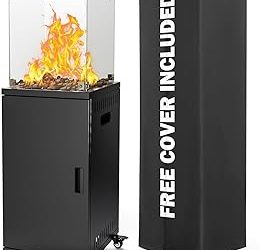
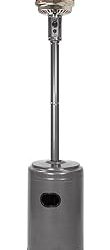
The 87-inch quartz tube produces a tall amber column of flame that functions as both heat source and warm, low-blue focal point — closer in spirit to a fire pit than a floodlight. Best under a high pergola with open sides; the hammered bronze finish and lockable wheels make it easy to reposition seasonally.
Pamapic 50,000 BTU Round Table Heater
The integrated tabletop is the underrated feature here: it consolidates your tea, your book, and your heat source into one spot so you’re not repeatedly getting up and re-engaging. The 304 stainless burner and triple protection system are appropriate for the higher output, which suits larger groups or genuinely cold nights.
Pamapic 41,000 BTU Propane Heater (Ink)
CSA certification and a slightly lower output make this the sensible pick for balconies and compact backyards where a 50,000 BTU tower would be overkill and oppressive. Lockable wheels and included cover mean less friction between deciding to sit outside and actually doing it — which is most of the battle with any evening routine.
48,000 BTU Flame Pyramid Heater with Cover
A well-priced entry into the glass-tube category, with triple safety protection and durable wheels that handle deck boards without fighting you. Ships with its own cover, so weather protection is handled from day one rather than after the first storm.
Frequently Asked Questions
Can I use a propane patio heater under a roof?
Only under a roof with open sides and adequate clearance — typically 24–36 inches overhead, per the manufacturer’s specification. Fully enclosed spaces, low ceilings, and screened rooms with limited airflow call for an electric infrared unit instead.
Does sitting by a heater actually help me sleep?
Indirectly, yes. Warming your hands, feet, and skin encourages heat loss from your core, and that falling core temperature is one of the strongest physiological cues for sleep onset. The bigger benefit is behavioral: a comfortable outdoor spot competes successfully with late-night screens.
Will the light from a flame heater keep me awake?
Flame and quartz-tube heaters emit warm, long-wavelength light with minimal blue content, so their melatonin impact is small — far less than a phone at arm’s length. Position the unit outside your direct line of sight and you get warmth without the visual stimulation.
Do I really need a separate heater cover?
If your heater lives outdoors year-round, yes. A full-length zippered vinyl cover sized to your reflector — the 70-inch version fits standard 21-inch reflectors — keeps water out of the burner assembly and prevents the corrosion that causes ignition failures in year two.
Final Thoughts
For a true covered patio, porch, or gazebo, the 1500W hanging infrared heater is the safest and most targeted way to make your evenings outside habitual rather than occasional. If you have open sides and want ambience that supports a screen-free wind-down, the Pamapic 48,000 BTU pyramid delivers warm firelight along with the heat, while the Pamapic 50,000 BTU round table model is the better call for hosting and colder climates.