Key takeaways
- Port size and flow rate: Match the NPT thread to your compressor’s outlet, not to your hose fitting. A 1/4″ inline trap chokes a 60-gallon two-stage unit; a 3/4″ body rated near 141 CFM is overkill on a pancake compressor. Undersized ports create pressure drop that starves tools mid-job.
- Number of stages: A single particulate bowl catches bulk water and grit. Three stages add a coalescing element for oil aerosols. Four stages finish with desiccant beads for genuinely dry air — the tier you want for clear coats, plasma cutting, and anything where a single droplet ruins the work.
- Drain type: Manual petcocks get forgotten and back up. Semi-automatic drains dump when pressure drops. Fully automatic float drains purge continuously without you touching them, which matters most on units mounted behind equipment or in a corner you rarely visit.
- Bowl material and regulator range: Metal bowls tolerate solvent vapor and heat far better than polycarbonate, and a 0–240 PSI regulator with a legible gauge lets you dial tool pressure precisely instead of guessing at the tank.
- Placement and consumables: Install at least 20–25 feet of cooled line downstream of the pump so vapor has condensed before filtration, and confirm replacement elements and desiccant are actually sold separately — a sealed cartridge is a disposable tool, not an investment.
What's inside
Anyone who has ever pulled the trigger on a spray gun and watched a perfect finish bloom into blotches knows the culprit: water. Compressed air is warm, humid air under pressure, and the moment it cools inside your hose it drops that moisture as liquid — straight into your tools, your paint, your plasma torch, and eventually your tank walls as rust. If your compressor lives in a garage or basement that shares walls with the rooms where your household actually rests, the problem compounds: a damp, oil-misted workspace radiates humidity and odor into adjacent living areas, and a compressor fighting waterlogged lines cycles harder and louder than it needs to. Dry air is quieter air, and a quieter, drier garage is a genuinely better neighbor to a bedroom on the other side of the wall.
This guide takes that whole-home view seriously. Below we compare the water separators, filter-regulators, and multi-stage drying systems worth buying in 2026, from compact inline moisture traps for occasional touch-up work to industrial four-stage columns that deliver desiccant-dry air for automotive refinishing. We cover port sizing, flow ratings, drain style, and the maintenance realities nobody mentions on the box — so you can match a unit to your compressor and your space rather than overbuying hardware that will sit half-used on a wall bracket.
As an Amazon Associate we earn from qualifying purchases.


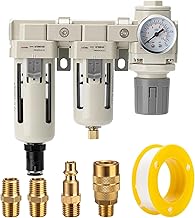

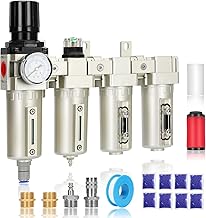

How to Choose a/an Air Compressor Water Separator (2026)
- Port size and flow rate: Match the NPT thread to your compressor’s outlet, not to your hose fitting. A 1/4″ inline trap chokes a 60-gallon two-stage unit; a 3/4″ body rated near 141 CFM is overkill on a pancake compressor. Undersized ports create pressure drop that starves tools mid-job.
- Number of stages: A single particulate bowl catches bulk water and grit. Three stages add a coalescing element for oil aerosols. Four stages finish with desiccant beads for genuinely dry air — the tier you want for clear coats, plasma cutting, and anything where a single droplet ruins the work.
- Drain type: Manual petcocks get forgotten and back up. Semi-automatic drains dump when pressure drops. Fully automatic float drains purge continuously without you touching them, which matters most on units mounted behind equipment or in a corner you rarely visit.
- Bowl material and regulator range: Metal bowls tolerate solvent vapor and heat far better than polycarbonate, and a 0–240 PSI regulator with a legible gauge lets you dial tool pressure precisely instead of guessing at the tank.
- Placement and consumables: Install at least 20–25 feet of cooled line downstream of the pump so vapor has condensed before filtration, and confirm replacement elements and desiccant are actually sold separately — a sealed cartridge is a disposable tool, not an investment.
The Best Air Compressor Water Separator (2026)s Reviewed
3/4″ NPT Industrial 4-Stage Air Drying System
The most capable unit here, pairing high-flow 3/4″ porting with four stages of filtration and an auto drain — the right specification for sandblasting cabinets and full-panel spray work where sustained CFM matters as much as dryness. Treat it as a permanent wall-mounted installation rather than something you move between jobs.
1/2″ NPT 4-Stage Air Dryer, 141 CFM
Our best all-round pick for a serious home shop: desiccant-grade output at 1/2″ porting, a 0–240 PSI regulator, and enough headroom for a plasma cutter and an HVLP gun on the same line. The auto drain means it quietly maintains itself between sessions.
1/2″ NPT Industrial 3-Stage Filter Dryer with Regulator
A smart middle path if you don’t need desiccant: particulate and coalescing stages remove water and oil mist convincingly, and the integrated regulator keeps your wall setup compact. Ideal for general repair, framing nailers, and primer coats.
1/2″ NPT 3-Stage System with Metal Bowl and Desiccant
The metal-bowl construction is the standout, resisting solvent attack and heat where clear plastic eventually crazes. With a desiccant column included, it punches above its stage count for finish work.
LE LEMATEC AI303 1/4″ Inline Filter
The value choice for point-of-use protection — a compact auto-draining moisture trap that mounts at the gun or the hose end for touch-up painting and small plasma jobs. Not a substitute for a wall unit on a big compressor, but excellent insurance for portable setups.
Frequently Asked Questions
Where should I install a water separator?
Downstream of the tank, after a cooling run of pipe or hose — ideally 20 feet or more. Air leaving the pump is too hot for filtration to work; the moisture is still vapor. Mount vertically, with the bowl down and flow direction matching the arrow on the body.
Do I still need one if my compressor has a tank drain?
Yes. Draining the tank removes accumulated water but does nothing about the vapor traveling through your lines with every cycle. The two are complementary maintenance steps, not alternatives.
How often does desiccant need replacing?
It depends on humidity and duty cycle, but plan on regenerating or swapping beads every few months of regular use. Colour-indicating desiccant makes this obvious at a glance — once it stops changing shade, it’s saturated and passing moisture through.
Will a separator reduce my compressor’s noise?
Indirectly. Clean, dry lines reduce restriction and tool stalling, so the compressor cycles less often and for shorter bursts — noticeably less disruptive if your garage adjoins a bedroom or a home office. For real acoustic isolation, pair it with anti-vibration pads and a sealed door.
Final Thoughts
For most home workshops, the 1/2″ NPT 4-Stage Air Dryer is the sweet spot — desiccant-dry air, generous flow, and a maintenance-free auto drain. Step up to the 3/4″ 4-Stage Industrial System if you run a blast cabinet or a high-demand spray setup, and keep a LE LEMATEC AI303 inline trap in the drawer for portable work. Buy for the compressor you own and the air quality your projects demand, and you’ll spend far less time chasing fisheyes and rust than hardware.