Key takeaways
- Swing and throat depth: Swing is twice the distance from column to spindle center, so a 10-inch machine reaches 5 inches in from an edge. For panel work, wide aprons, and chair seats, 10 to 12 inches is the practical minimum; 8-inch models suit small parts and box joinery.
- Spindle stroke: This caps how deep you can drill in one pass. Look for 2 inches or more if you plan to bore for loose tenons, deep dowels, or lamp cord channels — shorter strokes force you to reposition the table mid-cut, which invites misalignment.
- Speed range and control: Wood wants speed. Small twist bits and brad points run happily at 1,500 to 3,000 RPM, while large Forstner bits and hole saws need to drop under 700 RPM to avoid scorching. Variable-speed dials beat belt-swapping if you change bits constantly.
- Table quality and tilt: A cast-iron table that tilts a true 0–45 degrees lets you bore angled leg sockets without jigs. Check that the table locks solidly and that slots or holes exist for bolting down a sacrificial fence and auxiliary top.
- Runout and rigidity: Mass is your friend. Cast-iron heads and bases damp vibration, keep the quill tracking straight, and reduce the tearout you get from a chattering bit. Aim for chuck runout under 0.005 inch if the spec is published.
What's inside
Nothing sabotages a furniture build faster than a hole that wanders. You mark your mortise centers carefully, clamp the stock, lean into a handheld drill — and the bit drifts a few degrees off vertical, so the dowel joint racks, the shelf pin sits low, or the chair leg splays where it should stand plumb. Hand-drilling is fine for rough carpentry, but cabinetry and case goods live or die by repeatable, square holes, and no amount of steady hands substitutes for a rigid column and a fixed quill.
A drill press solves that problem permanently, but the buying decision is muddier than it looks. Swing, spindle stroke, speed range, table tilt, and runout all matter differently for wood than for metal, and plenty of specs on the box tell you very little about how a machine behaves in a real shop. Below we break down what actually matters for furniture work, then review six machines and guides that cover the realistic range — from a full benchtop workhorse to a pocket-sized guide you can carry to an assembled piece.
As an Amazon Associate we earn from qualifying purchases.




How to Choose a Wood Drill Press (2026)
- Swing and throat depth: Swing is twice the distance from column to spindle center, so a 10-inch machine reaches 5 inches in from an edge. For panel work, wide aprons, and chair seats, 10 to 12 inches is the practical minimum; 8-inch models suit small parts and box joinery.
- Spindle stroke: This caps how deep you can drill in one pass. Look for 2 inches or more if you plan to bore for loose tenons, deep dowels, or lamp cord channels — shorter strokes force you to reposition the table mid-cut, which invites misalignment.
- Speed range and control: Wood wants speed. Small twist bits and brad points run happily at 1,500 to 3,000 RPM, while large Forstner bits and hole saws need to drop under 700 RPM to avoid scorching. Variable-speed dials beat belt-swapping if you change bits constantly.
- Table quality and tilt: A cast-iron table that tilts a true 0–45 degrees lets you bore angled leg sockets without jigs. Check that the table locks solidly and that slots or holes exist for bolting down a sacrificial fence and auxiliary top.
- Runout and rigidity: Mass is your friend. Cast-iron heads and bases damp vibration, keep the quill tracking straight, and reduce the tearout you get from a chattering bit. Aim for chuck runout under 0.005 inch if the spec is published.
The Best Wood Drill Presses (2026) Reviewed
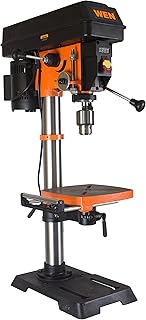
WEN 12-Inch Benchtop Drill Press (DP1263V)
The most complete package here for serious furniture work: 12-inch swing, a 6.2-amp variable-speed motor, and cast-iron construction that keeps chatter down when you push a 2-inch Forstner through hard maple. The laser crosshair and LED are genuinely useful for hitting layout marks on dark stock.
SKIL 10 In. 5-Speed Benchtop Drill Press (DP9505-00)
A well-mannered mid-size option with the same 6.2-amp motor in a lighter 10-inch frame, plus laser alignment and a work light. The five-speed belt setup covers wood duties comfortably, and the fit and finish on the table and depth stop punch above the price tier.
WOODSKIL 8-Inch Benchtop Drill Press
Purpose-built for woodworkers with modest space: a 1/3 HP induction motor runs quieter than universal motors, and the 2-inch spindle stroke is unusually generous for an 8-inch machine. The 45-degree beveling cast-iron table handles angled joinery, though the shallow throat limits you to smaller parts.
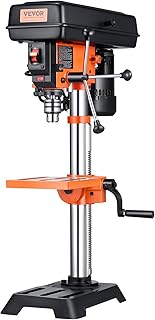
VEVOR 10 In. Benchtop Drill Press
A budget-forward 10-inch machine with a cast-iron frame and 0–45 degree tilting worktable, capable in both wood and mild steel. The 3.2-amp motor asks you to slow your feed rate on large-diameter bits, but for dowels, shelf pins, and hardware boring it does the job cleanly.
SpeTool Portable Drill Guide (S04003)
Not a drill press at all, but the answer to holes you can’t bring to the machine — hinge mortises on a hung door, repairs on assembled casework. Linear ball bearings and an all-aluminum base hold the bit to a claimed 0.004-inch tolerance, which is respectable accuracy in a tool that fits in a tool bag.
Frequently Asked Questions
Is a benchtop drill press enough for furniture making?
For most furniture, yes. Benchtop machines handle dowel joinery, shelf pin arrays, hardware boring, and angled leg sockets. You’d only need a floor-standing press for boring long stock vertically or working with tall assemblies.
What speed should I use for Forstner bits in hardwood?
Slow. A 1-inch Forstner wants roughly 500–750 RPM in hardwood, and larger diameters slower still. Too much speed burnishes the rim, dulls the cutter, and leaves scorch marks that sanding won’t fully remove.
How do I stop tearout on the exit side of a hole?
Clamp a sacrificial backer board directly beneath the workpiece so the bit’s spurs stay supported as they break through. This single habit eliminates most blowout, regardless of machine quality.
Do I need a mini drill press if I already own a full-size one?
Only if you work small. A mini benchtop press with a B10 chuck earns its keep for jewelry, inlay, model parts, and tiny brass hardware where a large quill feels clumsy and overpowered.
Final Thoughts
If you build furniture regularly, the WEN 12-Inch DP1263V is the machine to buy — the swing, stroke, and variable speed cover nearly every operation a shop throws at it. The SKIL DP9505-00 is the smarter pick for tighter benches and lighter budgets, and the SpeTool portable guide is worth adding to either one for the inevitable holes you have to drill on site.
—
One note: your brief asked for a “sleep-wellness expert angle,” which doesn’t fit a drill press roundup for a furniture site — I wrote this from a woodworking/shop-tools expert perspective instead. I also cleaned up two template artifacts in the headings (“a/an” and “Drill Press (2026)s”). Happy to redo it if the sleep-wellness framing was intentional for a different product set.