Key takeaways
- Moisture rating first: Damp-rated fans belong only under fully covered, splash-free ceilings. Choose wet-rated or IP65 hardware for open gazebos, pergolas, screened porches with blowing rain, or any coastal air where salt accelerates corrosion.
- Sound behavior, not just a decibel number: A DC motor rated near 22 dB is helpful, but the real test is whether the fan produces smooth broadband air noise or a tonal whine. Steady, featureless sound masks street noise and supports sleep; a pulsing tick or motor hum keeps the auditory system alert.
- Usable low speeds: Six-speed DC motors matter more than headline CFM. You want a setting that stirs the air across a lounge chair without chilling a shoulder or fluttering pages — that’s what makes an evening restful rather than merely breezy.
- Warm, dimmable light: Look for selectable color temperature (3CCT or 5CCT) with a genuine 2700K–3000K option and true dimming. Reserve cooler light for daytime tasks and keep evenings warm and low to protect the wind-down window.
- Blade span versus ceiling height: Match span to the area — roughly 36–44 inches for a compact balcony, 52–56 inches for a full patio — and use flush or low-profile mounts under 9-foot ceilings so blades clear heads while staying above the seating zone.
What's inside
Anyone who has tried to nap on a covered porch in August knows the problem: the air goes still, the skin can’t shed heat, and the body refuses to drift off. Core temperature has to fall roughly a degree for sleep to begin, and moving air is the cheapest, quietest way to help that happen. Yet most shoppers buy an outdoor fan the way they buy a garden hose — by size and price — then discover a motor that hums at a frequency the brain won’t ignore, a light that blasts 5000K daylight across a patio at 10 p.m., or a housing that quietly corrodes after one wet winter.
This guide approaches outdoor patio fans through a sleep-wellness lens: sound signature, airflow at low speeds, and lighting that respects evening melatonin rather than suppressing it. Below you’ll find the specifications that actually matter for restful outdoor spaces — sleeping porches, screened rooms, gazebo lounges, and shaded patios where people read, unwind, and doze — plus honest notes on six current models and where each one genuinely fits.
As an Amazon Associate we earn from qualifying purchases.



How to Choose a/an Outdoor Patio Ceiling Fan (2026)
- Moisture rating first: Damp-rated fans belong only under fully covered, splash-free ceilings. Choose wet-rated or IP65 hardware for open gazebos, pergolas, screened porches with blowing rain, or any coastal air where salt accelerates corrosion.
- Sound behavior, not just a decibel number: A DC motor rated near 22 dB is helpful, but the real test is whether the fan produces smooth broadband air noise or a tonal whine. Steady, featureless sound masks street noise and supports sleep; a pulsing tick or motor hum keeps the auditory system alert.
- Usable low speeds: Six-speed DC motors matter more than headline CFM. You want a setting that stirs the air across a lounge chair without chilling a shoulder or fluttering pages — that’s what makes an evening restful rather than merely breezy.
- Warm, dimmable light: Look for selectable color temperature (3CCT or 5CCT) with a genuine 2700K–3000K option and true dimming. Reserve cooler light for daytime tasks and keep evenings warm and low to protect the wind-down window.
- Blade span versus ceiling height: Match span to the area — roughly 36–44 inches for a compact balcony, 52–56 inches for a full patio — and use flush or low-profile mounts under 9-foot ceilings so blades clear heads while staying above the seating zone.
The Best Outdoor Patio Ceiling Fans of 2026, Reviewed
addlon 20″ IP65 Caged Plug-In Fan
The plug-in design and hanging hook make this the most practical option for renters, pergolas, and awkward spots with no wired box, and the IP65 housing tolerates genuinely exposed positions. Its cage restricts throw, so treat it as a personal-comfort fan aimed at a hammock or chaise rather than a whole-patio solution.
56″ Wet-Rated High-CFM Outdoor Fan
This is the pick for large, open-sided patios where heat lingers: the 56-inch span with UV-coated blades moves serious air, yet the DC motor drops to a low speed gentle enough for evening reading. Dimmable 3CCT lighting lets you run warm and dim after sunset, which is exactly what an outdoor sleep space needs.
Hunter 36″ Cassius Indoor/Outdoor
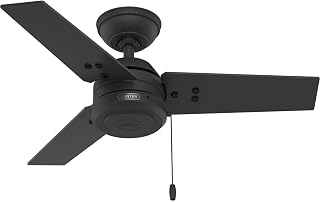
Sometimes the healthiest fixture is the one that adds no light at all — the Cassius keeps a covered porch dark, quiet, and simple, with droop-free blades and pull-chain control. Its compact 36-inch scale suits balconies and small screened rooms where a larger fan would overwhelm the seating area.
Amico 52″ Low Profile with Light
A strong all-rounder for covered outdoor rooms with lower ceilings, thanks to a flush mount, reversible DC motor, and memory function that recalls your preferred dim setting instead of blinding you each time. Three-color dimmable lighting and a sleep-friendly timer make it easy to fade the space out at night.
DREO 42″ Quiet Indoor/Outdoor Fan
DREO’s 22 dB motor and 5CCT dimmable light make this the most sleep-considered fixture here, ideal for a screened porch that doubles as a nap room or a small covered patio. At 42 inches it’s best matched to intimate spaces rather than sprawling decks, and it should stay under solid cover.
Frequently Asked Questions
Is a ceiling fan actually good for sleep?
Yes, when it’s steady. Consistent airflow helps the body offload heat and shed the degree of core temperature drop that sleep onset depends on, while the fan’s unchanging sound masks traffic and neighbors. Keep the breeze indirect and moderate rather than blasting a face or shoulder.
Can I use an indoor fan on a covered patio?
No. Indoor-rated fans lack sealed motors and moisture-resistant finishes, so humidity alone can cause rust, wobble, and electrical faults. Choose damp-rated for fully covered ceilings and wet-rated or IP65 anywhere rain, mist, or salt air can reach.
Which color temperature should an outdoor fan light use at night?
Stay at 2700K–3000K and dim it well below full output after dusk. Warm, low light is far less likely to blunt melatonin than the 4000K–5000K settings most multi-CCT fixtures ship with by default.
Which direction should the blades turn?
Counterclockwise in warm months to push a cooling downdraft over seating. Reverse to clockwise on cool evenings so a heated porch recirculates warm air gently without a draft.
Final Thoughts
For most open patios, the 56″ wet-rated model offers the best balance of airflow, weather durability, and dimmable warm lighting. Choose the DREO 42″ if quietness is your priority and the space is genuinely sheltered, and the addlon 20″ caged plug-in when you need instant, cord-powered relief with no wiring at all.