Key takeaways
- Low-end spindle speed: This is the single most important number. Steel cuts best between roughly 200 and 700 RPM depending on bit diameter, so a press whose slowest setting is 600 RPM will struggle with anything above 3/8″. Look for a genuine low range, not just a wide top end.
- Rigidity and mass: Cast iron heads, columns, and tables resist deflection and damp chatter. A heavier machine drills straighter holes and leaves a cleaner finish, and it keeps the bit from grabbing as it breaks through the far side.
- Magnetic force versus footprint: For structural work, holding force is your fixture. Anything under about 2,000 lbf is marginal for large annular cutters; 2,900 lbf and up gives real confidence on vertical and overhead surfaces. Confirm the mag base can grip your material thickness — thin stock weakens the magnetic circuit.
- Quill travel and throat depth: Quill stroke determines the maximum plate thickness you can drill in one pass, and throat depth dictates how far from an edge you can reach. Three inches of travel handles most home projects; less will frustrate you quickly.
- Coolant strategy and duty cycle: Steel generates heat that destroys edges. Check whether the machine has an integrated coolant or cooling system, or plan on manual cutting fluid application plus a motor with overload protection for extended sessions.
What's inside
Steel punishes tools that were designed for wood. Push a bargain benchtop drill through half-inch plate and you’ll feel it immediately: the chuck wobbles, the bit skates across your center punch, the swarf turns to blue dust, and the cutting edge dulls before the hole is through. The problem isn’t usually the operator — it’s that most consumer drill presses top out at spindle speeds far above what steel tolerates, and lack the rigidity to keep a bit tracking straight under real feed pressure. Steel wants slow, steady, unwavering rotation and a frame stiff enough that nothing flexes while the flute does its work.
This guide covers the machines that actually earn their place in a home or small fabrication shop: cast-iron benchtop presses for repeatable bench work, and portable magnetic drills for structural steel, beams, and anything too large to lift onto a table. Below you’ll find what specifications genuinely matter for ferrous metal, honest notes on each model’s strengths and limits, and answers to the questions that come up most often once the machine is on the bench. One practical aside worth flagging early: if your workspace shares a wall with a bedroom, prioritize a cast-iron body and a belt drive — mass absorbs vibration, and a quieter machine is one you’ll actually use in the evening without waking the house.
As an Amazon Associate we earn from qualifying purchases.



How to Choose a Drill Press For Steel (2026)
- Low-end spindle speed: This is the single most important number. Steel cuts best between roughly 200 and 700 RPM depending on bit diameter, so a press whose slowest setting is 600 RPM will struggle with anything above 3/8″. Look for a genuine low range, not just a wide top end.
- Rigidity and mass: Cast iron heads, columns, and tables resist deflection and damp chatter. A heavier machine drills straighter holes and leaves a cleaner finish, and it keeps the bit from grabbing as it breaks through the far side.
- Magnetic force versus footprint: For structural work, holding force is your fixture. Anything under about 2,000 lbf is marginal for large annular cutters; 2,900 lbf and up gives real confidence on vertical and overhead surfaces. Confirm the mag base can grip your material thickness — thin stock weakens the magnetic circuit.
- Quill travel and throat depth: Quill stroke determines the maximum plate thickness you can drill in one pass, and throat depth dictates how far from an edge you can reach. Three inches of travel handles most home projects; less will frustrate you quickly.
- Coolant strategy and duty cycle: Steel generates heat that destroys edges. Check whether the machine has an integrated coolant or cooling system, or plan on manual cutting fluid application plus a motor with overload protection for extended sessions.
The Best Drill Press For Steel (2026)s Reviewed
ZELCAN 1550W Magnetic Drill Press
With 3,125 lbf of magnetic clamping and stepless speed control down into proper steel territory, this is the most capable portable option here for beam and plate work. The reversible direction is more useful than it sounds — it makes tap extraction and cutter retrieval straightforward when a hole binds.
WEN 4206T 8-Inch Benchtop Drill Press
An honest entry-level cast-iron press that handles light steel — up to about 1/4″ mild plate with sharp bits and patience. Its slowest speed is the limiting factor, so treat it as a small-diameter machine rather than a general-purpose metal drill.
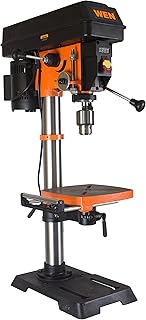
WEN DP1263V 12-Inch Variable Speed
The variable-speed motor and 6.2-amp draw make this the strongest value pick for a mixed home shop, with enough low-RPM range to run twist bits through half-inch stock. The laser and LED are conveniences rather than substitutes for a center punch, but the cast-iron build is the real selling point.
JET JWDP-12 Benchtop Drill Press
Machining tolerances are what separate this from the budget field: minimal spindle runout, a smooth quill, and a table that stays square through years of use. If you drill steel regularly and care about hole accuracy, this is the benchtop machine to buy once.
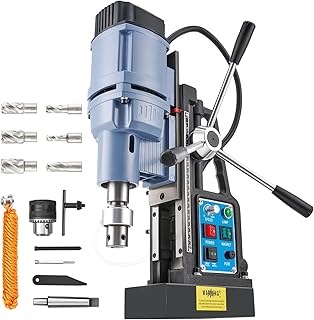
VEVOR 1450W Mag Drill with Annular Cutters
A well-priced route into annular cutting, with 2,922 lbf of hold, a 0–750 RPM range, and a cooling system plus overload protection for sustained jobsite use. The included cutter set gets you productive immediately, though most users eventually upgrade to premium cutters for cleaner slugs.
Frequently Asked Questions
What speed should I use for drilling steel?
As a rough rule, divide 300 by the bit diameter in inches to get a starting RPM for mild steel with high-speed steel bits — so about 600 RPM for a 1/2″ bit and slower still for larger holes. Harder alloys and stainless want even lower speeds with firm, continuous feed pressure.
Do I really need cutting fluid?
Yes. Fluid carries heat away from the cutting edge, and heat — not wear — is what kills most bits in steel. A sulfurized cutting oil or even a simple dark thread-cutting oil will dramatically extend edge life and improve hole finish.
Is a magnetic drill better than a benchtop press?
They solve different problems. A mag drill goes to the workpiece and excels on beams, columns, and large fabrications; a benchtop press brings precision and repeatability to parts you can carry. Serious metalworkers eventually own both.
Can I use standard twist bits in a magnetic drill?
Most mag drills accept twist bits via an adapter chuck, but they’re designed around annular cutters, which remove less material, generate less heat, and cut faster. Use twist bits for small diameters and annular cutters for anything over about 1/2″.
Final Thoughts
For most home shops drilling steel on the bench, the WEN DP1263V delivers the best balance of low-speed capability, cast-iron mass, and price, while the JET JWDP-12 is the accuracy-first choice for anyone who values tight tolerances and long-term reliability. If your work takes you to the steel rather than the reverse, the ZELCAN 1550W magnetic drill press offers the holding force and speed control to handle structural jobs safely and cleanly.