Key takeaways
- CFM at 90 PSI, not peak CFM: This is the only airflow number that matters. LVLP guns typically want 3–5 CFM; conventional HVLP guns can demand 10–13. Buy at least 30% above your gun’s rating so the motor isn’t running continuously.
- Tank capacity as a buffer: The tank doesn’t create air, it stores it. Small 2–6 gallon tanks are fine for touch-ups, bumpers and wheels; anything approaching a full panel or a whole vehicle benefits from 13 gallons or more so pressure stays flat between cycles.
- Noise level in decibels: Anything at or below 70 dB is genuinely conversational and won’t rattle a shared wall or wake a sleeping household. Traditional direct-drive units hit 85–95 dB — a difference you feel in fatigue, not just annoyance.
- Oil-free reliability and clean air: Oil-free pumps eliminate any chance of oil carryover contaminating your finish and require no crankcase maintenance. Regardless, always run a dedicated moisture trap and inline desiccant filter at the gun.
- Circuit draw and mobility: Confirm the unit runs on a standard 120V circuit and won’t trip your garage breaker alongside lights and heaters. Wheels and a balanced handle matter more than you’d think when the compressor needs to follow you around the car.
What's inside
Automotive finishes are unforgiving. A clearcoat that dries with tiger stripes, a basecoat that mottles, orange peel across a hood you spent a weekend blocking — nine times out of ten the culprit isn’t the gun or the operator, it’s air. Spray guns don’t ask for pressure so much as they ask for volume, delivered steadily, minute after minute. When a compressor can’t keep up, the motor short-cycles, pressure sags mid-pass, and moisture pushed out of an overworked tank finds its way into the fluid stream. And because most of us are painting in a garage bolted to the side of a house, there’s a second problem nobody mentions in the spec sheet: a compressor that kicks on at 95 decibels at 9 p.m. is a compressor you’ll stop using.
This guide approaches the problem from both directions — the airflow your gun actually needs, and the acoustic footprint your household can actually live with. Modern brushless, oil-free, twin-motor designs have quietly (literally) reshaped this category, with several units now running in the 66–70 dB range, roughly the level of ordinary conversation. Below we’ve gathered the compressors worth considering for auto painting in 2026, from compact ultra-quiet units for panel work to upright tanks built for full repaints, along with the specs that separate a usable machine from a frustrating one.
As an Amazon Associate we earn from qualifying purchases.


How to Choose an Air Compressor For Auto Painting (2026)
- CFM at 90 PSI, not peak CFM: This is the only airflow number that matters. LVLP guns typically want 3–5 CFM; conventional HVLP guns can demand 10–13. Buy at least 30% above your gun’s rating so the motor isn’t running continuously.
- Tank capacity as a buffer: The tank doesn’t create air, it stores it. Small 2–6 gallon tanks are fine for touch-ups, bumpers and wheels; anything approaching a full panel or a whole vehicle benefits from 13 gallons or more so pressure stays flat between cycles.
- Noise level in decibels: Anything at or below 70 dB is genuinely conversational and won’t rattle a shared wall or wake a sleeping household. Traditional direct-drive units hit 85–95 dB — a difference you feel in fatigue, not just annoyance.
- Oil-free reliability and clean air: Oil-free pumps eliminate any chance of oil carryover contaminating your finish and require no crankcase maintenance. Regardless, always run a dedicated moisture trap and inline desiccant filter at the gun.
- Circuit draw and mobility: Confirm the unit runs on a standard 120V circuit and won’t trip your garage breaker alongside lights and heaters. Wheels and a balanced handle matter more than you’d think when the compressor needs to follow you around the car.
The Best Air Compressor For Auto Painting (2026)s Reviewed
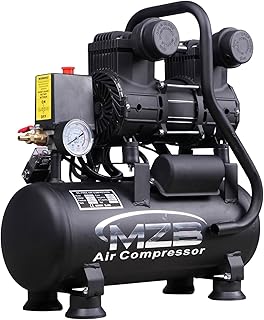
MZB 2.4 Gallon Ultra Quiet Air Compressor
At 5.65 CFM from a 2.4-gallon tank and just 70 dB, this is a precision instrument rather than a workhorse — ideal for detail guns, airbrush work, wheels and spot repairs where you need clean, steady air without filling the garage with noise. Pair it with an LVLP gun and keep expectations realistic on panel-sized work.
18.5-Gallon Upright Oil-Free Compressor
The upright 18.5-gallon format is the sweet spot for serious hobbyist painting: enough stored volume to shoot a door or fender without pressure drop, in a footprint that tucks against a wall. Oil-free construction keeps maintenance to draining the tank and nothing else.
VEVOR 13-Gallon Air Compressor
A well-judged balance of capacity and civility — 4.6 SCFM at 90 PSI, 125 PSI max, and 66 dB operation, the quietest figure in this lineup. The thickened steel body and wheels make it a practical single-compressor solution for painting, tire work and general shop duty.
Klutch 29-Gallon Air Compressor
If you’re planning a full respray, this is the one to buy: 5.1 CFM at 90 PSI, 175 PSI max, and a 29-gallon reservoir that keeps the pump resting instead of laboring. It’s louder than the ultra-quiet models, but the recovery speed and accessible tank drain justify the trade.
AAIN 6.3 Gallon Ultra Quiet Air Compressor
Six CFM and 116 PSI from a 70 dB, 6.3-gallon package is an unusually generous airflow-to-noise ratio, making this the standout compact pick for panel painting in attached garages. The wheels are a welcome addition at this size.
Frequently Asked Questions
How much CFM do I really need to paint a car?
For LVLP and modern HVLP guns, plan on 6–10 CFM at 90 PSI sustained. Check your specific gun’s requirement and add headroom; running a compressor at 100% duty cycle overheats the pump and drives moisture into the line.
Can a small tank work for auto painting?
Yes, for small areas. A 2–6 gallon tank paired with an efficient LVLP gun handles bumpers, wheels, mirrors and blend panels well. For hoods, roofs or full vehicles, larger storage prevents mid-pass pressure fluctuation.
Is an oil-free compressor safe for painting?
It’s actually preferable, since there’s no lubricant to migrate downstream into your finish. Water vapor remains the real threat, so a moisture separator and desiccant filter are non-negotiable regardless of pump type.
Do quiet compressors sacrifice performance?
Not meaningfully anymore. Low-RPM twin-motor designs achieve 66–70 dB while delivering competitive airflow; they typically cost more per CFM but reward you with usable evening hours and far less fatigue.
Final Thoughts
For most home painters, the AAIN 6.3 Gallon delivers the best combination of airflow and near-silent operation, while the VEVOR 13-Gallon is the smarter buy if you want one compressor to cover painting and everyday shop tasks at just 66 dB. If a full vehicle respray is on the calendar, step up to the Klutch 29-Gallon and let the tank do the work.