Key takeaways
- CFM at 90 PSI, not horsepower: This single figure decides everything. HVLP guns typically draw 9–13 CFM; LVLP guns often run on 4–6 CFM. Match the compressor’s rated delivery to your gun’s requirement with headroom, and treat horsepower claims as marketing.
- Tank volume as a buffer, not a substitute: A large tank smooths demand spikes and lets the motor rest, but it cannot manufacture air. Twenty gallons paired with honest output beats sixty gallons fed by a weak pump. For full-panel work, 20 gallons is a sensible floor.
- Moisture control before the gun: Compressed air carries water and oil vapor, and both cause fisheyes. Budget for a desiccant dryer, an inline filter, and enough hose length for the air to cool. Oil-free pumps reduce one variable but don’t eliminate the need for filtration.
- Duty cycle and recovery time: Painting is sustained draw, not intermittent bursts. Look for units rated for continuous or near-continuous operation, and check how quickly the tank refills — long recovery means pressure sag mid-pass.
- Measured noise output: Anything published at 66–70 dB is roughly conversational and workable near living space; standard direct-drive compressors reach 85–95 dB and are genuinely disruptive indoors. If your shop adjoins bedrooms, this is a comfort and health consideration, not a luxury.
What's inside
Automotive paintwork is unforgiving. A compressor that can’t hold steady pressure will betray you in the finish itself — dry spray at the edges, orange peel across a hood, a tiger-stripe clear coat that looks fine wet and dreadful once it flashes off. The frustration for most buyers isn’t choosing between brands; it’s that spray guns are rated in CFM, compressors are marketed in horsepower and gallons, and those numbers rarely line up in a way that tells you whether your gun will actually keep breathing through a full panel.
There’s a second consideration people underestimate, and it’s one I’ve spent years thinking about in a different context: noise. A garage compressor cycling on at 90 decibels is a household event, especially if the garage shares a wall with a bedroom or sits beneath one. Sleep architecture is fragile in the back half of the night, and intrusive noise spikes fragment it even when they don’t fully wake you. So this guide weighs continuous air delivery first, then tank strategy, then how loudly a machine earns its keep — because a compressor you can only run at 2 p.m. on a Saturday is a compressor you’ll resent. Below, six popular options, from a cordless inflator that has no business painting a car to a 20-gallon ultra-quiet unit that genuinely can.
As an Amazon Associate we earn from qualifying purchases.



How to Choose a/an Air Compressor For Painting Cars (2026)
- CFM at 90 PSI, not horsepower: This single figure decides everything. HVLP guns typically draw 9–13 CFM; LVLP guns often run on 4–6 CFM. Match the compressor’s rated delivery to your gun’s requirement with headroom, and treat horsepower claims as marketing.
- Tank volume as a buffer, not a substitute: A large tank smooths demand spikes and lets the motor rest, but it cannot manufacture air. Twenty gallons paired with honest output beats sixty gallons fed by a weak pump. For full-panel work, 20 gallons is a sensible floor.
- Moisture control before the gun: Compressed air carries water and oil vapor, and both cause fisheyes. Budget for a desiccant dryer, an inline filter, and enough hose length for the air to cool. Oil-free pumps reduce one variable but don’t eliminate the need for filtration.
- Duty cycle and recovery time: Painting is sustained draw, not intermittent bursts. Look for units rated for continuous or near-continuous operation, and check how quickly the tank refills — long recovery means pressure sag mid-pass.
- Measured noise output: Anything published at 66–70 dB is roughly conversational and workable near living space; standard direct-drive compressors reach 85–95 dB and are genuinely disruptive indoors. If your shop adjoins bedrooms, this is a comfort and health consideration, not a luxury.
The Best Air Compressor For Painting Cars (2026)s Reviewed
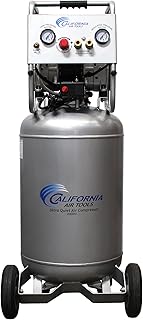
California Air Tools 20020AD
This is the one I’d point a serious hobbyist toward: a 20-gallon tank, oil-free dual-piston pump, and a published 70 dB rating that makes early-morning or late-evening sessions realistic in an attached garage. The automatic drain valve is a small feature with outsized value, since neglected condensate is the quiet killer of both tanks and paint jobs.
VEVOR 13-Gallon Air Compressor
At 4.6 SCFM at 90 PSI and 66 dB, this sits in a useful middle ground — enough sustained air for LVLP guns and spot repairs, quiet enough to run without annoying the household, and mobile on its own wheels. Expect to work in stages rather than shooting an entire vehicle in one uninterrupted session.
California Air Tools CAT-4610AC
The 4.6-gallon aluminum twin tank is built for portability and trim work, and its oil-free, low-noise pump is a pleasure to have in a small space. For automotive painting, though, treat it as a touch-up and detail tool: the tank simply lacks the reserve for continuous panel coverage.
8 Gallon Ultra Quiet Air Compressor
A 4.52 CFM rating and 70 dB operation make this a reasonable entry point for bumpers, mirrors, and small refinish jobs where a full-size unit is overkill. Pair it with a low-consumption gun and a proper dryer, and it punches above its footprint.
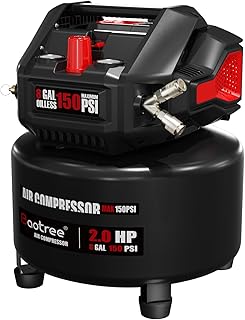
Baotree 8 Gallon Portable Air Compressor
The 150 PSI ceiling gives a bit of extra stored energy, but 2.8 SCFM at 90 PSI is the honest number, and it’s the one that limits you to smaller repairs and nailing work. Good value as a general garage compressor; not the machine for a color-and-clear job.
Frequently Asked Questions
Can I paint a whole car with an 8-gallon compressor?
Realistically, no — not in one continuous session. You can complete a vehicle panel by panel with rest intervals, but pressure sag between refills risks visible banding. A 20-gallon or larger tank with matched CFM is the safer path.
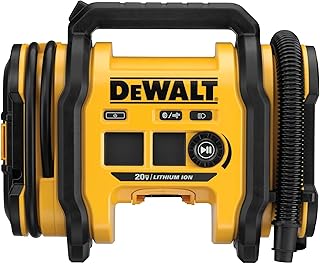
Is the DEWALT DCC020IB useful for painting?
Not for spraying. It’s a cordless tire inflator with automatic shut-off and an LED light — excellent for topping off tires before a road trip, but it has no tank reserve or sustained CFM for a spray gun.
Do I need an oil-free compressor for automotive paint?
Oil-free pumps remove one contamination risk, but oil-lubricated units paint beautifully with correct filtration. Either way, a coalescing filter and desiccant dryer are non-negotiable.
How quiet is quiet enough near a bedroom?
Sustained noise below about 70 dB, behind a closed garage door, generally won’t reach levels that fragment sleep in an adjacent room. Standard 90 dB compressors almost certainly will — avoid running them during sleeping hours regardless of the model.
Final Thoughts
For genuine automotive refinishing with the fewest compromises, the California Air Tools 20020AD is the clear recommendation: adequate reserve, honest output, and a noise profile that respects the rest of the house. If your projects are smaller or space is tight, the VEVOR 13-Gallon offers the best balance of air delivery and quiet portability, while the California Air Tools CAT-4610AC remains a fine companion for touch-ups and trim.