Key takeaways
- CFM at 90 PSI, not peak HP: Match the compressor’s rated delivery to your gun’s continuous draw with 30–40% headroom. Most HVLP guns want 9–13 CFM; LVLP guns often run happily on 3–5 CFM, which is why gun choice and compressor choice must be made together.
- Tank volume as a buffer: Gallons don’t create air, they smooth demand. A 4.6-gallon twin stack suits touch-up and small parts; 13 to 30 gallons keeps duty cycles reasonable across a fender or hood without constant recovery pauses.
- Noise rating in dBA: Anything in the 60–70 dBA range is conversation-level and won’t carry through a wall or ceiling. Above 85 dBA you’re into ear-protection territory and, if anyone is sleeping nearby, into genuine disruption — sound at that level fragments sleep even when the sleeper doesn’t fully wake.
- Moisture management: Compressed air condenses water, and water in the line means fisheyes. Look for a tank drain you’ll actually use, an integrated regulator with a trap, and plan on adding a desiccant dryer at the gun for clearcoat.
- Oil-free versus lubricated: Oil-free heads eliminate the risk of oil carryover contaminating your finish and need almost no upkeep, though they generally have shorter service lives than oil-splash pumps under heavy daily use.
What's inside
Automotive paint is unforgiving. A panel can be prepped perfectly, the color can be mixed to spec, and the booth can be spotless — and the finish will still ripple, spit, or blush if the air feeding the gun arrives inconsistently. That’s the trap most first-time buyers fall into: they shop by horsepower stickers and tank gallons, then discover their compressor cycles every twenty seconds mid-pass, dropping pressure at the cap and leaving tiger stripes down a door. The gun didn’t fail. The air supply did.
This guide looks at compressors through the two lenses that actually matter for paintwork: sustained airflow at working pressure, and how livable the machine is in a shared space. That second point gets dismissed too often. Most home refinishing happens in an attached garage on evenings and weekends — frequently under a bedroom — and a 90 dBA cast-iron twin-stack will end a project faster than any technical shortcoming. Below, you’ll find quiet oil-free units, higher-CFM vertical tanks for full-panel work, and compact airbrush setups for graphics and touch-in, with clear guidance on which category fits your gun.
As an Amazon Associate we earn from qualifying purchases.


How to Choose a/an Air Compressor For Automotive Painting (2026)
- CFM at 90 PSI, not peak HP: Match the compressor’s rated delivery to your gun’s continuous draw with 30–40% headroom. Most HVLP guns want 9–13 CFM; LVLP guns often run happily on 3–5 CFM, which is why gun choice and compressor choice must be made together.
- Tank volume as a buffer: Gallons don’t create air, they smooth demand. A 4.6-gallon twin stack suits touch-up and small parts; 13 to 30 gallons keeps duty cycles reasonable across a fender or hood without constant recovery pauses.
- Noise rating in dBA: Anything in the 60–70 dBA range is conversation-level and won’t carry through a wall or ceiling. Above 85 dBA you’re into ear-protection territory and, if anyone is sleeping nearby, into genuine disruption — sound at that level fragments sleep even when the sleeper doesn’t fully wake.
- Moisture management: Compressed air condenses water, and water in the line means fisheyes. Look for a tank drain you’ll actually use, an integrated regulator with a trap, and plan on adding a desiccant dryer at the gun for clearcoat.
- Oil-free versus lubricated: Oil-free heads eliminate the risk of oil carryover contaminating your finish and need almost no upkeep, though they generally have shorter service lives than oil-splash pumps under heavy daily use.
The Best Air Compressor For Automotive Painting (2026)s Reviewed
California Air Tools 8010 PK with LVLP Spray Kit
The smartest entry point here, because it solves the CFM mismatch by pairing an 8-gallon quiet compressor with an LVLP gun sized to it. At 60 dBA it’s genuinely usable at night in an attached garage, and the wheeled steel tank moves easily between bays.
Klutch 29-Gallon Vertical Compressor
With 5.1 CFM at 90 PSI, 175 PSI max, and a 29-gallon reservoir, this is the pick for anyone painting full panels or running a gun alongside air tools. The vertical footprint costs you almost no floor space, and the accessible drain makes moisture control a habit rather than a chore.
California Air Tools CAT-4610AC Twin Tank
An aluminum twin-stack that stays quiet and weighs little enough to carry up a step. It’s best understood as a precision-work compressor — jambs, mirror caps, motorcycle tanks, spot repairs — rather than a whole-car machine.
VEVOR 13-Gallon Quiet Compressor
At 4.6 SCFM and 66 dB, this hits a useful middle ground: enough sustained air for LVLP panel work, quiet enough not to dominate the space, and a thickened steel body that feels more substantial than the price suggests. The wheels make it a practical shared-duty shop unit.
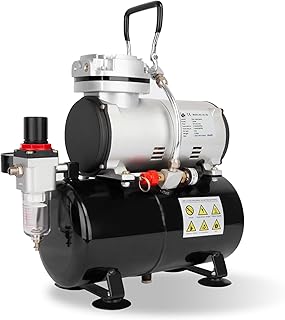
Timbertech ABPST08 Airbrush Compressor
For pinstriping, custom graphics, and blending small repairs, a full-size compressor is overkill. The 3L tank, built-in regulator, moisture trap, and cooling fan give you steady low-pressure air for long detail sessions without heat soak — and it’s quiet enough to run indoors.
Frequently Asked Questions
How much CFM do I really need to spray a car?
Check your gun’s spec sheet first. Conventional HVLP guns commonly need 9–13 CFM at 90 PSI sustained; LVLP guns can drop that to 3–5 CFM, which brings quiet 8–13 gallon compressors into play.
Can I paint a whole car with a small quiet compressor?
With an LVLP gun and patience, yes — but you’ll work in sections and wait on recovery. If you’re spraying clear over a full vehicle, a larger tank like the Klutch 29-gallon is worth the extra footprint.
Is a compressor quiet enough to use at night?
Units in the 60–66 dBA range sit around normal speech volume and generally won’t wake someone through a wall or floor. Bear in mind that a compressor kicking on intermittently is more disruptive to sleep than steady noise, so shorter duty cycles help as much as low dBA.
Do I still need an air dryer?
Yes. Tank traps catch bulk water only; add an inline desiccant filter close to the gun and drain the tank after every session, especially in humid weather.
Final Thoughts
For most home refinishers, the California Air Tools 8010 PK is the sensible starting point — it arrives correctly matched to its gun and stays neighbor-friendly. Step up to the Klutch 29-gallon if you’re painting full vehicles or running air tools alongside, and keep a Timbertech ABPST08 on the bench for graphics and fine detail work.