Key takeaways
- Measure your clearance, not your room: Leave 36 inches between the table edge and any wall or cabinet — 42 if someone walks behind seated diners. An oval’s tapered ends often buy you six to eight inches of walking room a rectangle wouldn’t.
- Choose your base by leg position: A single strip or pedestal base gives every chair unobstructed knee room and lets you squeeze in one extra guest. Four chunky corner legs are more rock-solid but fix your seating plan permanently.
- Interrogate the extension mechanism: Butterfly and removable-leaf systems differ enormously in effort. If you’ll extend it weekly, test for smooth glides and a supported center seam; if it’s twice a year, removable leaves with storage are simpler and cheaper.
- Match the finish to your evening habits: Warm walnut and honey oak tones read as low-arousal and cosy under dim, low-colour-temperature lighting — the kind of light you want after sunset. High-gloss black is striking but reflects overhead bulbs straight into your eyes.
- Weigh top thickness and material honestly: Solid hardwood tops resist dents and can be sanded back after years of use; engineered wood with a thickened edge profile delivers the same visual heft for less money but won’t survive standing water.
What's inside
Most people shopping for a dining table think about square footage and finish samples. As someone who spends their working hours studying evening routines and their effect on sleep quality, I’d ask you to consider something else first: the last two hours before bed are the ones that decide how you sleep, and for most households those hours happen at the dining table. A cramped, awkward table pushes families toward eating standing up at the counter, or worse, in front of a screen with a plate balanced on the knees. Round-cornered oval tables solve a genuinely physical problem — no sharp corners to navigate in a narrow room, no traffic-flow bottleneck, and a shape that lets four people face each other rather than sitting in a row. That conversational geometry is exactly what winds the nervous system down after a stimulating day.
This guide looks at the oval dining tables worth buying in 2026, judged on the criteria that actually matter for daily use: seating capacity versus real footprint, base stability, surface durability under nightly wiping, extension mechanisms that don’t sag, and whether the piece encourages people to linger at it. I’ve included extendable models for small apartments, solid-wood farmhouse builds for larger rooms, and pedestal-style mid-century designs for anyone who hates knocking their knees on a table leg.
As an Amazon Associate we earn from qualifying purchases.


How to Choose an Oval Dining Table (2026)
- Measure your clearance, not your room: Leave 36 inches between the table edge and any wall or cabinet — 42 if someone walks behind seated diners. An oval’s tapered ends often buy you six to eight inches of walking room a rectangle wouldn’t.
- Choose your base by leg position: A single strip or pedestal base gives every chair unobstructed knee room and lets you squeeze in one extra guest. Four chunky corner legs are more rock-solid but fix your seating plan permanently.
- Interrogate the extension mechanism: Butterfly and removable-leaf systems differ enormously in effort. If you’ll extend it weekly, test for smooth glides and a supported center seam; if it’s twice a year, removable leaves with storage are simpler and cheaper.
- Match the finish to your evening habits: Warm walnut and honey oak tones read as low-arousal and cosy under dim, low-colour-temperature lighting — the kind of light you want after sunset. High-gloss black is striking but reflects overhead bulbs straight into your eyes.
- Weigh top thickness and material honestly: Solid hardwood tops resist dents and can be sanded back after years of use; engineered wood with a thickened edge profile delivers the same visual heft for less money but won’t survive standing water.
The Best Oval Dining Tables of 2026, Reviewed
41–78″ Extendable Dining Table with Storage Shelf, Walnut
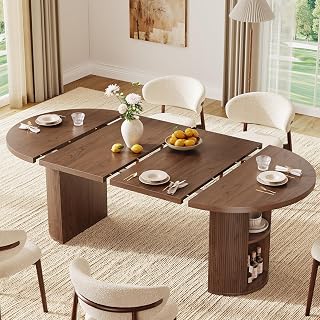
The most adaptable table here: it compresses to a two-person breakfast footprint and opens to seat eight, with a fluted pedestal base that keeps chair placement flexible at every length. The lower storage shelf is genuinely useful for keeping placemats and candles within reach, which makes setting an unhurried evening table a ten-second job rather than a chore you skip.
43″–59″ Extendable Oval Dining Table, Black
Purpose-built for small spaces, this one starts as a compact round and stretches into a true oval via removable leaves, all on a heavy-duty base that doesn’t wobble when extended. Choose it if your dining area doubles as a workspace and you need the table to shrink back out of the way most days.
Solid Wood 63″ Rustic Farmhouse Oval Table, Honey Oak
A reinforced beam and chunky legs make this the most structurally serious table in the roundup, and solid honey oak will look better in a decade than it does on delivery day. It’s the right pick for a household that eats together nightly and wants a surface that tolerates homework, board games, and hot dishes without ceremony.
T4TREAM 63″ Fluted Oval Dining Table, Walnut
The fluted strip pedestal and thickened edge give this table a designer profile at a mid-range price, seating four to six with total knee freedom. Its warm walnut tone is particularly forgiving under dimmed pendant lighting — a small detail that makes a real difference to how relaxed a room feels after dark.
70.8″ Oval Dining Table with Wood Strip Base, Walnut
The largest fixed-size option, and the one I’d recommend for open-plan rooms where the table anchors the space. Nearly six feet of surface comfortably hosts six, with a modern farmhouse silhouette that avoids looking bulky thanks to the slatted base.
Frequently Asked Questions
How many people can an oval table really seat?
Allow 24 inches of edge per person. A 63-inch oval seats four generously or six when the base is a central pedestal; a 70-inch model handles six comfortably and eight for a squeeze at holidays.
Is an oval table better than a rectangle for small rooms?
Usually yes. The curved ends remove the corners that catch hips and chair backs, improving circulation in rooms under about 11 feet wide without sacrificing usable surface area.
Do extendable tables feel less stable?
Well-engineered ones don’t. Look for a supported center seam, a heavy or wide-footprint base, and leaves that lock rather than merely rest — and always check the extended-length stability, not the closed length.
Does where I eat dinner actually affect my sleep?
Indirectly but meaningfully. Eating at a table rather than a screen slows the meal, supports better digestion before bed, and creates a clear transitional ritual between the working day and evening wind-down — all of which help sleep onset.
Final Thoughts
If you want maximum flexibility from a small room, the 41–78″ extendable walnut table with its storage shelf is the smartest buy of 2026. For a table built to be inherited, the 63″ solid honey oak farmhouse model is unmatched at its price, while the T4TREAM 63″ fluted oval offers the best balance of contemporary design, knee room, and value for a family of four to six.