Key takeaways
- Match SCFM to your loudest tool, not your smallest: A brad nailer sips air; a framing or roofing nailer gulps it. Check the SCFM rating at 90 PSI on your tool’s spec sheet and buy a compressor that exceeds it by roughly 30%, or the motor will run almost continuously — which is where the noise problem starts.
- Treat decibels as a real specification: Anything in the 78–82 dB range is conversational-shout territory and carries through drywall. Sub-72 dB models are genuinely different to live with. If you build in a garage attached to bedrooms, this single number will matter more than tank size.
- Size the tank for your work rhythm: Six gallons is the sweet spot for furniture and trim: enough reserve to fire dozens of fasteners between motor cycles, small enough to refill fast. One-gallon tanks are for upholstery and pin work where you want portability above all.
- Oil-free means less ritual, more decibels: Oil-free pumps skip the maintenance schedule entirely and tolerate cold garages, but they’re typically louder than oil-lubricated designs. For occasional weekend furniture work, the trade is usually worth it.
- Plan for vibration, not just volume: Rubber feet, an anti-vibration mat, or a scrap of dense carpet under the tank kills the low-frequency thrum that travels through joists. Low frequencies are exactly what wake people up, and they’re the part no decibel rating on the box captures.
What's inside
Anyone who has run a framing nailer at 7 a.m. in a quiet neighborhood knows the real cost of a badly chosen compressor: not the price tag, but the shattered morning. I spend most of my working life on sleep environments — mattress selection, blackout layers, the acoustics of a bedroom wall — and the single most common complaint I hear from renovators isn’t dust or delays. It’s that the tool that upholstered the headboard also woke the baby, three rooms away. Pneumatic tools are wonderful for furniture work: brad nailers for trim, staplers for webbing and upholstery, pin nailers for delicate face frames. The compressor feeding them is the loud, vibrating, often overlooked half of the equation.
This guide approaches air compressors the way I’d approach a bedroom retrofit — asking how much noise reaches the sleeping human, how much vibration transfers through a shared floor, and whether the machine can do its job in short, controlled bursts rather than a long grinding cycle. Below you’ll find the models I’d recommend for home furniture builds and light jobsite work in 2026, sorted by the tools they actually keep fed, plus the specifications that matter and the ones that are mostly marketing.
As an Amazon Associate we earn from qualifying purchases.



How to Choose a/an Air Compressor For Pneumatic Tools (2026)
- Match SCFM to your loudest tool, not your smallest: A brad nailer sips air; a framing or roofing nailer gulps it. Check the SCFM rating at 90 PSI on your tool’s spec sheet and buy a compressor that exceeds it by roughly 30%, or the motor will run almost continuously — which is where the noise problem starts.
- Treat decibels as a real specification: Anything in the 78–82 dB range is conversational-shout territory and carries through drywall. Sub-72 dB models are genuinely different to live with. If you build in a garage attached to bedrooms, this single number will matter more than tank size.
- Size the tank for your work rhythm: Six gallons is the sweet spot for furniture and trim: enough reserve to fire dozens of fasteners between motor cycles, small enough to refill fast. One-gallon tanks are for upholstery and pin work where you want portability above all.
- Oil-free means less ritual, more decibels: Oil-free pumps skip the maintenance schedule entirely and tolerate cold garages, but they’re typically louder than oil-lubricated designs. For occasional weekend furniture work, the trade is usually worth it.
- Plan for vibration, not just volume: Rubber feet, an anti-vibration mat, or a scrap of dense carpet under the tank kills the low-frequency thrum that travels through joists. Low frequencies are exactly what wake people up, and they’re the part no decibel rating on the box captures.
The Best Air Compressor For Pneumatic Tools (2026)s Reviewed
DEWALT DWFP55126 Pancake, 6 Gallon
The default recommendation for good reason: 165 max PSI and 2.6 SCFM at 90 PSI handle brad nailers, staplers, and trim guns without breaking a sweat, and the high-efficiency motor starts reliably in a cold garage. At roughly 75–78 dB it isn’t whisper-quiet, but the fast recovery means shorter run times overall.
Metabo HPT EC914S Pancake, 6 Gallon
With 200 PSI storage and 4 CFM of flow, this is the one I’d choose if you’re running two nailers simultaneously — a second pair of hands on a bed frame or deck. The extra pressure headroom translates to noticeably fewer motor cycles per hour, which is the quietest kind of quiet.
BOSTITCH BTFP02012-WPK Kit
Rated around 78.5 dB and weighing about 29 pounds, this is the friendliest option for shared-wall workshops and apartment builds. The included hose and accessory kit also means you’re not making a second trip for fittings.
SENCO PC1010 1-Gallon
At 20 pounds and roughly 68–73 dB, the PC1010 is the compressor I actually recommend to furniture hobbyists working indoors. It won’t feed a framing nailer, but for upholstery staplers, pin nailers, and headboard assembly it’s quiet enough to run while someone naps upstairs.
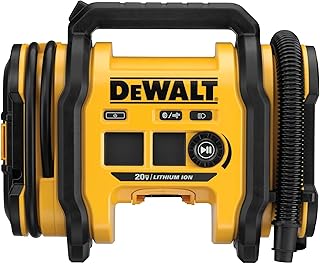
DEWALT DCC020IB 20V MAX Inflator
Not a tool-driving compressor — it’s a cordless inflator with automatic shut-off and an LED light, ideal for air mattresses, guest beds, and pneumatic furniture casters. Worth owning alongside a pancake unit rather than instead of one.
Frequently Asked Questions
Can I use one of these to inflate an air mattress?
A pancake compressor delivers high pressure at low volume — the opposite of what a mattress bladder wants, and you risk overinflating it. Use the DEWALT DCC020IB or a dedicated bed pump instead.
How quiet is quiet enough to work near a sleeping child?
Sustained noise above roughly 45 dB at the sleeper’s ear disrupts sleep architecture. Given typical wall attenuation, a 70 dB compressor two rooms away is usually tolerable; a 80 dB one directly below a bedroom is not.
Do I need 200 PSI?
Not for pressure — most tools cap at 120 PSI. Higher storage pressure simply means more usable air per tank fill, so the motor cycles less often.
Where does a scroll compressor like the Goodman ZR25K5EPFV800 fit in?
It doesn’t. That’s an HVAC refrigerant compressor for air conditioning systems, not a source of compressed air for pneumatic tools — worth flagging, since the listings sometimes appear side by side.
Final Thoughts
For most furniture builders, the DEWALT DWFP55126 is the balanced choice: capable, durable, and quick to recover. If you’re working indoors or near sleeping spaces, the SENCO PC1010 is the one I’d put in the room with you, and the Metabo HPT EC914S earns its place when two nailers are running and you need airflow to spare.