Key takeaways
- Noise level: Anything at or under roughly 60 dBA sits in conversation territory and stays workable in a shared home; standard pancake units run 78–90 dBA, which is loud enough to require hearing protection and to carry through walls. Treat the dBA rating as a spec, not a footnote.
- SCFM at 90 PSI: This is the honest measure of capability. Brad nailers and pin nailers sip air; framing nailers, HVLP spray guns, and sanders drink it. Match SCFM to your thirstiest tool with headroom to spare, or the motor will run nearly continuously.
- Tank size and duty cycle: A 1-gallon tank is fine for trim and upholstery tacking. Four to eight gallons lets the motor rest between cycles — quieter overall, cooler running, and far less fatiguing across a long glue-up or finishing session.
- Oil-free versus oil-lubricated: Oil-free pumps need no maintenance and won’t mist oil onto raw wood or finish coats, which matters enormously for furniture. Oil-lubricated pumps run quieter and last longer but demand upkeep and level placement.
- Portability and tank material: Aluminum tanks resist rust and cut weight; wheels and a real handle decide whether the unit actually gets moved or lives permanently in one corner. Weigh the spec sheet against the stairs in your house.
What's inside
Most people shopping for an air compressor are thinking about PSI, tank size, and how fast they can drive a brad nail. As someone who spends most of my working life studying sleep environments, I’d ask you to think about one more number first: decibels. A compressor that shrieks at 90 dBA doesn’t just make your ears ring — it rules out an entire category of work. You can’t glue up a headboard at 9 p.m. with a toddler asleep down the hall, you can’t finish a bookshelf in a garage attached to a bedroom wall, and you can’t work in a duplex without a neighbor learning your name for the wrong reasons. Noise, in practice, is what determines when you get to build furniture, which usually determines whether you build it at all.
This guide looks at air tool compressors through that lens: quiet enough for indoor and evening work, capable enough for real furniture projects, and portable enough to move between a shop, a spare room, and a driveway. I’ve compared the ultra-quiet oil-free models that dominate this category against the traditional pancake workhorses that still make sense for framing, roofing, and daytime jobsites — plus one cordless inflator that isn’t for tools at all but earns its spot in the trunk. Below you’ll find how to choose, individual reviews, and answers to the questions I get most.
As an Amazon Associate we earn from qualifying purchases.



How to Choose a Air Tool Compressor (2026)
- Noise level: Anything at or under roughly 60 dBA sits in conversation territory and stays workable in a shared home; standard pancake units run 78–90 dBA, which is loud enough to require hearing protection and to carry through walls. Treat the dBA rating as a spec, not a footnote.
- SCFM at 90 PSI: This is the honest measure of capability. Brad nailers and pin nailers sip air; framing nailers, HVLP spray guns, and sanders drink it. Match SCFM to your thirstiest tool with headroom to spare, or the motor will run nearly continuously.
- Tank size and duty cycle: A 1-gallon tank is fine for trim and upholstery tacking. Four to eight gallons lets the motor rest between cycles — quieter overall, cooler running, and far less fatiguing across a long glue-up or finishing session.
- Oil-free versus oil-lubricated: Oil-free pumps need no maintenance and won’t mist oil onto raw wood or finish coats, which matters enormously for furniture. Oil-lubricated pumps run quieter and last longer but demand upkeep and level placement.
- Portability and tank material: Aluminum tanks resist rust and cut weight; wheels and a real handle decide whether the unit actually gets moved or lives permanently in one corner. Weigh the spec sheet against the stairs in your house.
The Best Air Tool Compressor (2026)s Reviewed
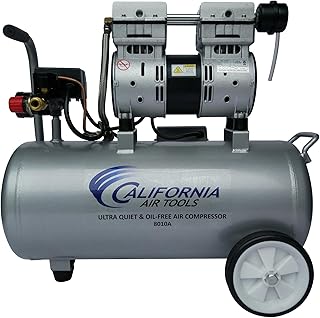
California Air Tools 8010A
At 60 dBA with an 8-gallon aluminum tank and a 1.0 HP oil-free pump, this is the compressor I’d point most furniture makers toward: the large tank means long stretches of silence between motor cycles, and the wheels make it genuinely movable. It’s the closest thing here to a shop compressor you can run indoors without wrecking the household.
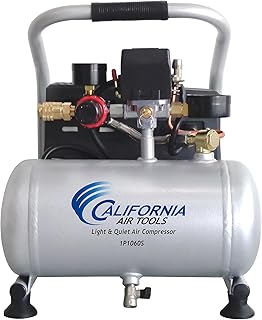
California Air Tools CAT-1P1060S
The quietest unit in the roundup at 56 dBA, and small enough to carry with one hand — ideal for upholstery staplers, pin nailers, and finish work in a spare bedroom or apartment. The 1-gallon tank means frequent cycling, so treat it as a precision tool rather than a production machine.
California Air Tools CAT-4610AC
The twin aluminum tanks split the difference beautifully: 4.6 gallons of capacity, ultra-quiet oil-free operation, and a footprint that still fits under a bench. This is my pick for anyone who wants quiet performance but doesn’t have room for the 8-gallon.
DEWALT Pancake Compressor (DWFP55126)
A 6-gallon, 165 max PSI pancake that delivers 2.6 SCFM at 90 PSI — more raw capability than the quiet models, and the right answer for roofing, framing, or anything where noise isn’t a constraint. Plan on hearing protection and daytime hours only.
BOSTITCH BTFP02012-WPK
A well-priced 6-gallon, 150 PSI kit that arrives with hose and accessories, so you’re working the day it lands. Quieter than most pancakes in its class without pretending to be an ultra-quiet unit.
Frequently Asked Questions
Can I really use an air compressor indoors at night?
With a 56–60 dBA model, yes, within reason. That’s roughly the volume of a dishwasher or normal speech — audible but not disruptive through a closed door. Set it on a rubber mat to kill vibration transfer through the floor, which is what actually wakes people.
How much difference is there between 60 dBA and 80 dBA?
Far more than the numbers suggest. Decibels are logarithmic, so 80 dBA is perceived as roughly four times as loud as 60 dBA and sits near the threshold where sustained exposure risks hearing damage.
Is the DEWALT DCC020IB an air tool compressor?
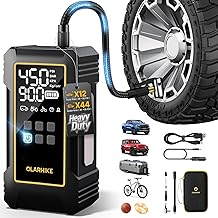
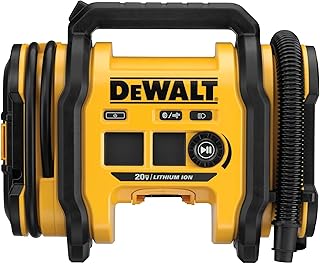
No — it’s a 20V MAX cordless tire inflator with automatic shut-off and an LED light. It won’t run nailers, but it’s excellent for vehicles, bike tires, and inflatables, and it’s genuinely convenient to keep charged in the car.
What tools can a 1-gallon compressor actually run?
Brad nailers, pin nailers, upholstery staplers, and blow-off nozzles work fine. Framing nailers, spray guns, and air sanders will outrun it almost immediately.
Final Thoughts
If you build furniture in or near living space, the California Air Tools 8010A is the strongest all-around choice — quiet, large-tanked, and rust-resistant, with enough capacity for real finishing work. Tight on room, step down to the CAT-4610AC, which keeps the low noise floor in a much smaller package. And if your work is loud by nature and happens in daylight, the DEWALT DWFP55126 gives you more air per dollar than anything else here.