Key takeaways
- Bulb shielding and glare path: Lying down changes your sight line entirely. Fixtures with upward-facing sockets, frosted shades, or crystal that diffuses rather than exposes the filament will keep bare bulbs out of your field of view from the mattress — the single biggest comfort variable in a bedroom.
- Dimmability, verified twice: Confirm both that the fixture is dimmer-compatible and that your wall switch is rated for LED loads. A smooth taper down to roughly 10 percent output lets you drop the room to a low, warm glow while you wind down instead of choosing between full brightness and darkness.
- Color temperature you control: Most chandeliers ship without bulbs, which is an advantage. Choose 2200K–2700K for evening use; anything at 4000K or above belongs in a kitchen. Blue-heavy light in the evening is the wavelength range most associated with delayed melatonin onset.
- Ceiling height and clearance: Standard guidance is at least seven feet of clearance beneath the fixture, measured from the floor. On an eight-foot ceiling, that effectively caps you at a flush-mount or a semi-flush design under about 14 inches tall. Reserve tall candle-style pendants for nine-foot ceilings or for placement away from walking paths.
- Maintenance realism: Crystal collects dust, and dust cuts output while making a fixture look tired. Fewer, larger crystal elements clean in minutes; dense strands of small beads take an afternoon. Factor in how often you’ll genuinely want to do it.
Most people shop for a bedroom chandelier the same way they shop for a dining room fixture: they pick the one that photographs best. Then they install it, flip the switch at 10 p.m., and discover that a ceiling full of bright, unshielded bulbs is the fastest way to tell your brain that the day isn’t over yet. Light in the hour before bed does real physiological work — it influences melatonin timing, sleep latency, and how consolidated your sleep feels by morning. A fixture that ignores that is decor first and bedroom furniture second.
This guide approaches the category from a sleep-wellness perspective rather than a purely aesthetic one. Below you’ll find the criteria that actually matter in a sleeping space — bulb shielding, color temperature compatibility, dimming behavior, glare geometry, and ceiling clearance — followed by reviews of the six fixtures worth considering in 2026, from compact flush-mount crystal designs for standard eight-foot ceilings to statement pendants for larger primary suites.
Our top picks


As an Amazon Associate we earn from qualifying purchases at no extra cost to you. Ratings are shown as listed on Amazon.
🛒 Best Price Today on Amazon
Prime members get fast, free shipping on everything above, plus member-only deals. New members get a 30-day free trial — cancel anytime.
How to Choose a Bedroom Chandelier (2026)
- Bulb shielding and glare path: Lying down changes your sight line entirely. Fixtures with upward-facing sockets, frosted shades, or crystal that diffuses rather than exposes the filament will keep bare bulbs out of your field of view from the mattress — the single biggest comfort variable in a bedroom.
- Dimmability, verified twice: Confirm both that the fixture is dimmer-compatible and that your wall switch is rated for LED loads. A smooth taper down to roughly 10 percent output lets you drop the room to a low, warm glow while you wind down instead of choosing between full brightness and darkness.
- Color temperature you control: Most chandeliers ship without bulbs, which is an advantage. Choose 2200K–2700K for evening use; anything at 4000K or above belongs in a kitchen. Blue-heavy light in the evening is the wavelength range most associated with delayed melatonin onset.
- Ceiling height and clearance: Standard guidance is at least seven feet of clearance beneath the fixture, measured from the floor. On an eight-foot ceiling, that effectively caps you at a flush-mount or a semi-flush design under about 14 inches tall. Reserve tall candle-style pendants for nine-foot ceilings or for placement away from walking paths.
- Maintenance realism: Crystal collects dust, and dust cuts output while making a fixture look tired. Fewer, larger crystal elements clean in minutes; dense strands of small beads take an afternoon. Factor in how often you’ll genuinely want to do it.
The Best Bedroom Chandelier (2026)s Reviewed
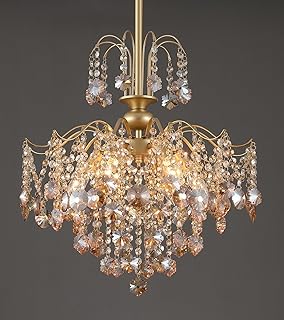
Q&S Modern Gold Amber Crystal Chandelier
The amber crystal is the sleep-relevant detail here — tinted glass warms the transmitted light and softens the hard sparkle that clear crystal throws across a dark ceiling. UL listing and six lights give you real flexibility: run two or three bulbs in the evening and the full set when you’re getting dressed.
WUZUPS Crystal Flush Mount Ceiling Light
At 13.4 inches tall and 12.6 inches wide, this is the answer for eight-foot ceilings where a hanging fixture would loom over the bed. The single E26 socket sits inside the crystal body, so the light arrives diffused rather than direct — pair it with a 2700K dimmable LED and it becomes a genuinely restful overhead.
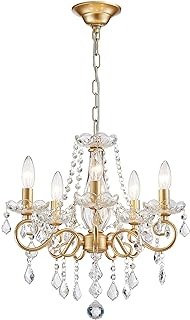
Saint Mossi 5-Light K9 Crystal Chandelier
Saint Mossi’s K9 crystal has better clarity and refraction than the acrylic substitutes at this price, which matters because higher-quality crystal scatters light more evenly instead of producing hot spots. It’s the most polished-looking option of the group and reads as intentional design rather than an add-on.
WUZUPS 5-Light Candle Chandelier in Rustic White
The rustic white finish and candle silhouette suit farmhouse and transitional bedrooms, and the E12 candelabra base naturally caps wattage — a built-in guard against over-lighting a room meant for rest. At 23.2 inches tall, plan on a nine-foot ceiling or an off-center placement.
KAISITE Modern Gold 5-Light Chandelier
Crystal-free and industrial-leaning, this is the pick if you find sparkle distracting at the end of the day or simply want less to dust. The exposed sockets do mean you should choose frosted or opal bulbs rather than clear ones to control glare from bed.
Frequently Asked Questions
Is a chandelier over the bed a good idea?
It can be, provided the bulbs aren’t visible from a reclined position and the fixture clears the mattress by a comfortable margin. If you’re at all unsure about your ceiling anchor or joist support, mount it centered in the room instead of directly above the headboard.
What bulbs should I use in a bedroom chandelier?
Dimmable LEDs at 2200K–2700K, frosted rather than clear, and modest in output — roughly 300 to 450 lumens each across five or six sockets is plenty for a bedroom. Higher CRI bulbs (90 or above) render skin tones and textiles far more accurately.
Do I need an electrician to install one?
If you’re replacing an existing fixture on a box already rated for the weight, most people manage it themselves. Heavier crystal chandeliers often require a fan-rated or braced box, and that upgrade is worth a professional’s hour.
How big should the fixture be?
Add your room’s length and width in feet; the sum in inches is a reasonable starting diameter. A 12-by-14-foot bedroom lands near 26 inches, though in bedrooms specifically it’s fine to size down for a lighter visual presence.
Final Thoughts
For low ceilings and evening-friendly light, the WUZUPS flush mount is the most sleep-conscious choice in this lineup, with the Q&S amber crystal fixture close behind for its inherently warmer output. If your ceiling has the height and you want a design-forward centerpiece, the Saint Mossi K9 crystal chandelier delivers the best-quality light of the group — just put it on a dimmer and give it warm bulbs.