Key takeaways
- Rip capacity over raw power: Nearly every home saw runs a 15-amp motor, so the real differentiator is how wide a panel you can rip. Around 24 inches handles most furniture work; 32 inches lets you break a full sheet of plywood down the middle without a track saw.
- Fence quality: A fence that shifts under hand pressure will haunt every joint you cut. Look for rack-and-pinion adjustment that stays parallel to the blade, and test it in person if you can — a repeatable fence saves more time than any extra 500 RPM.
- Dust management: Fine wood dust lingers for hours and travels through door gaps into bedrooms. Prioritize a shrouded blade with a genuine dust port you can pair with a shop vac, and treat the port diameter as a spec that matters.
- Footprint and stowability: If breaking down the saw takes ten minutes, you’ll leave it up, and it will slowly consume the garage. A folding or rolling stand that collapses in under a minute is the single best predictor of whether a home saw actually gets used.
- Safety hardware: Insist on a riving knife, functional blade guard, anti-kickback pawls, and a push stick. Fatigue degrades judgment faster than most people admit — if you’re cutting late, working tired, the guarding is what stands between a slip and a hospital visit.
What's inside
Most home woodworkers don’t run out of ambition — they run out of acceptable hours. The garage saw that felt like a great idea on Saturday morning becomes a source of friction by Sunday night, when a shriek of carbide through plywood cuts through a nursery wall or a neighbor’s bedroom. As someone who spends most of my working life studying how households protect their rest, I’ve come to see the table saw as a sleep-hygiene decision as much as a woodworking one. Noise, dust, vibration, and the sheer time a bad setup steals from your evening all bleed into how well the house recovers overnight.
This guide looks at home-use table saws through that dual lens: cut quality first, then livability. I’ve weighted rip capacity, fence accuracy, and motor strength alongside the practical things that decide whether a saw fits into a shared home — how quickly it folds away, how much airborne dust it throws into a space adjoining living areas, how heavy it is to move alone, and whether it can be paused mid-project without losing your setup. Below are the models worth your money in 2026, followed by a buying framework and answers to the questions I hear most.
As an Amazon Associate we earn from qualifying purchases.



How to Choose a Table Saw For Home Use (2026)
- Rip capacity over raw power: Nearly every home saw runs a 15-amp motor, so the real differentiator is how wide a panel you can rip. Around 24 inches handles most furniture work; 32 inches lets you break a full sheet of plywood down the middle without a track saw.
- Fence quality: A fence that shifts under hand pressure will haunt every joint you cut. Look for rack-and-pinion adjustment that stays parallel to the blade, and test it in person if you can — a repeatable fence saves more time than any extra 500 RPM.
- Dust management: Fine wood dust lingers for hours and travels through door gaps into bedrooms. Prioritize a shrouded blade with a genuine dust port you can pair with a shop vac, and treat the port diameter as a spec that matters.
- Footprint and stowability: If breaking down the saw takes ten minutes, you’ll leave it up, and it will slowly consume the garage. A folding or rolling stand that collapses in under a minute is the single best predictor of whether a home saw actually gets used.
- Safety hardware: Insist on a riving knife, functional blade guard, anti-kickback pawls, and a push stick. Fatigue degrades judgment faster than most people admit — if you’re cutting late, working tired, the guarding is what stands between a slip and a hospital visit.
The Best Table Saw For Home Use (2026)s Reviewed
DEWALT DWE7491RS 10-Inch with Rolling Stand
This remains the benchmark for serious home shops: 32-1/2 inches of rip capacity, a fence that tracks true across its full travel, and a rolling stand that tilts up and wheels out of the way in seconds. It’s the one saw here that genuinely handles sheet goods, and its dust shroud does a respectable job of keeping fine particulate out of the rest of the house.
SKIL TS6307-00 10-Inch Portable Jobsite Saw
SKIL undercuts the DEWALT on price without gutting the fundamentals, and its folding stand deploys with unusually little fuss. The rack-and-pinion fence is accurate enough for cabinet work, making this my usual recommendation for a first serious saw in a shared garage.
DEWALT DWE7485 8-1/4 in. Compact Saw
The compact DEWALT trades blade diameter for a form factor one person can carry up a step and stow on a shelf. If your projects are trim, small case pieces, and furniture repairs rather than full sheets, its smaller blade also runs noticeably quieter than a 10-inch equivalent.
DOVAMAN DTS10A 10-Inch Table Saw with Stand
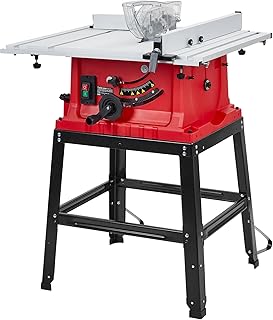
A copper-motor 10-inch saw with a single-side extension and a legitimate 3.35-inch depth of cut at 90 degrees, at a price that reads like a bargain. Expect to spend an hour truing the fence and blade alignment out of the box; do that work and it performs well above its cost.
10-Inch 15A Table Saw with 36 x 25-Inch Tabletop
The generous 36-by-25-inch table gives long boards real support, and the included protective cover is a small thoughtful touch for a saw living in a damp garage. Best suited to occasional weekend work rather than daily production.
Frequently Asked Questions
How loud is a home table saw, really?
Under load, most jobsite saws sit in the 95–105 dB range at the operator’s position — loud enough to require hearing protection and loud enough to carry through interior walls. Plan cuts for daytime hours and treat late-night ripping as off-limits in a shared home.
Is a 10-inch blade necessary, or will 8-1/4 inches do?
An 8-1/4-inch saw cuts most furniture stock comfortably and is lighter and quieter. Choose 10 inches if you regularly cut thick hardwood, deep bevels, or 4x material.
Do I need a dust collector?
A standard shop vac connected to the dust port captures the majority of coarse chips and much of the fine dust. Add a filter rated for fine particulate and work with the garage door open — respiratory irritation is a well-documented sleep disruptor.
Can I use these saws to cut metal or plastic?
Several models advertise multi-material capability, but only with the correct blade and slower feed rate. Never cut metal with a wood blade, and check clearance around the guard for chip ejection.
Final Thoughts
If you have the space and intend to build real furniture, the DEWALT DWE7491RS earns its premium through fence accuracy and sheet-goods capacity. The SKIL TS6307-00 is the value pick for most home shops, and the compact DEWALT DWE7485 is the right answer for small spaces and quieter, tidier work — the saw you’ll actually reach for on a weekday evening without waking the house.