Key takeaways
- Diameter over length: Stick with 3/4″ ID for any run past about thirty feet. Undersized pipe creates pressure drop that forces the compressor to cycle more often, which is precisely the behavior that makes a shop unlivable next to living space. Half-inch line is only appropriate for short drops to a single tool.
- Pressure rating with margin: Look for a documented 200 PSI rating even if your compressor tops out at 135. Headroom protects against thermal spikes and gives the whole system a longer, quieter service life.
- Fitting material and seal design: Aluminum outlet blocks and brass push-to-connect fittings hold their seal far better through temperature swings than plastic-bodied equivalents. This is the single biggest predictor of whether your system stays silent overnight.
- Piece count matched to your layout: Sketch your walls before buying. A 37-piece kit is plenty for a single-bay garage with two drops; a two-bay shop with a workbench, lift, and blast cabinet needs 90-plus pieces and multiple tees.
- Gauges and manifolds: Individual pressure gauges at each outlet sound like overkill until you’re diagnosing a leak. They turn a two-hour soap-bubble hunt into a thirty-second glance.
What's inside
Anyone who has run an air compressor in an attached garage knows the sound signature intimately: the low groan of the motor kicking on, the hiss of a fitting that never quite sealed, and the maddening two-in-the-morning restart when a slow leak bleeds the tank down. As someone who spends most of my working life studying what wrecks human sleep, I can tell you that intermittent, unpredictable noise is far more disruptive than steady noise of the same volume. A leaky, undersized air line doesn’t just waste electricity — it turns your compressor into a random noise generator on the other side of a bedroom wall.
The fix is almost always the piping, not the compressor. A properly sized, genuinely leak-free hard line lets the tank hold pressure overnight, cuts cycle frequency during the day, and delivers full CFM to the far corner of the shop instead of choking it down through fifty feet of coiled rubber. Below, I’ve gathered the compressed air line kits worth your money in 2026, with notes on what actually matters — pressure rating, fitting quality, layout flexibility — and what’s just marketing. Every kit here uses 3/4″ HDPE tubing with aluminum or brass hardware, the combination that has quietly become the standard for home and light-commercial shops.
As an Amazon Associate we earn from qualifying purchases.




How to Choose a Pipe For Air Compressor Lines (2026)
- Diameter over length: Stick with 3/4″ ID for any run past about thirty feet. Undersized pipe creates pressure drop that forces the compressor to cycle more often, which is precisely the behavior that makes a shop unlivable next to living space. Half-inch line is only appropriate for short drops to a single tool.
- Pressure rating with margin: Look for a documented 200 PSI rating even if your compressor tops out at 135. Headroom protects against thermal spikes and gives the whole system a longer, quieter service life.
- Fitting material and seal design: Aluminum outlet blocks and brass push-to-connect fittings hold their seal far better through temperature swings than plastic-bodied equivalents. This is the single biggest predictor of whether your system stays silent overnight.
- Piece count matched to your layout: Sketch your walls before buying. A 37-piece kit is plenty for a single-bay garage with two drops; a two-bay shop with a workbench, lift, and blast cabinet needs 90-plus pieces and multiple tees.
- Gauges and manifolds: Individual pressure gauges at each outlet sound like overkill until you’re diagnosing a leak. They turn a two-hour soap-bubble hunt into a thirty-second glance.
The Best Pipe For Air Compressor Lines (2026)s Reviewed
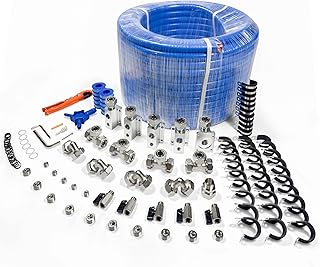
3/4″ x 200ft HDPE Air Piping System, 53 Pieces (9120)
This is the sweet spot for most two-car garages and small shops — enough tubing for a full perimeter loop with room for error, paired with aluminum outlet blocks that seat cleanly and stay seated. The 200 PSI rating and generous fitting count make it the kit I’d recommend to someone piping a shop that shares a wall with a bedroom.
3/4″ x 100ft Pressure Gauge Shop Air Line Kit
The built-in gauge is more than a convenience feature; it gives you an immediate read on whether the system held pressure overnight, which is how you catch a slow leak before it becomes a nightly disturbance. Ideal for a single-bay garage or a focused workbench setup.
3/4″ x 300ft 5-Way Multi-Outlet Manifold Kit (9130G)
The individually gauged five-way manifolds are the standout here, letting you isolate and monitor each branch independently — genuinely useful in a shop running a lift, a sprayer, and hand tools off one compressor. It’s the most kit for the most demanding installation, and overkill for anything under 600 square feet.
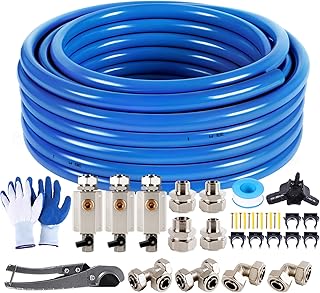
3/4″ x 100ft HDPE Kit with Aluminum Outlet Blocks, 37 Pieces
A clean, no-nonsense starter system for a straightforward one-compressor, two-drop layout. The fittings punch above the price point, though you’ll want to buy a few spare elbows if your walls have more than a couple of corners.
3/4″ x 100ft Shop Air Line Kit, 90 Pieces with Brass Fittings
Ninety pieces including brass rather than aluminum hardware makes this the most adaptable kit for an irregular space with lots of turns, obstructions, and drops. Brass costs a little weight but rewards you with fittings you can disassemble and reuse when your layout inevitably changes.
Frequently Asked Questions
Is HDPE tubing really as good as black iron pipe?
For home and light-commercial pressures, yes — and it’s better in one important respect. HDPE doesn’t corrode, so you won’t be blowing rust flakes into your tools or your paint job. It also cuts and joins with hand tools instead of a pipe threader.
Why does my compressor kick on when nothing is running?
You have a leak, almost certainly at a fitting rather than in the tubing itself. Close the tank valve, note the gauge reading, and check it an hour later; if pressure drops, spray each joint with soapy water and watch for bubbles.
How much tubing should I actually buy?
Measure your intended run and add roughly 25 percent. Corners, drops, and the inevitable rerouting eat length faster than anyone expects, and splicing in a short section later means one more potential leak point.
Will better piping make my compressor quieter?
Indirectly, and meaningfully. Correctly sized pipe reduces pressure drop so the motor runs less often, and a leak-free system stops the overnight restarts entirely. If shop noise is bleeding into your sleep, piping is the cheapest intervention available.
Final Thoughts
For most readers, the 200-foot 53-piece HDPE system (9120) is the right call — it covers a typical garage with margin and its aluminum outlet blocks hold pressure reliably enough to keep the compressor quiet after hours. Step up to the 300-foot 5-way manifold kit (9130G) if you’re running multiple air-hungry tools and want per-branch gauges, or choose the 90-piece brass-fitting kit if your space has awkward geometry and you value fittings you can take apart and reuse.