Key takeaways
- Air delivery, not just max PSI: SCFM or CFM at 90 PSI is the number that determines whether your nailer keeps firing. Roughly 2.6 CFM handles one brad or finish nailer comfortably; 4 CFM lets two framing nailers run together without stalling the crew.
- Noise, measured honestly: Decibels are logarithmic, so a drop from 90 to 79 dB is a very large perceived difference, not a small one. If the compressor lives in a garage under a bedroom, treat quiet operation as a hard requirement rather than a bonus feature.
- Recovery cycle frequency: A compressor that refills quickly spends less total time running, which means fewer noise events per hour. Long, infrequent cycles are far less disruptive to sleep than short bursts every ninety seconds.
- Oil-free pump versus maintenance: Oil-free pumps skip the drain-and-refill routine and tolerate cold garages well. The tradeoff is a shorter service life under daily professional use — acceptable for nearly all homeowners.
- Weight and coupler count: Anything above about 35 pounds becomes a two-hand carry up stairs. Dual quick couplers matter if a second person is working alongside you, or if you want to leave an inflation hose permanently attached.
What's inside
Most compressor guides talk about torque, tank size, and duty cycle. Very few mention the thing homeowners actually complain about six months later: the noise. As someone who spends most of my working life on sleep environments — nursery acoustics, shift-worker bedrooms, the 2 p.m. toddler nap that holds a household together — I can tell you that a 90-decibel motor cycling on the other side of a plaster wall is not a minor inconvenience. It’s a wake-up event. And if you’re renovating the same house you’re sleeping in, that matters as much as PSI.
This guide covers the six-gallon pancake compressors worth owning in 2026, judged on the usual mechanical fundamentals — recovery time, air delivery at 90 PSI, pump longevity — but also on how livable they are inside an occupied home. You’ll find what specs genuinely predict performance, which models run quietly enough for daytime trim work above a sleeping baby, and where a slightly louder machine earns its noise with real capability.
As an Amazon Associate we earn from qualifying purchases.


How to Choose a Pancake Air Compressor (2026)
- Air delivery, not just max PSI: SCFM or CFM at 90 PSI is the number that determines whether your nailer keeps firing. Roughly 2.6 CFM handles one brad or finish nailer comfortably; 4 CFM lets two framing nailers run together without stalling the crew.
- Noise, measured honestly: Decibels are logarithmic, so a drop from 90 to 79 dB is a very large perceived difference, not a small one. If the compressor lives in a garage under a bedroom, treat quiet operation as a hard requirement rather than a bonus feature.
- Recovery cycle frequency: A compressor that refills quickly spends less total time running, which means fewer noise events per hour. Long, infrequent cycles are far less disruptive to sleep than short bursts every ninety seconds.
- Oil-free pump versus maintenance: Oil-free pumps skip the drain-and-refill routine and tolerate cold garages well. The tradeoff is a shorter service life under daily professional use — acceptable for nearly all homeowners.
- Weight and coupler count: Anything above about 35 pounds becomes a two-hand carry up stairs. Dual quick couplers matter if a second person is working alongside you, or if you want to leave an inflation hose permanently attached.
The Best Pancake Air Compressors (2026) Reviewed
BOSTITCH 6 Gallon Oil-Free Pancake Kit (BTFP02012-WPK)
This is the one I recommend to anyone renovating around a napping child or a sleeping night-shift partner: BOSTITCH tuned the motor specifically for lower operating noise, and the difference is genuinely audible through a closed door. The included accessory kit and light weight make it the easiest model here to move room to room without waking the house.
DEWALT 6 Gallon 165 PSI (DWFP55126)
The 165 PSI tank stores meaningfully more usable air than a 150 PSI unit of the same volume, which means fewer motor starts per project and a quieter overall workday. Its high-efficiency motor also starts reliably in cold weather — relevant if your compressor overwinters in an unheated garage.
Metabo HPT 6 Gallon 200 PSI (EC914S)
At 4 CFM and 200 PSI, this is the capability pick, capable of driving multiple framing, siding, or roofing nailers at once without falling behind. It’s the loudest recommendation on this list, so schedule it for waking hours and choose something gentler if you’re working over occupied bedrooms.
PORTER-CABLE 6 Gallon 150 Max PSI
A dependable, no-drama oil-free unit delivering 2.6 CFM at 90 PSI, which is plenty for trim carpentry, upholstery work, and furniture assembly. It’s the sensible budget entry point when your projects are occasional and single-tool.
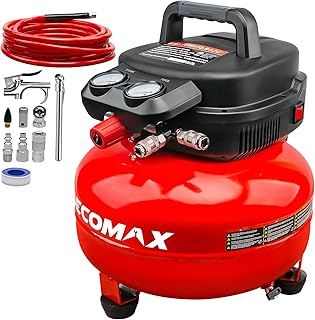
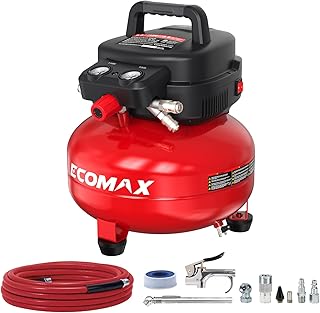
ECOMAX 6 Gallon 175 PSI with Accessory Kit
The 175 PSI tank and 3 CFM output sit usefully between the DEWALT and the Metabo HPT, and the ten-piece kit with dual quick couplers means you can start working the day it arrives. Long-term durability data is thinner than for the legacy brands, so it suits light-to-moderate use best.
Frequently Asked Questions
How loud is a pancake compressor, really?
Most run between roughly 75 and 90 decibels at close range. That upper end is comparable to a garbage disposal or a loud hairdryer, which is more than enough to rouse a light sleeper two rooms away.
Can I run one during a child’s nap?
With a quiet model, thick intervening walls, and a closed door, often yes. Test it once during waking hours and listen from the bedroom before you gamble on it.
Is six gallons enough for furniture and trim work?
Comfortably. Six gallons paired with 2.6 CFM handles brad nailers, staplers, and upholstery guns continuously; you’d only want more for framing or spray finishing.
Does a bigger tank mean less noise?
Indirectly, yes. A larger or higher-pressure tank cycles less often, so you get fewer separate noise events even if peak loudness is unchanged.
Final Thoughts
If your compressor shares a house with sleeping people, buy the BOSTITCH BTFP02012-WPK — the noise reduction is worth more than a few extra PSI. The DEWALT DWFP55126 is the best all-round choice for homeowners who want higher stored pressure and fewer cycles, and the Metabo HPT EC914S is the clear pick if you need to power two nailers at once and can keep the work to daylight hours.