Key takeaways
- Rigidity over raw load rating: A 2,000 lb static capacity means little if the top deflects when you cam over a single-stage press. Look for thick hardwood or rubberwood tops, welded or heavily gusseted steel frames, and bolt-through mounting points rather than thin particleboard with a laminate skin.
- Adjustable height matters more than you think: Standing press work is comfortable around elbow height; seated case prep and powder measuring want a lower surface. A bench that adjusts between roughly 28″ and 39″ lets you match the task instead of forcing your shoulders to compensate — which is exactly what causes the next-day ache that fragments sleep.
- Depth and length for a real workflow: Reloading is a line, not a point. Budget space for press, powder measure, scale, tumbler, and a staging tray. Anything under about 24″ deep forces stacking, and stacked stations lead to spilled powder and constant reaching.
- Integrated power and lighting: Built-in outlets and USB ports keep trickler, tumbler, and task light cords off the floor. Pair the bench with a high-CRI, dimmable lamp rather than a cold overhead fixture — bright blue-heavy light late at night measurably delays sleep onset, and a warm, directional task light reads a scale beam just as well.
- Storage that removes motion: Drawers, bins, and pegboards aren’t cosmetic. Every die, shell holder, and caliper you don’t have to stand up and fetch is one less repetition of the twist-and-reach pattern that fatigues the lower back over a two-hour session.
What's inside
Handloading is a discipline of small margins. A tenth of a grain, a few thousandths of runout, a primer seated just shy of the pocket floor — these are the differences between a load you trust and one you second-guess at 300 yards. Yet most home reloaders build all of that precision on top of a surface that flexes, a stool that’s the wrong height, and a lamp that throws shadows across the powder scale. The result is predictable: hunched shoulders after 40 minutes, a stiff neck the next morning, and sessions that drift later and later into the night because the setup makes everything take longer than it should.
I spend most of my professional life studying how bodies recover — and one of the least-discussed drains on sleep quality is the late-evening hobby bench that quietly demands too much from your spine and eyes. A well-chosen reloading bench is not just about rigidity and load rating; it’s about working at the correct height, keeping tools within reach so you stop twisting, and finishing at a sane hour instead of grinding through a case-prep session under bad ergonomics. Below, I’ve assessed the strongest home-scale reloading benches available for 2026 against three lenses at once: mechanical stability, storage intelligence, and postural comfort over long sittings.
As an Amazon Associate we earn from qualifying purchases.




How to Choose a Workbench For Reloading (2026)
- Rigidity over raw load rating: A 2,000 lb static capacity means little if the top deflects when you cam over a single-stage press. Look for thick hardwood or rubberwood tops, welded or heavily gusseted steel frames, and bolt-through mounting points rather than thin particleboard with a laminate skin.
- Adjustable height matters more than you think: Standing press work is comfortable around elbow height; seated case prep and powder measuring want a lower surface. A bench that adjusts between roughly 28″ and 39″ lets you match the task instead of forcing your shoulders to compensate — which is exactly what causes the next-day ache that fragments sleep.
- Depth and length for a real workflow: Reloading is a line, not a point. Budget space for press, powder measure, scale, tumbler, and a staging tray. Anything under about 24″ deep forces stacking, and stacked stations lead to spilled powder and constant reaching.
- Integrated power and lighting: Built-in outlets and USB ports keep trickler, tumbler, and task light cords off the floor. Pair the bench with a high-CRI, dimmable lamp rather than a cold overhead fixture — bright blue-heavy light late at night measurably delays sleep onset, and a warm, directional task light reads a scale beam just as well.
- Storage that removes motion: Drawers, bins, and pegboards aren’t cosmetic. Every die, shell holder, and caliper you don’t have to stand up and fetch is one less repetition of the twist-and-reach pattern that fatigues the lower back over a two-hour session.
The Best Workbench For Reloading (2026)s Reviewed
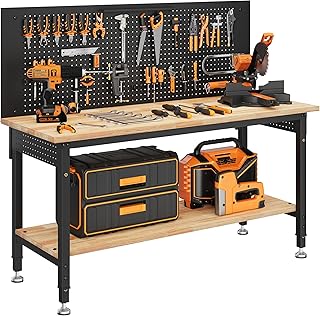
CAMMOO 60″ Work Bench with Storage & Pegboard
This is the most complete single purchase on the list: enough length for a full press-to-storage workflow, a pegboard that puts hand tools at eye level, and an integrated power strip that keeps cabling tidy. If you have the wall space, the 60″ footprint is the sweet spot between capability and room dominance.
CAMMOO 48″ Adjustable Workbench
The 28″–39″ height range is the standout feature here, and it’s the reason I recommend this bench to anyone who alternates between standing press strokes and seated case inspection. Four ETL-listed outlets and two USB ports handle a trickler, tumbler, and lamp without a floor-level extension cord.
OLBRUS 48″ Adjustable Workbench
A dense hardwood top with a protective rubber pad gives this bench a slightly deader, less resonant feel under a press — pleasant on the wrists and quieter in a shared house. Build quality on the steel frame is a step above budget competitors at similar dimensions.
Frankford Arsenal Platinum Series Reloading Stand
The only purpose-built reloading option here, and the right answer for small spaces or renters: an adjustable steel frame, a reinforced wood center for press mounting, and storage bins sized for brass and components. Less general-purpose surface area, but far better ergonomics than clamping a press to a dining table.
47.2″ Heavy Duty Work Bench with Drawer and Storage
A compact, honest starter bench with a wood top, metal frame, and a drawer for dies and shell holders. It’s the sensible entry point if you’re still deciding how deep into handloading you’ll go, and it doubles cleanly as a 3D printer or craft station.
Frequently Asked Questions
What height should a reloading bench be?
For standing press work, aim for a surface roughly at wrist-to-elbow height — commonly 36″–39″ for most adults. For seated precision tasks, drop to 28″–32″. If you do both, an adjustable bench is genuinely worth the premium.
Do I need a 2,000 lb capacity bench?
Not for the weight of your equipment, no. The high rating is a proxy for frame stiffness, which is what actually keeps a press from rocking. Judge the frame geometry and top thickness rather than the headline number.
Is a longer bench like the 120″ model overkill at home?
Only if your wall can’t take it. Extended benches let you keep tumbling, trimming, and loading permanently set up, which eliminates the setup-teardown friction that pushes sessions late. Note that it ships in two boxes and needs two people to assemble.
Why does bench setup affect sleep?
Two mechanisms: musculoskeletal strain from sustained poor posture raises nighttime discomfort and wake-ups, and bright, blue-rich task lighting in the final hours before bed suppresses melatonin. Correct height plus warm, dimmable task light addresses both.
Final Thoughts
For most home reloaders, the CAMMOO 60″ with pegboard is the best all-round buy — length, storage, and power in one unit. If postural comfort is your priority, the CAMMOO 48″ Adjustable earns its keep through the height range alone, while the Frankford Arsenal Platinum Series stand remains the smartest choice for tight or temporary spaces. Whichever you pick, set the height deliberately, light it warmly, and stop the session before fatigue starts making your decisions for you.