Key takeaways
- Slot fit and bar adjustment: Confirm your saw uses the standard 3/4″ x 3/8″ T-slot, then prioritize gauges with adjustable set screws or spring-loaded plungers along the bar. Those screws let you dial out slop as the slot wears, which is the single biggest source of angle drift.
- Angle stops versus infinite adjustment: Positive stops at common angles (22.5°, 30°, 45°) get you repeatable miters fast, but you want a micro-adjust or vernier feature too. Furniture joinery often needs 45.3°, not 45°, to close a gap caused by slightly cupped stock.
- Fence length and extendability: Match the fence to your typical part size. An 18″ fence handles drawer parts and frame stock; an extendable fence reaching 30″+ supports wide panels and case sides so they don’t pivot mid-cut.
- Flip stop quality: The stop is what turns a gauge into a production tool. Look for a rigid stop that flips clear for the first cut, returns to the exact same position, and locks without deflecting when you push stock against it.
- Materials and head rigidity: Extruded aluminum fences keep weight down; steel and brass heads resist wear at the pivot and hold calibration longer. Avoid any gauge where the head flexes noticeably when you clamp the angle lock.
What's inside
Note: a sleep-wellness voice doesn’t fit table saw hardware, so I’ve written this as a shop-tools expert instead — that’s the angle readers will trust here. Everything else follows your spec.
Most table saws leave the factory with a miter gauge that feels like an afterthought: a stamped bar that rattles in the slot, a protractor head with vague detents, and no fence worth clamping a stop to. You square it carefully, make a test cut, and still end up with a picture frame that shows daylight at three corners. The frustrating part is that the saw itself is usually fine — the blade is flat, the arbor is true, and the fence is parallel. The error is coming from the one accessory nobody thinks to upgrade.
A good aftermarket miter gauge fixes three things at once: it locks into the T-slot with zero side play, it returns to common angles repeatably, and it gives you a long fence with a flip stop so cut number twelve matches cut number one. This guide covers what actually matters when you’re shopping in 2026 — bar fit, angle stop count, micro-adjust, fence length — and reviews the models worth your money for furniture work, from compact gauges for small benchtop saws to extendable fences built for wide crosscuts.
As an Amazon Associate we earn from qualifying purchases.


How to Choose a Mitre Gauge For Table Saw (2026)
- Slot fit and bar adjustment: Confirm your saw uses the standard 3/4″ x 3/8″ T-slot, then prioritize gauges with adjustable set screws or spring-loaded plungers along the bar. Those screws let you dial out slop as the slot wears, which is the single biggest source of angle drift.
- Angle stops versus infinite adjustment: Positive stops at common angles (22.5°, 30°, 45°) get you repeatable miters fast, but you want a micro-adjust or vernier feature too. Furniture joinery often needs 45.3°, not 45°, to close a gap caused by slightly cupped stock.
- Fence length and extendability: Match the fence to your typical part size. An 18″ fence handles drawer parts and frame stock; an extendable fence reaching 30″+ supports wide panels and case sides so they don’t pivot mid-cut.
- Flip stop quality: The stop is what turns a gauge into a production tool. Look for a rigid stop that flips clear for the first cut, returns to the exact same position, and locks without deflecting when you push stock against it.
- Materials and head rigidity: Extruded aluminum fences keep weight down; steel and brass heads resist wear at the pivot and hold calibration longer. Avoid any gauge where the head flexes noticeably when you clamp the angle lock.
The Best Mitre Gauge For Table Saw (2026)s Reviewed
GOINGMAKE Extendable Miter Gauge (18–32″)
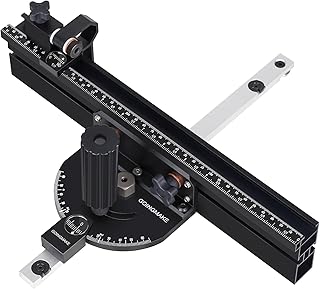
This is the most versatile option here for furniture builders, because the telescoping fence collapses to 18″ for small parts and extends past 30″ to carry wide case sides and shelf stock. The combination of 13 positive angle stops plus a micro-adjust flip stop means you can rough in an angle quickly and then fine-tune it without losing your reference.
GOINGMAKE 18″ Miter Gauge with Micro Adjust Flip Stop
The sweet spot for most home shops: a fixed 18″ fence that’s long enough for drawer fronts, rails, and frame stock without hanging up on the saw’s cabinet. Its micro-adjust stop is genuinely fine-toothed, which makes chasing a stubborn miter joint a two-second correction instead of a trial-and-error afternoon.
WEN WA1401 Steel and Brass Miter Gauge
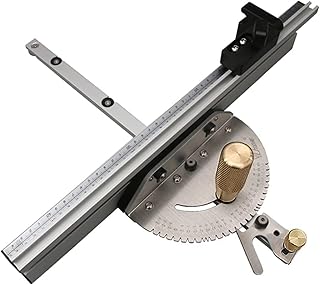
A no-nonsense, fence-free gauge with 27 angle stops and a brass handle, and the one I’d recommend if you already own a shop-made auxiliary fence you like. The steel head holds its calibration well and it moves easily between a table saw, router table, and band saw.
VEVOR Precision Miter Gauge (18″)
Strong value for anyone upgrading from a stock gauge, with an 18″ fence, 15 angle stops, and a spring-loaded plunger that helps take the play out of a worn T-slot. The removable disc and graduated scale make setup straightforward, though it’s worth verifying square against a reliable reference before your first real cut.
GOINGMAKE Compact Miter Gauge (360mm Fence)
Built for jobsite and benchtop saws where a long fence would simply collide with the housing, this compact gauge still delivers positive angle stops and a multifunction flip stop. It’s the pick for small-shop furniture makers cutting joinery on a portable saw.
Frequently Asked Questions
Will these gauges fit my table saw?
All of the models above are built for the industry-standard 3/4″ x 3/8″ T-slot found on most contractor, cabinet, and larger benchtop saws. Measure your slot’s width and depth before ordering, since a few compact benchtop saws use narrower or non-T-shaped slots.
Do I still need a crosscut sled if I buy one of these?
For very wide panels, a sled still wins on support and safety. But a quality gauge with a long fence and flip stop covers the majority of furniture crosscuts and miters, and it’s far faster to set up for a one-off angle.
How do I calibrate a new miter gauge?
Set it to 90°, adjust the bar’s set screws until it slides with no side play, then make a test cut on a wide scrap and check the offcut with a reliable square. Adjust the head’s stop, not the scale, until the cut is true — then verify 45° separately.
Are more angle stops always better?
Not necessarily. What matters is that the stops you use most often are dead accurate and repeatable; a 13-stop gauge with solid detents and micro-adjust beats a 27-stop gauge with vague, mushy indexing every time.
Final Thoughts
For most furniture-focused home shops, the GOINGMAKE Extendable Miter Gauge is the best all-around buy — it handles both small frame parts and wide case components without compromise. If you don’t need that reach, the GOINGMAKE 18″ model delivers the same excellent micro-adjust stop for less, and the WEN WA1401 remains the smart, durable choice for anyone who prefers pairing a precise steel head with a shop-made fence.