Key takeaways
- Match GPM to the job, not PSI: Pressure loosens dirt; flow carries it away. A 2.5 GPM machine is ample for siding, decks, and vehicles, while 3.5–4.0 GPM is what makes large concrete pads finish in an afternoon instead of a weekend.
- Insist on a triplex or serviceable pump: AAA triplex and comparable commercial pumps use replaceable seals, valves, and oil, so a worn unit is a repair rather than a landfill trip. Sealed axial pumps are fine for occasional use but are effectively disposable.
- Weigh the frame against your storage reality: Aluminum frames resist corrosion and roll easily up a shed ramp; welded steel absorbs jobsite abuse. Check the empty weight before you commit to lifting it into a truck bed alone.
- Respect the noise and timing: These engines run in the 85–95 dB range at the operator’s position, loud enough to require hearing protection and loud enough to carry through closed bedroom windows. Plan sessions for mid-morning through late afternoon, and choose a longer hose so the engine can sit further from windows while you work.
- Plan for hose length and nozzle range: A 25-foot hose forces you to drag the engine constantly; 35 to 50 feet lets it stay parked. Five quick-connect tips plus a soap nozzle cover nearly every residential and light-commercial surface.
What's inside
Most people buy a gas pressure washer twice: once in a hurry, and once after they’ve learned what actually matters. The first purchase is usually driven by a single number on the box, and it disappoints within a season — the pump fails, the engine won’t restart after winter storage, or the machine turns out to be so loud and so rough at the handles that using it feels like a punishment. Add the fact that noisy weekend chores tend to spill into early mornings and late evenings, and a poorly chosen machine becomes a problem for your household’s rest as much as your driveway.
This guide approaches the category the way I approach the rest of a well-run home: durability first, then usability, then the small details that keep the equipment from disrupting daily rhythms. Every unit below pairs a Honda engine with a serviceable pump, which is the combination that separates a ten-year tool from a two-year one. Below you’ll find how to read the specifications honestly, short reviews of the standouts for 2026, and answers to the questions buyers ask after the sale rather than before it.
As an Amazon Associate we earn from qualifying purchases.




How to Choose a Gas Pressure Washer With Honda Engine (2026)
- Match GPM to the job, not PSI: Pressure loosens dirt; flow carries it away. A 2.5 GPM machine is ample for siding, decks, and vehicles, while 3.5–4.0 GPM is what makes large concrete pads finish in an afternoon instead of a weekend.
- Insist on a triplex or serviceable pump: AAA triplex and comparable commercial pumps use replaceable seals, valves, and oil, so a worn unit is a repair rather than a landfill trip. Sealed axial pumps are fine for occasional use but are effectively disposable.
- Weigh the frame against your storage reality: Aluminum frames resist corrosion and roll easily up a shed ramp; welded steel absorbs jobsite abuse. Check the empty weight before you commit to lifting it into a truck bed alone.
- Respect the noise and timing: These engines run in the 85–95 dB range at the operator’s position, loud enough to require hearing protection and loud enough to carry through closed bedroom windows. Plan sessions for mid-morning through late afternoon, and choose a longer hose so the engine can sit further from windows while you work.
- Plan for hose length and nozzle range: A 25-foot hose forces you to drag the engine constantly; 35 to 50 feet lets it stay parked. Five quick-connect tips plus a soap nozzle cover nearly every residential and light-commercial surface.
The Best Gas Pressure Washer With Honda Engine (2026)s Reviewed
SIMPSON PowerShot PS3228
The Honda GX200 and AAA triplex pump make this the most sensible entry point for a homeowner who intends to keep the machine for a decade, and 3300 PSI at 2.5 GPM handles fences, patios, and driveways without gouging softwood. The 25-foot MorFlex hose is the one compromise — budget for an extension so you aren’t repositioning the frame every few minutes.
Simpson Aluminum ALH3425
Essentially the PowerShot’s better-equipped sibling: same GX200 and triplex pump, but a corrosion-resistant aluminum frame and a 35-foot hose that keeps the engine parked and further from the house. This is the version I recommend to anyone washing near open windows or storing the unit in a damp garage.
NorthStar 4200 PSI
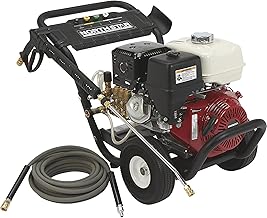
A genuinely commercial-grade cold-water unit whose 3.5 GPM flow strips grease and ground-in grime from shop floors and equipment far faster than any residential machine. It’s heavy and unapologetically loud, so treat it as a scheduled-work tool rather than something you fire up on a whim.
Westinghouse WPX3400
The most approachable option here, with an onboard soap tank and a five-nozzle set that make quick work of cars, railings, and outdoor furniture. It’s the practical choice for light, frequent use, though the pump isn’t built for the long service life of the triplex-equipped Simpsons.
Simpson Water Blaster ALWB60827
At 4200 PSI and 4.0 GPM with a 50-foot hose, this is a large-property machine — long driveways, barns, and multi-building cleanups — and the aluminum frame keeps it manageable despite the output. Overkill for a townhouse, close to ideal for acreage.
Frequently Asked Questions
How loud are these machines, and can I use one early in the morning?
Expect roughly 85–95 dB at the handles, comparable to a gas mower. Always wear hearing protection, and hold off until at least mid-morning; many municipalities restrict powered equipment before 8 or 9 a.m., and sound carries further in cool, still morning air.
Why does the Honda engine matter if the pump is what fails?
Honda’s GX-series engines start reliably after storage and have widely available parts, which means a worn pump is worth replacing rather than scrapping the whole unit. The engine determines the machine’s lifespan; the pump determines its maintenance schedule.
What maintenance actually keeps one running?
Change the pump oil per the manual, use a fuel stabilizer or run the tank dry before storage, flush the pump with antifreeze protectant before hard frosts, and rinse the inlet filter after each use.
Can I use one of these on outdoor furniture?
Yes, with the widest nozzle, a 40-degree or soap tip, and at least two feet of standoff. Teak, powder-coated aluminum, and resin wicker tolerate rinsing well; upholstered cushions and older painted surfaces do not.
Final Thoughts
For most homes, the Simpson Aluminum ALH3425 is the smart buy — Honda reliability, a rebuildable triplex pump, and enough hose to keep the engine away from windows and doorways. Choose the SIMPSON PowerShot PS3228 if you want the same mechanical foundation at a lower entry cost, and step up to the Simpson ALWB60827 only if you have acreage or outbuildings that justify 4.0 GPM.