Key takeaways
- Measure the gap, not the counter: Standard kitchen counters sit at 36 inches, and you want 9 to 12 inches of clearance between seat top and countertop underside. That puts most buyers at 24 to 26 inches of seat height — measure your own surface before trusting any product label.
- Insist on a footrest: Dangling feet force your thighs to carry the full weight of your legs, which tightens hip flexors and drags your pelvis into a slouch. A well-positioned rail lets your legs settle, and settled legs are the difference between fifteen minutes and an hour of comfortable sitting.
- Match back height to how you use the space: Full backs and barrel silhouettes support genuine lingering; backless saddle seats keep sightlines open and tuck away completely. Choose based on whether your island is a workspace, a dining spot, or both.
- Test the seat depth against your own legs: A pan-style or curved seat that cradles you without pressing behind the knees prevents the circulation pinch that makes people fidget. Deep barrel seats suit taller frames; shallower saddles work better for shorter legs.
- Be honest about upholstery upkeep: Linen breathes beautifully and feels warm under bare arms, but it drinks coffee. Faux and bonded leather wipe clean in seconds and hold up under kids, which is why they dominate high-traffic kitchens.
What's inside
Most people shop for counter stools the same way they shop for a lamp: they find something that looks right, put it in the cart, and hope for the best. Then the stools arrive, and the household discovers what a bad seat actually costs. Breakfast becomes a five-minute affair instead of a relaxed twenty. Evening conversations migrate to the couch because nobody wants to perch on a hard ring of wood. In my work on sleep and recovery habits, I’ve noticed that the kitchen island is often where the day is supposed to wind down — where the phone gets put away, where tea gets drunk, where tomorrow gets talked through. A stool that fights your spine quietly sabotages all of that, and the fallout shows up hours later in a wound-up nervous system and a restless first hour in bed.
This guide approaches counter stools as furniture you’ll actually sit in for long stretches, not just objects that fill space under an overhang. I’ve weighted lumbar support, seat depth, footrest placement, swivel behavior, and the practical realities of cleaning and assembly — the details that determine whether a stool becomes a gathering spot or a decoration. Below you’ll find the models worth your attention this year, followed by a sizing and selection framework so you can buy once and stop thinking about it.
As an Amazon Associate we earn from qualifying purchases.




How to Choose a Kitchen Counter Stools (2026)
- Measure the gap, not the counter: Standard kitchen counters sit at 36 inches, and you want 9 to 12 inches of clearance between seat top and countertop underside. That puts most buyers at 24 to 26 inches of seat height — measure your own surface before trusting any product label.
- Insist on a footrest: Dangling feet force your thighs to carry the full weight of your legs, which tightens hip flexors and drags your pelvis into a slouch. A well-positioned rail lets your legs settle, and settled legs are the difference between fifteen minutes and an hour of comfortable sitting.
- Match back height to how you use the space: Full backs and barrel silhouettes support genuine lingering; backless saddle seats keep sightlines open and tuck away completely. Choose based on whether your island is a workspace, a dining spot, or both.
- Test the seat depth against your own legs: A pan-style or curved seat that cradles you without pressing behind the knees prevents the circulation pinch that makes people fidget. Deep barrel seats suit taller frames; shallower saddles work better for shorter legs.
- Be honest about upholstery upkeep: Linen breathes beautifully and feels warm under bare arms, but it drinks coffee. Faux and bonded leather wipe clean in seconds and hold up under kids, which is why they dominate high-traffic kitchens.
The Best Kitchen Counter Stools (2026)s Reviewed
Swivel Counter Stools with Full Back, Set of 2 (24″)
The combination of a genuine full back, linen padding, and a smooth swivel makes this the most conversation-friendly option here — you can turn toward whoever walks in without shuffling the whole stool. At 24 inches it’s the safest choice for a standard 36-inch counter.
26″ Barrel Counter Stools with Backrest and Arms
The wraparound barrel shape and armrests create something closer to a lounge chair than a stool, which is exactly what you want if your island doubles as the spot where the family actually eats. The 450-pound rating also signals frame construction that won’t develop a wobble by year two.
Raynesys 24″ Bonded Leather Curved Stools
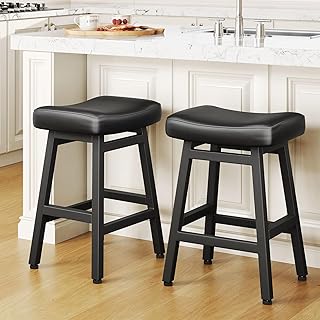
The curved seat does real ergonomic work, keeping your hips centered rather than letting you slide forward into a slump, and the all-black bonded leather wipes down instantly. This is my default recommendation for households with young children.
PrimeZone 26″ Solid Wood Saddle Backless Stools
A saddle seat encourages an upright, engaged posture that many people find more comfortable than a bad backrest, and the nailhead trim plus solid wood frame give it a farmhouse presence that photographs well. Skip it if anyone in the house wants to sit and read for an hour.
FSC Certified Faux Leather Barstools, Set of 3 (27″)
Three matched stools at a sensible price is unusual, making this the practical pick for wider islands, and the FSC certification means the wood is responsibly sourced. Note the 27-inch seat height — verify your counter clearance carefully before ordering.
Frequently Asked Questions
What’s the difference between counter height and bar height?
Counter stools run 24 to 27 inches and pair with 36-inch kitchen counters. Bar stools run 29 to 32 inches and are built for 42-inch pub-height bars. Mixing them up is the single most common return reason.
How many stools fit at my island?
Allow 26 to 30 inches of counter width per stool so elbows don’t collide. A 60-inch overhang comfortably seats two; you need roughly 90 inches before three stools stop feeling cramped.
Are swivel stools worth the extra cost?
If people talk at your island, yes. Swiveling removes the awkward twist-and-scoot that makes stools feel like temporary seating, and it’s noticeably easier on knees and lower backs.
Does seating comfort really affect sleep?
Indirectly but meaningfully. Uncomfortable seating cuts short the slow, unhurried evening rituals — tea, conversation, reading — that help downshift the nervous system before bed. Comfortable seating makes those habits easy to keep.
Final Thoughts
For most kitchens, the Swivel Counter Stools with Full Back deliver the best balance of support, mobility, and standard-height fit, while the 26″ Barrel Counter Stools are the upgrade worth making if your island is where meals and long conversations happen. Families who prioritize easy cleanup should go straight to the Raynesys curved bonded leather set — measure your counter clearance first, then buy for the way you actually want to spend your evenings.