Key takeaways
- CFM before horsepower: Horsepower ratings are marketing; delivered CFM at 90 PSI is the real spec. Add up your most demanding tools, then add 30% headroom. An impact wrench wants 4–5 CFM, a DA sander 12 or more, and an HVLP gun can pull 12–14 CFM continuously.
- Tank size as a buffer, not a source: A larger tank doesn’t create air, it stores it. A 20–30 gallon vertical tank smooths out intermittent work and reduces cycling; nothing under 20 gallons will keep a sander happy for long.
- Noise floor matters more than peak volume: Look for a published decibel figure. Anything at or under 60 dB is conversation-level and genuinely livable near sleeping areas. Between 60 and 80 dB you’ll want a closed door and daytime-only use. Above 85 dB, plan on hearing protection and real acoustic isolation.
- Oil-free versus oil-lubricated: Oil-free pumps are lighter, need almost no upkeep, and start reliably in cold weather, but they’re typically louder and have a shorter service life. Oil-lubricated pumps run cooler, quieter, and longer if you commit to checking levels.
- Power and placement first: Confirm your circuit before you buy. Larger 220V units need dedicated wiring, and any compressor benefits from being mounted on vibration pads away from shared walls — placement often cuts more perceived noise than a spec sheet upgrade.
What's inside
Anyone who has worked in a shop attached to a house — or has a bedroom above the bay — knows that an air compressor is not just a tool decision. It’s a sound decision. A cheap single-stage unit kicking on at 6 a.m. can register in the mid-90-decibel range, roughly the volume of a gas mower running in the hallway. That noise travels through shared framing, wakes children, ends conversations, and quietly wears down the people living around your work. Meanwhile, undersizing the tank makes the problem worse: a compressor that can’t keep up cycles constantly, so instead of one loud burst you get an all-day rhythm of surges that the nervous system never fully tunes out.
This guide looks at automotive shop compressors through two lenses at once: whether they can actually feed impact wrenches, ratchets, and spray equipment, and what they do to the acoustic environment around them. Below you’ll find our picks for 2026, a short buying framework covering CFM, duty cycle, and noise floor, honest notes on where each machine fits, and answers to the questions we get most often from readers running a shop inside a residential footprint.
As an Amazon Associate we earn from qualifying purchases.


How to Choose a/an Air Compressor For Automotive Shop (2026)
- CFM before horsepower: Horsepower ratings are marketing; delivered CFM at 90 PSI is the real spec. Add up your most demanding tools, then add 30% headroom. An impact wrench wants 4–5 CFM, a DA sander 12 or more, and an HVLP gun can pull 12–14 CFM continuously.
- Tank size as a buffer, not a source: A larger tank doesn’t create air, it stores it. A 20–30 gallon vertical tank smooths out intermittent work and reduces cycling; nothing under 20 gallons will keep a sander happy for long.
- Noise floor matters more than peak volume: Look for a published decibel figure. Anything at or under 60 dB is conversation-level and genuinely livable near sleeping areas. Between 60 and 80 dB you’ll want a closed door and daytime-only use. Above 85 dB, plan on hearing protection and real acoustic isolation.
- Oil-free versus oil-lubricated: Oil-free pumps are lighter, need almost no upkeep, and start reliably in cold weather, but they’re typically louder and have a shorter service life. Oil-lubricated pumps run cooler, quieter, and longer if you commit to checking levels.
- Power and placement first: Confirm your circuit before you buy. Larger 220V units need dedicated wiring, and any compressor benefits from being mounted on vibration pads away from shared walls — placement often cuts more perceived noise than a spec sheet upgrade.
The Best Air Compressor For Automotive Shop (2026)s Reviewed
California Air Tools 20040CAD (4.0 HP, 20 Gallon)
This is the sweet spot for a serious shop that shares a building with living space: a 75 dB noise level and enough output to run sanders and spray equipment without constant recovery cycles. The automatic drain valve is a genuinely useful touch, saving you the weekly ritual of crawling under the tank.
DEWALT 30 Gallon Portable (175 PSI, Oil Lube)
The largest-capacity pick here and the one we’d choose for high-demand days, thanks to an oil-lubricated pump that runs cooler and lasts longer under sustained load. It’s louder than the California Air Tools units, so treat it as a daytime, closed-door machine rather than an early-morning one.
Klutch 29-Gallon (2.5 HP, 175 PSI)
A well-balanced oil-free vertical unit with quick recovery and a tank drain that’s actually reachable, making it a low-maintenance workhorse for nailing, inflation, and general shop tasks. At 5.1 CFM it will handle impact tools comfortably but will struggle with continuous sanding.
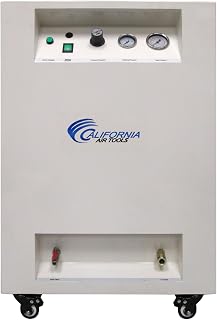
California Air Tools 10020SPC (58 dB, Sound Proof Cabinet)
At 58 dB this is the quietest option on the list by a wide margin — you can hold a phone call beside it, and it won’t wake anyone through a wall. The trade-off is a 10-gallon tank and 2.0 HP, so it’s best suited to lighter automotive work, tire service, and detailing rather than bodywork.
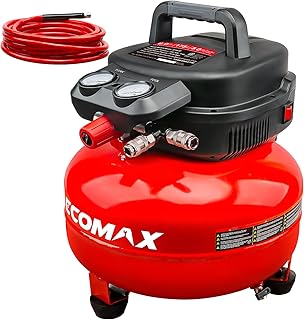
ECOMAX 6 Gal Pancake (175 PSI, 25 ft Hose)
An affordable entry point that arrives ready to work with dual couplers and a hose included, and it moves easily between bays. Use it for tires, air ratchets, and quick jobs; it’s the pick for supplementing a larger compressor, not replacing one.
Frequently Asked Questions
How quiet does a compressor need to be for a home-attached shop?
Aim for 60 dB or below if anyone might be sleeping nearby. Because decibels are logarithmic, a 58 dB unit isn’t slightly quieter than an 85 dB one — it’s perceived as roughly one-eighth as loud.
Is a 20-gallon tank enough for automotive work?
For impact wrenches, ratchets, blow guns, and inflation, yes, provided the CFM rating is adequate. For sanders or paint spraying, step up to 30 gallons or more.
Can I reduce the noise of a compressor I already own?
Considerably. Set it on rubber isolation pads, keep it off shared walls, extend the intake with a longer air filter line, and enclose it with sound-absorbing panels while preserving airflow for cooling.
Do I need a 220V circuit?
Only for the larger units like the 20040CAD. The 120V models here run on standard household circuits, though each should ideally have its own dedicated breaker.
Final Thoughts
If your shop shares walls or a ceiling with living space, the California Air Tools 20040CAD is the best overall balance of real output and a livable noise floor, while the 10020SPC in its sound-proof cabinet is unmatched for light automotive work in genuinely quiet conditions. Choose the DEWALT 30 Gallon if raw capacity and long-term durability outweigh noise concerns.