Key takeaways
- Measure the gap, not the stool: Aim for 9–12 inches between seat top and counter underside. Standard 36″ counters want a 24–26″ seat; 42″ bars want 28–30″. Too little clearance and you’ll perch forward all evening, which locks the low back.
- Insist on a real backrest: A back that reaches the lower ribs lets the spine stack passively instead of being held upright by muscle. Backless stools are fine for five-minute use and quietly exhausting for anything longer.
- Check for a footrest or correct leg length: Unsupported feet mean constant micro-tension in the hips and calves — the same tension that surfaces later as restless legs in bed. A metal footrest ring or bar solves this instantly.
- Match the surface to the room’s temperature: Linen and woven fabric breathe and stay neutral to the touch, which suits warm kitchens. Bonded and faux leather wipe clean in seconds — ideal near cooking splatter, though they can feel cool in winter.
- Decide on swivel honestly: A 360° swivel reduces the twisting and bracing that tight kitchens demand, and it’s a genuine relief for stiff hips. Fixed bases feel more planted and are easier for small children to climb safely.
What's inside
Most people shopping for bar stools are thinking about height, finish, and whether the fabric will survive spaghetti night. Almost nobody is thinking about sleep — and that’s the oversight I keep running into as a sleep-wellness consultant. The kitchen island is where a huge amount of modern evening life happens: the last glass of water, the late email, the 9 p.m. homework negotiation. If the seat you’re perched on forces you into a hunched, braced posture, your nervous system reads that as work, not wind-down. Shoulders creep up, breathing gets shallow, and the transition into rest gets pushed back by an hour without anyone noticing why.
This guide looks at bar and counter height stools through that lens: back support that lets you actually exhale, footrests that stop your legs from dangling and tensing, seat depth that doesn’t cut circulation, and surfaces that feel calm rather than clammy. Below you’ll find our picks for 2026, followed by a practical selection framework and answers to the questions buyers ask most.
As an Amazon Associate we earn from qualifying purchases.




How to Choose Bar Height Stools (2026)
- Measure the gap, not the stool: Aim for 9–12 inches between seat top and counter underside. Standard 36″ counters want a 24–26″ seat; 42″ bars want 28–30″. Too little clearance and you’ll perch forward all evening, which locks the low back.
- Insist on a real backrest: A back that reaches the lower ribs lets the spine stack passively instead of being held upright by muscle. Backless stools are fine for five-minute use and quietly exhausting for anything longer.
- Check for a footrest or correct leg length: Unsupported feet mean constant micro-tension in the hips and calves — the same tension that surfaces later as restless legs in bed. A metal footrest ring or bar solves this instantly.
- Match the surface to the room’s temperature: Linen and woven fabric breathe and stay neutral to the touch, which suits warm kitchens. Bonded and faux leather wipe clean in seconds — ideal near cooking splatter, though they can feel cool in winter.
- Decide on swivel honestly: A 360° swivel reduces the twisting and bracing that tight kitchens demand, and it’s a genuine relief for stiff hips. Fixed bases feel more planted and are easier for small children to climb safely.
The Best Bar Height Stools (2026), Reviewed
26″ Modern Barrel Counter Stools with Backrest and Arms (Beige)
The barrel silhouette and armrests here do something most counter stools don’t: they give your elbows somewhere to land, which drops the shoulders and slows the breath. Linen upholstery keeps things cool, and the 450 lb rating means the frame stays silent and steady rather than flexing under shifting weight.
Swivel Counter Stools with Full Back, 24″ (Grey)
The full padded back is the standout — it supports the lumbar curve high enough that you can genuinely lean rather than hover. Pair that with the swivel and metal footrest and you have a stool that suits long, low-key kitchen evenings without the usual fidgeting.
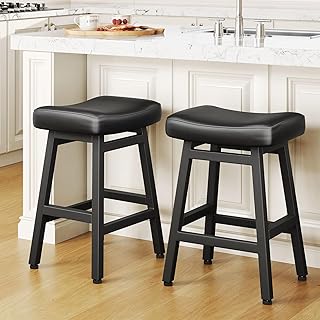
Raynesys 24″ Bonded Leather Counter Stools, Curved
The curved seat cradles rather than flattens, keeping pressure off the sit bones during extended use, and heavy-duty metal legs give it a reassuringly inert feel. Bonded leather wipes down in seconds, which makes this the low-maintenance choice for households with young kids.
DUMOS Faux Leather Bar Stools, Set of 4, 26″
The best-value option if you’re seating a whole family, and the armless profile tucks in neatly so the island stays visually uncluttered — worth more than people expect, since a cleared, calm kitchen genuinely supports evening wind-down. Back support is present but modest, so consider these for gathering rather than three-hour work sessions.
Nalupatio Adjustable Swivel Bar Stools (Black)
Height adjustment is the quiet advantage: you can dial in that ideal 10-inch clearance for each person instead of compromising on one fixed number. The gas-lift-and-swivel combination also means less awkward twisting to reach the counter behind you.
Frequently Asked Questions
What’s the difference between counter height and bar height?
Counter height stools have roughly 24–27″ seats and suit standard 35–37″ kitchen counters. Bar height stools sit at 28–33″ and are made for 41–43″ raised bars. Buying by name alone is the most common mistake — always measure.
Can seating posture really affect how well I sleep?
Indirectly but meaningfully. Sustained bracing in the evening keeps the sympathetic nervous system engaged and leaves residual muscular tension that makes settling in bed harder. Supported, relaxed sitting removes one small barrier to a smooth transition.
Are swivel stools less stable?
Not with a well-weighted base. Look for a wide footprint, a metal frame, and a stated weight capacity above 300 lb. Cheap swivels wobble because the base is undersized, not because the mechanism is inherently unstable.
How many stools fit at my island?
Allow 26–30 inches of counter width per person, measured centre to centre. Armchair-style stools need the upper end of that range; armless models like the DUMOS set fit comfortably at the lower end.
Final Thoughts
If you want one stool that supports genuine evening relaxation, the 26″ Modern Barrel stools with arms are the pick — the enclosed shape and armrests do real work in helping you settle. For flexible households, the Nalupatio adjustable swivel stools let each person find their own comfortable clearance, while the Raynesys bonded leather set offers the best mix of curved support and effortless cleanup.