Key takeaways
- Inner diameter: Choose 1/4″ for tire inflation, brad nailers, and blow guns; step up to 3/8″ when you’re feeding impact wrenches, framing nailers, or spray equipment that needs sustained volume without pressure drop at the tool.
- Material behavior in cold: Hybrid polymer stays supple well below freezing, polyurethane is the lightest option and coils tidily, and rubber resists abrasion but stiffens badly in an unheated garage. Match the material to the temperature you actually work in.
- Length versus drag: Fifty feet covers a two-car bay and most driveway work; 100 feet reaches the far corner of a lot but costs you noticeable pressure and adds real weight to pull. Buy the shortest length that reaches your furthest realistic job.
- Fittings and coupler standard: Confirm the plug and coupler match the standard already on your compressor and tools — industrial (Milton M-style) is the most common in North America. Brass fittings resist corrosion; bend restrictors at each end prevent the failure point most hoses die from.
- Working pressure and quiet operation: A 300 PSI rating gives generous headroom over typical 90–120 PSI tool demands. Just as important, look for smooth, well-machined couplers that seat without hissing — a leaking connection is both wasted air and an irritating noise floor in a shared space.
What's inside
Most people don’t think about air hoses until they’re on their knees at 6 a.m., topping off a tire before work, wrestling with a length of rubber that has curled itself into a stiff figure-eight overnight. As someone who spends most working hours talking with people about rest, recovery, and the small frictions that erode both, I’ve come to see garage gear as part of the same picture. A hose that kinks, drags, or whistles at the coupler adds noise, adds effort, and adds minutes to jobs that should take seconds — often at the exact hours when the rest of the household is asleep. The wrong hose is a low-grade stressor. The right one disappears into the work.
This guide looks at air compressor hoses through that practical lens: how they behave in cold mornings and hot afternoons, how much they fight you, how quietly they seal, and how easily they coil back up so the workspace stays orderly rather than becoming one more thing on the mental list. Below you’ll find our current picks for 2026, followed by a buying framework, short reviews of the top contenders, and answers to the questions we hear most often.
As an Amazon Associate we earn from qualifying purchases.


How to Choose a/an Air Compressor Hoses (2026)
- Inner diameter: Choose 1/4″ for tire inflation, brad nailers, and blow guns; step up to 3/8″ when you’re feeding impact wrenches, framing nailers, or spray equipment that needs sustained volume without pressure drop at the tool.
- Material behavior in cold: Hybrid polymer stays supple well below freezing, polyurethane is the lightest option and coils tidily, and rubber resists abrasion but stiffens badly in an unheated garage. Match the material to the temperature you actually work in.
- Length versus drag: Fifty feet covers a two-car bay and most driveway work; 100 feet reaches the far corner of a lot but costs you noticeable pressure and adds real weight to pull. Buy the shortest length that reaches your furthest realistic job.
- Fittings and coupler standard: Confirm the plug and coupler match the standard already on your compressor and tools — industrial (Milton M-style) is the most common in North America. Brass fittings resist corrosion; bend restrictors at each end prevent the failure point most hoses die from.
- Working pressure and quiet operation: A 300 PSI rating gives generous headroom over typical 90–120 PSI tool demands. Just as important, look for smooth, well-machined couplers that seat without hissing — a leaking connection is both wasted air and an irritating noise floor in a shared space.
The Best Air Compressor Hoses (2026)s Revieweds
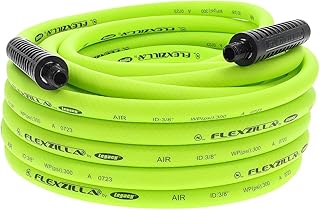
Flexzilla 3/8 in. x 50 ft. Hybrid Polymer Air Hose
Flexzilla remains the benchmark for a reason: the hybrid polymer jacket lies flat almost immediately out of the box and stays limp in genuine cold, which means you’re never fighting memory coils across a concrete floor. The 1/4″ MNPT ends let you fit your own couplers, and the high-visibility ZillaGreen is a small but real safety feature in a dim garage.
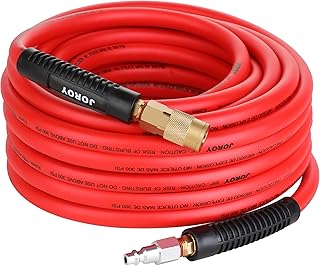
Hybrid Air Hose 3/8″ x 50 ft. with Brass Coupler and Plug
This is the sensible all-rounder for someone equipping a home bay from scratch, arriving with brass coupler and plug already installed so there’s no trip back out for fittings and thread sealant. It handles 300 PSI with margin and shrugs off temperature swings that turn cheaper rubber hoses into stubborn springs.
Hybrid Air Hose 3/8″ x 50 ft. with Industrial Coupler Kit (Green)
A close value alternative to the premium hybrids, with the same kink resistance and a complete industrial quick-connect kit included. If you run impact tools and want full 3/8″ flow without paying a brand premium, this is the pick that makes the most financial sense.
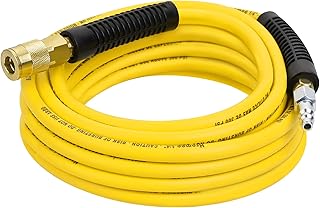
Air Compressor Hose 1/4″ x 25 ft. Hybrid with Fittings
Twenty-five feet of 1/4″ hybrid is the right answer for tire duty, bike tires, blow-gun cleanup, and finish nailing — light enough to carry one-handed and short enough to recoil in seconds. Keep this one hanging by the door and reserve the long 3/8″ line for real work.
YOTOO Polyurethane Recoil Air Hose, 1/4″ x 25 ft.
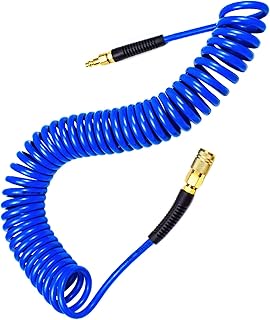
Recoil hoses excel in tight, tidy spaces because they retract themselves and never sprawl across a walkway — a genuine advantage if your compressor lives in a shared basement or a garage that doubles as storage. Expect some pull-back tension at full extension, which is the tradeoff for that self-managing coil.
Frequently Asked Questions
Does hose diameter really affect tool performance?
Yes, more than length does for most users. A 1/4″ hose chokes high-consumption tools like impact wrenches and sanders, causing them to bog down; 3/8″ delivers the volume those tools need to hit rated torque and speed.
Why does my hose leak at the coupler?
Usually a worn O-ring inside the quick-connect, a plug that isn’t fully seated, or thread tape applied too thinly at the fitting. Replace the O-ring first — it’s the cheapest fix and resolves the majority of persistent hisses.
Is polyurethane or hybrid polymer better?
Polyurethane is lighter and coils more neatly, making it ideal for short, frequently handled lines. Hybrid polymer is tougher underfoot and more abrasion-resistant, which is what you want for a 50-foot line dragged across concrete and gravel.
How should I store a hose to make it last?
Drain the compressor tank, relieve line pressure, and hang the hose in wide loops on a broad-radius hook rather than folding it or coiling it tightly around a nail. Sharp bends near the fittings are the single most common cause of premature failure.
Final Thoughts
For most home garages, the Flexzilla 3/8″ x 50 ft. is the hose worth buying once and forgetting about, with the Hybrid 3/8″ x 50 ft. with brass fittings a strong ready-to-run alternative at a friendlier price. Pair either with the 1/4″ x 25 ft. hybrid for quick tire-and-cleanup duty, and you’ll have a setup that stays flexible, seals quietly, and stops stealing time from the parts of your day that matter more.