Key takeaways
- Airflow over pressure: Max PSI is mostly marketing for off-road use — almost nothing you inflate needs more than 45 PSI. CFM is what fills a tire. Look for 4+ CFM for 31–33 inch tires and 7 CFM or better for 35s and up.
- Duty cycle: A 100% duty cycle rating means the unit can run continuously without a mandatory cooldown. Anything less and you’ll be babysitting a thermal cutoff halfway through your third tire.
- Power delivery: Direct battery clamps draw far more current than a 12V socket and are non-negotiable for high-output pumps. Cordless models trade some speed for the freedom to inflate away from the vehicle.
- Hose length and fittings: Measure from your intended mounting point to the farthest valve stem, then add slack. Braided hose, brass couplers, and a locking chuck save far more frustration than any digital display.
- Storage footprint: Cased kits protect the pump but eat drawer space. If you sleep in your rig, weigh where the compressor lives when the platform is deployed — a bag that stows under a seat beats a hard case that rides on your mattress.
What's inside
Anyone who has aired down for a sandy trail knows the real work starts on the way home. You’re parked on the shoulder at dusk, four tires sitting at 15 PSI, and the little compressor you bought for bicycle duty is wheezing through its third overheat shutdown. Trail recovery gear gets all the attention, but the tool that actually determines whether you make it back to pavement — and whether you get a full night’s rest instead of a two-hour roadside ordeal — is the air compressor bolted in your cargo area.
This guide looks at portable and semi-permanent 12V compressors through the lens of what matters after a long day outdoors: how fast they refill a set of 33s, whether they can run continuously without cooling breaks, and how much space and noise they cost you at camp. Below you’ll find current standouts across cordless, single-cylinder, and dual-cylinder categories, plus the specs worth checking before you commit.
As an Amazon Associate we earn from qualifying purchases.




How to Choose an Air Compressor For Off Roading (2026)
- Airflow over pressure: Max PSI is mostly marketing for off-road use — almost nothing you inflate needs more than 45 PSI. CFM is what fills a tire. Look for 4+ CFM for 31–33 inch tires and 7 CFM or better for 35s and up.
- Duty cycle: A 100% duty cycle rating means the unit can run continuously without a mandatory cooldown. Anything less and you’ll be babysitting a thermal cutoff halfway through your third tire.
- Power delivery: Direct battery clamps draw far more current than a 12V socket and are non-negotiable for high-output pumps. Cordless models trade some speed for the freedom to inflate away from the vehicle.
- Hose length and fittings: Measure from your intended mounting point to the farthest valve stem, then add slack. Braided hose, brass couplers, and a locking chuck save far more frustration than any digital display.
- Storage footprint: Cased kits protect the pump but eat drawer space. If you sleep in your rig, weigh where the compressor lives when the platform is deployed — a bag that stows under a seat beats a hard case that rides on your mattress.
The Best Air Compressor For Off Roading (2026)s Reviewed
ALL-TOP Dual Cylinder 12V Kit (12.35 ft³/min)
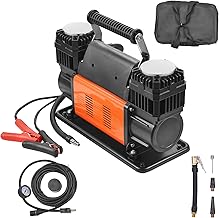
This is the closest thing to an onboard air system that still fits in a case, and the twin-cylinder head genuinely fills 35s in the time single pumps need for one tire. It draws serious amperage, so run it with the engine on and clamp straight to the battery terminals.
VEVOR 10.6 CFM Dual-Cylinder Inflator
A strong value pick for high-output airing up, with enough flow to reset a bead-adjacent low tire and adapters for everything from ball valves to RV air bags. Build quality sits a notch below premium kits, but for occasional weekend duty the output-per-dollar is hard to argue with.
DEWALT 20V MAX Tire Inflator (DCC020IB)
If you already own DEWALT batteries, this is the most sensible purchase on the list: automatic shutoff at your target pressure, a usable work light, and no wiring whatsoever. It’s a top-off and adjustment tool rather than a full four-tire recovery pump, so pair it with something larger for big rubber.
ETENWOLF VORTEX S6 Cordless Inflator
The 19,200mAh pack and dual-cylinder head give this one real cordless credibility, and the 100% duty cycle rating means it won’t quit mid-tire the way most battery inflators do. Excellent for trailheads, kayaks, and anywhere you’d rather not drag a cable.
ROCGORLD R8 12V Portable Inflator
A tidy, fast single-cylinder unit whose dual digital screen makes setting and monitoring pressure genuinely easy in low light. Best suited to stock-to-mildly-lifted trucks and mixed household duty rather than heavy 37-inch work.
Frequently Asked Questions
How much CFM do I actually need?
For 31–33 inch tires, 4–6 CFM airs up a full set in roughly 15 minutes. For 35s and larger, target 7 CFM or more, or expect to spend half an hour at the trailhead.
Can I run a compressor from the 12V accessory socket?
Only the smaller units. Most sockets are fused at 10–20 amps, and high-output pumps pull 30–60 amps. Use the supplied battery clamps and keep the engine running.
Should I leave it mounted or store it in a case?
Permanent mounting is faster and protects the pump from being tossed around, but requires a clean air intake and vibration isolation. Cased kits are the better default if you swap vehicles.
Do I need a tank?
Not for tires. A tank helps with impact tools and instant bead seating, but it adds weight and complexity most trail users never recoup.
Final Thoughts
For serious airing up on 35s and beyond, the ALL-TOP dual-cylinder kit is the one worth the outlay and the wiring. The VEVOR 10.6 CFM undercuts it while delivering most of the speed, and the ETENWOLF VORTEX S6 is the pick if you value cordless convenience and a genuine 100% duty cycle over raw flow.