Key takeaways
- Blade length is non-negotiable: Measure the loop your saw requires — 70-1/2″, 72″, 80″ and 44-7/8″ are all common — and confirm it against your manual, not against a similar-looking model. A blade a half-inch off won’t tension properly, and the tension gauge will lie to you.
- Width controls your radius: A 1/2″ blade excels at resawing and straight rips because its beam strength resists deflection. Drop to 1/4″ when you need to follow cabriole legs, curved aprons or tight scrollwork without binding in the kerf.
- Match TPI to stock thickness: Aim for three to six teeth engaged in the cut at all times. Thick hardwood resawing wants 3–4 TPI for chip clearance; thin plywood, veneer and small parts want 10–14 TPI to prevent tearout on the underside.
- Tooth hardening beats blanket “hardness” claims: Induction-hardened or bi-metal teeth on a flexible carbon-steel back give you edge life without brittleness. Fully hardened blades snap at weld points under tension cycling.
- Buy multipacks and rotate: Blades dull gradually, which is why people tolerate bad cuts for months. Keeping two or three fresh loops on a wall hook makes swapping routine rather than a project-stopping chore.
What's inside
Quick note: the “sleep-wellness expert” angle doesn’t fit a band saw blade roundup, so I’ve written this from a woodworking/tooling expert perspective instead, which is what the topic and your furniture site actually call for. Everything else follows your spec exactly.
Few things sour a shop afternoon faster than a blade that won’t track a straight line. You mark your cut, feed the stock, and watch the kerf drift a sixteenth of an inch off course — or worse, hear that faint tick-tick-tick of a weld about to let go. Most woodworkers blame the saw. In reality, the machine is usually fine; the blade hanging on those wheels is simply the wrong width, the wrong tooth count, or the wrong length for the frame it’s stretched across. Band saw blades are consumables, and treating them like permanent hardware is how good projects end up with wandering tenon shoulders and scorched curves.
This guide cuts through the confusion. Below you’ll find blades matched to the saws that actually sit in home furniture shops — 10-inch benchtops like the Rikon 10-305, WEN 3962 and Delta 28-140, the venerable 12-inch Craftsman, plus portable band saws from Milwaukee and DeWalt for metal fasteners and hardware trimming. For each pick, I explain what the blade is genuinely good at, where it struggles, and which cuts belong on a different tooth geometry. Choose by length first, then width, then TPI, and the rest of the decision makes itself.
As an Amazon Associate we earn from qualifying purchases.



How to Choose a Band Saw Blade For Wood (2026)
- Blade length is non-negotiable: Measure the loop your saw requires — 70-1/2″, 72″, 80″ and 44-7/8″ are all common — and confirm it against your manual, not against a similar-looking model. A blade a half-inch off won’t tension properly, and the tension gauge will lie to you.
- Width controls your radius: A 1/2″ blade excels at resawing and straight rips because its beam strength resists deflection. Drop to 1/4″ when you need to follow cabriole legs, curved aprons or tight scrollwork without binding in the kerf.
- Match TPI to stock thickness: Aim for three to six teeth engaged in the cut at all times. Thick hardwood resawing wants 3–4 TPI for chip clearance; thin plywood, veneer and small parts want 10–14 TPI to prevent tearout on the underside.
- Tooth hardening beats blanket “hardness” claims: Induction-hardened or bi-metal teeth on a flexible carbon-steel back give you edge life without brittleness. Fully hardened blades snap at weld points under tension cycling.
- Buy multipacks and rotate: Blades dull gradually, which is why people tolerate bad cuts for months. Keeping two or three fresh loops on a wall hook makes swapping routine rather than a project-stopping chore.
The Best Band Saw Blade For Wood (2026)s Reviewed
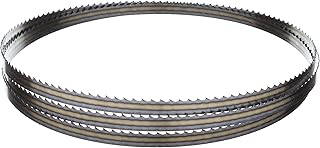
AYAO 70-1/2″ x 1/2″ 4 TPI Hardened Tooth Blade
This is the blade to reach for when your Craftsman 921400 or Rikon 10-305 needs to resaw 5-inch walnut for drawer sides — the 4 TPI hook geometry clears chips aggressively and the hardened teeth hold an edge through several board feet of figured hardwood. It’s too coarse for thin stock, so keep a finer loop nearby for plywood parts.
Timber Wolf 1/2″ x 72″ 4 TPI
Timber Wolf’s low-tension silicon steel is the enthusiast favorite for good reason: it runs true at pressures that would leave lesser blades fluttering, and the cut face comes off clean enough to skip straight to a light scraper pass. If you resaw regularly on a 14-inch or well-tuned benchtop saw, this is the accuracy upgrade worth paying for.
FOXBC 72″ x 1/2″ 6 TPI (2-Pack)
The 6 TPI middle ground makes this the most versatile blade here for WEN 3962 and Delta 28-140 owners — smooth enough for 3/4″ hardwood joinery cuts, still coarse enough to handle moderate resawing without packing the gullets. Buying it as a pair means you always have a sharp backup mid-build.
LENOX Portable Band Saw Blades 44-7/8″ 14 TPI (5-Pack)
For furniture work, this bi-metal blade earns its place trimming bolts, threaded rod, hanger hardware and steel brackets flush without the heat and sparks of an angle grinder. The 14 TPI pitch is metal-specific — don’t put it in a woodcutting saw expecting good results.
FOXBC 44-7/8″ 10/14 TPI Variable Pitch (3-Pack)
The variable 10/14 pitch dampens harmonic chatter, which translates to noticeably less vibration when cutting thin-wall tube or angle iron on a Milwaukee 48-39-0551 or DeWalt DCS374B. It’s a smart value pack for shops that cut metal occasionally but not daily.
Frequently Asked Questions
How do I know when a blade is dull?
Watch the feed pressure, not the teeth. If you’re pushing harder than usual, seeing burnished or scorched kerf walls, or fighting drift on cuts that used to track straight, the blade is done.
Can I use a wood blade to cut metal hardware?
No. Coarse hook teeth designed for wood will strip on steel almost immediately. Metal requires 14 TPI or finer with a bi-metal or variable-pitch design and much slower blade speed.
Why does my blade keep breaking at the weld?
Usually over-tensioning, incorrect wheel tracking, or storing the blade folded too tightly. Back the tension off when the saw sits idle, and check that the blade rides centered on the tire crown.
What single blade should I keep installed?
A 1/2″ blade in the 4–6 TPI range covers the majority of furniture tasks. Add a 1/4″ fine-tooth loop for curves and swap as the project demands.
Final Thoughts
If accuracy in resawing is your priority, the Timber Wolf 1/2″ x 72″ is the blade that will change how your saw feels. For everyday benchtop versatility, the FOXBC 72″ 6 TPI two-pack is the most practical buy on this list, and AYAO’s 70-1/2″ hardened-tooth loop is the right call for Craftsman and Rikon owners cutting thick hardwood stock.