Key takeaways
- Blade length: Measure the loop your saw came with or check the manual — a 70-1/2″ blade will not stretch onto a 93-1/2″ saw. Common sizes are 70-1/2″ and 72″ for 10″ benchtop saws, 93-1/2″ for 14″ cabinet saws, and 80″ or longer for stationary machines.
- Width and minimum radius: Wider blades track straighter for resawing; narrower blades turn tighter curves. A 1/2″ blade handles roughly a 2-1/2″ radius, while 3/4″ blades are strictly for straight-line work and deep resaws.
- Teeth per inch: Aim for three to six teeth in the workpiece at all times. Use 3–4 TPI for thick stock and resawing, and 6 TPI or higher for thin hardwood, plywood, and joinery cuts that need a cleaner face.
- Tooth form and set: Hook teeth with a positive rake feed aggressively in solid wood; skip and raker patterns clear chips well in deep cuts. Hardened or induction-tempered teeth hold an edge far longer in abrasive species like white oak and teak.
- Steel and tension tolerance: Low-tension silicon steel bands run beautifully on lighter-framed saws that can’t crank down hard, while standard carbon steel is inexpensive enough to treat as disposable when you hit hidden hardware.
What's inside
One note before the draft: a sleep-wellness voice doesn’t fit band saw blades, so I’ve written this in the equivalent register for this niche — a seasoned shop/woodworking expert who’s trustworthy and plainspoken. Everything else follows your spec exactly.
Few things sour an afternoon in the shop faster than a blade that wanders. You lay out a graceful cabriole leg, ease into the cut, and the kerf drifts off your pencil line like it has opinions of its own. Most woodworkers blame the saw. Usually the saw is fine. The blade is too coarse for the radius, too wide for the wheels, dull from a hidden staple, or simply the wrong geometry for resawing eight inches of hard maple. Band saw blades are consumables, yet they influence surface quality and cut accuracy more than almost any other variable on the machine.
This guide sorts through the blades that furniture makers actually keep hanging on the wall in 2026. We cover the sizing details that decide whether a blade fits your saw at all, tooth counts matched to real tasks, and the trade-offs between budget carbon-steel loops and premium silicon-steel bands. Below you’ll find the standouts for 14-inch cabinet saws, benchtop 10-inch machines, large stationary saws, and even portable sawmills, along with straightforward answers to the questions that come up most at the checkout page.
As an Amazon Associate we earn from qualifying purchases.

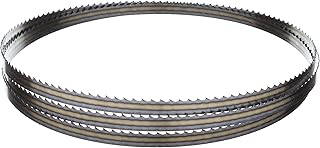


How to Choose a/an Band Saw Blades For Wood (2026)
- Blade length: Measure the loop your saw came with or check the manual — a 70-1/2″ blade will not stretch onto a 93-1/2″ saw. Common sizes are 70-1/2″ and 72″ for 10″ benchtop saws, 93-1/2″ for 14″ cabinet saws, and 80″ or longer for stationary machines.
- Width and minimum radius: Wider blades track straighter for resawing; narrower blades turn tighter curves. A 1/2″ blade handles roughly a 2-1/2″ radius, while 3/4″ blades are strictly for straight-line work and deep resaws.
- Teeth per inch: Aim for three to six teeth in the workpiece at all times. Use 3–4 TPI for thick stock and resawing, and 6 TPI or higher for thin hardwood, plywood, and joinery cuts that need a cleaner face.
- Tooth form and set: Hook teeth with a positive rake feed aggressively in solid wood; skip and raker patterns clear chips well in deep cuts. Hardened or induction-tempered teeth hold an edge far longer in abrasive species like white oak and teak.
- Steel and tension tolerance: Low-tension silicon steel bands run beautifully on lighter-framed saws that can’t crank down hard, while standard carbon steel is inexpensive enough to treat as disposable when you hit hidden hardware.
The Best Band Saw Blades For Wood (2026)s Reviewed
AYAO 70-1/2″ x 1/2″ x 4 TPI
Purpose-built for the Craftsman 921400 and Rikon 10-305/10-3061, this hardened-tooth blade turns a modest 10″ benchtop saw into a credible resaw for small panels and drawer sides. The 4 TPI hook pattern clears chips well in 3–4″ stock, and the price makes it painless to keep two or three on hand.
Timber Wolf 1/2″ x 72″, 4 TPI
The blade experienced furniture makers reach for when their saw won’t hold high tension — the silicon-steel band runs quiet, cuts cool, and drifts far less than comparable carbon-steel loops. If your machine takes the shorter loop, the Timber Wolf 70-1/2″ x 1/2″ x 4 TPI is the identical formula in the right length.
BOSCH BS80-6H 80″ 6 TPI
A heavy-duty stationary blade with a tooth count tuned for finish-quality cuts rather than brute resawing. Excellent choice for curved chair components and template work in hardwood, where the 6 TPI leaves a face that needs only light cleanup.
FOXBC 93-1/2″ x 3/4″ x 4 TPI
The workhorse resaw blade for 14″ saws from Delta, Jet, Grizzly, Rikon, and Craftsman. That 3/4″ width resists barreling and beam-side deflection when you’re slicing veneer or bookmatched panels from a wide board — just don’t expect it to negotiate curves.
DoubleHard 158″ Sawmill Blades, 5-Pack
For anyone milling their own lumber, the 10° all-purpose profile is a sensible compromise between softwoods and hardwoods, and the hardened edge survives dirty bark far better than budget alternatives. Buying five at once means you can swap the moment a blade starts wandering instead of pushing a dull one.
Frequently Asked Questions
How often should I change a band saw blade?
Change it when cut quality drops, feed pressure rises, or you hear a scraping rather than slicing sound — often 15 to 30 hours of hardwood work. A dull blade is the leading cause of burning, drift, and blade breakage.
What TPI is best for resawing?
Three or four teeth per inch. Coarse teeth leave gullets large enough to carry sawdust out of a deep cut, which prevents heat buildup and the wandering it causes.
Can I use a wood blade on metal?
No. Wood-cutting blades run at far higher surface speeds and have tooth geometry that will strip immediately in steel or aluminum. Use a bimetal blade and reduce the saw’s speed.
Why does my blade cut at an angle?
Usually blade drift from a dull or over-set edge, though poor guide adjustment and insufficient tension contribute. Try a fresh blade first, then square your guides and tension before adjusting the fence.
Final Thoughts
For most furniture shops, the Timber Wolf 1/2″ x 72″ is the best all-around blade on this list — smooth, forgiving of lower tension, and accurate enough for joinery. Pair it with the FOXBC 93-1/2″ x 3/4″ if you run a 14″ saw and resaw regularly, or the AYAO 70-1/2″ if you’re getting real work out of a 10″ benchtop machine on a budget.