Key takeaways
- Match diameter to square footage: A single-bay garage under 300 sq ft is well served by a 65″ span. Two-bay spaces from 400–600 sq ft want 72″–80″. Anything approaching a workshop, gym, or three-car footprint needs 96″ to move air across the full floor without dead zones in the corners.
- Read CFM, not speed count: Cubic feet per minute is the only honest measure of output. For real cooling relief on a hot afternoon, look for 6,000 CFM minimum; over 7,000 CFM produces a perceptible breeze at floor level even from a 10-foot ceiling.
- Insist on a DC motor: Direct-current motors draw roughly 60–70% less power than legacy AC units and — the part I care about most — run without the low-frequency hum that makes a space feel subtly agitating. If you’ll ever nap, meditate, or work quietly out there, this is non-negotiable.
- Confirm reversible airflow: Winter is when a garage fan earns its keep. Reversing the blades at low speed pulls the 15-degree-warmer air off the ceiling and mixes it downward, which can cut heater runtime substantially in an insulated bay.
- Check downrods and damp rating: Sloped ceilings, exposed trusses, and low headroom all demand adjustable downrods. And since garages swing wildly in humidity, a damp rating protects the motor and finish from condensation and coastal moisture.
What's inside
As a sleep-wellness consultant, I spend most of my working hours talking about airflow, ambient noise, and thermal comfort — the three levers that decide whether a space feels restful or hostile. Garages fail on all three. They bake under an uninsulated roof, trap exhaust and solvent fumes at head height, and echo every sound off bare concrete. Whether you’re rebuilding a carburetor, lifting weights at 6 a.m., or hosting a spillover guest bed on a summer weekend, that stale, superheated air is what makes an hour in there feel like three.
The fix isn’t a box fan wedged in the doorway. It’s a high-volume, low-noise overhead fan sized to the actual cubic footage of the room. Below, I’ve evaluated six large-diameter garage and shop fans on the metrics that matter to me professionally: total air movement, motor acoustics, reversibility for winter destratification, and mounting flexibility for the sloped or low ceilings most garages actually have. Here’s what earned a spot.
As an Amazon Associate we earn from qualifying purchases.



How to Choose a/an Ceiling Fan For Garage (2026)
- Match diameter to square footage: A single-bay garage under 300 sq ft is well served by a 65″ span. Two-bay spaces from 400–600 sq ft want 72″–80″. Anything approaching a workshop, gym, or three-car footprint needs 96″ to move air across the full floor without dead zones in the corners.
- Read CFM, not speed count: Cubic feet per minute is the only honest measure of output. For real cooling relief on a hot afternoon, look for 6,000 CFM minimum; over 7,000 CFM produces a perceptible breeze at floor level even from a 10-foot ceiling.
- Insist on a DC motor: Direct-current motors draw roughly 60–70% less power than legacy AC units and — the part I care about most — run without the low-frequency hum that makes a space feel subtly agitating. If you’ll ever nap, meditate, or work quietly out there, this is non-negotiable.
- Confirm reversible airflow: Winter is when a garage fan earns its keep. Reversing the blades at low speed pulls the 15-degree-warmer air off the ceiling and mixes it downward, which can cut heater runtime substantially in an insulated bay.
- Check downrods and damp rating: Sloped ceilings, exposed trusses, and low headroom all demand adjustable downrods. And since garages swing wildly in humidity, a damp rating protects the motor and finish from condensation and coastal moisture.
The Best Ceiling Fan For Garage (2026)s Reviewed
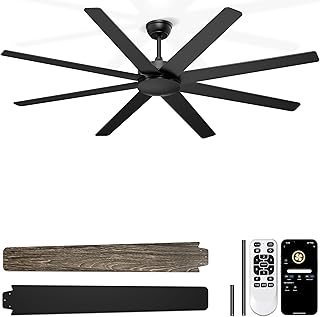
72″ Black Large Ceiling Fan with Remote/App Control
At 7,138 CFM from a 72″ span, this is the best output-per-inch ratio in the group, and the eight-blade configuration spreads that air more evenly than a five-blade equivalent. App control is a genuine convenience — you can spin it up from the kitchen so the bay is already cooled by the time you walk out.
ZMISHIBO 65″ Ceiling Fan, 6-Speed
The right answer for a single-bay garage or a converted workshop with limited ceiling area, delivering 6,116 CFM without overwhelming a compact room. Its six-speed DC motor is quiet enough at settings one and two that I’d comfortably recommend it for a garage that doubles as a guest or yoga space.
ZMISHIBO 80″ Ceiling Fan with Lights
The only pick here with integrated lighting, and the 24W three-CCT LED is smarter than most — switch to the warmest color temperature in the evening to avoid the blue-heavy light that suppresses melatonin before bed. Dual-finish blades and a damp rating make it equally at home over a covered patio.
ZMISHIBO 96″ Industrial Ceiling Fan, 8 Aluminum Blades
This is the serious destratification tool of the bunch: eight aluminum blades on a 96″ span move enough air to homogenize temperature in a three-car garage or small warehouse. The three included downrods and flat-or-sloped mounting hardware solve the installation headaches that derail most big-fan projects.
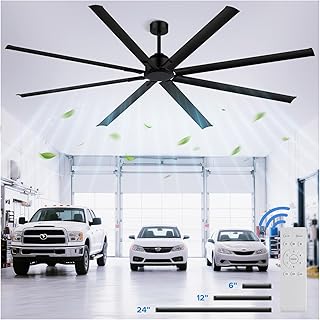
96″ Industrial HVLS Shop Ceiling Fan
A true HVLS design — high volume, low speed — which is precisely the acoustic profile you want, since blade tip speed, not diameter, generates noise. Running it at speed two produces a broad, gentle drift of air across a gym or shop floor with almost nothing audible.
Frequently Asked Questions
What size ceiling fan do I need for a two-car garage?
Plan on 72″ to 80″ for a typical 400–600 sq ft two-car bay with a 9–10 foot ceiling. If your ceiling exceeds 12 feet or the space is used for heavy work, step up to 96″ and use a longer downrod to bring the blades closer to the occupied zone.
Can these fans handle humidity and cold?
Damp-rated models are built for unconditioned, uninsulated spaces and tolerate condensation, temperature swings, and coastal air. They are not rated for direct rain, so avoid fully exposed mounting positions.
How low can the fan hang without being a hazard?
Keep at least seven feet of clearance from the floor to the blades, and verify clearance for raised garage doors, vehicle roof boxes, and lift arms before you drill. Measure the door in its fully open position — that’s the mistake I see most often.
Will a garage fan actually help me sleep better?
Indirectly, yes. Cooling a garage gym means you can train earlier without overheating, and finishing physical work in a well-ventilated space rather than a stifling one lowers evening arousal. If the garage adjoins a bedroom, reducing its heat load also reduces heat transfer through the shared wall overnight.
Final Thoughts
For most readers, the 72″ model with remote and app control is the sweet spot — 7,138 CFM, whisper-level DC operation, and a footprint that suits the majority of two-car garages. Compact single-bay spaces should go with the ZMISHIBO 65″, while anyone conditioning a genuine workshop, gym, or three-car garage will get the most from the ZMISHIBO 96″ industrial model and its eight aluminum blades.