Key takeaways
- Working height: Aim for a surface that lands near the crease of your wrist when you stand with arms hanging loose — roughly 31 to 35 inches for most adults. Anything lower forces sustained spinal flexion, which is precisely the kind of low-grade strain that resurfaces once you lie down.
- Genuine stability: Load capacity is only half the story. A bench rated for a thousand pounds can still shimmy sideways, and your body compensates by tensing through the shoulders and grip. Look for wide-set legs, locking mechanisms, and a frame that resists lateral flex, not just downward force.
- Fold-and-store honesty: A bench you dread collapsing is a bench that lives permanently in the middle of your floor. Check the folded thickness, whether it stands upright against a wall, and how many steps the collapse actually takes. One-motion designs get used; fiddly ones don’t.
- Weight versus muscle: Heavier frames damp vibration beautifully but punish anyone carrying them up steps. Be realistic about how often you’ll move it and who will be doing the lifting — repeated awkward carries are a common route to the kind of back tweak that ruins a week of sleep.
- Clamping and hold-downs: Integrated clamps and bench dogs mean your hands guide the tool instead of fighting the workpiece. Fewer white-knuckle moments translate to less residual tension in the forearms and neck when you finally sit down for the evening.
What's inside
Most buying guides treat a workbench as a purely mechanical decision: load rating, footprint, clamp count. I come at it from a different direction. After years of working with people whose sleep had quietly fallen apart, I kept finding the same culprits hiding in the garage — a hunched-over surface that left the lower back throbbing at 11 p.m., a wobbly table that turned a twenty-minute repair into a two-hour battle, a project sprawled across the floor because there was nowhere to set it down. Physical strain and unfinished tasks are two of the most reliable ways to sabotage a night’s rest, and both are often furniture problems disguised as personal failings.
This guide looks at the best portable workbenches you can buy in 2026 through that lens: surfaces that hold steady so your shoulders can relax, heights that keep your spine neutral, and folding designs that let you close the project down and walk away instead of leaving it to nag at you from across the room. Below you’ll find the top-rated options, followed by the criteria I’d weigh before committing, honest notes on each pick, and answers to the questions buyers ask most.
As an Amazon Associate we earn from qualifying purchases.



How to Choose a Portable Workbench (2026)
- Working height: Aim for a surface that lands near the crease of your wrist when you stand with arms hanging loose — roughly 31 to 35 inches for most adults. Anything lower forces sustained spinal flexion, which is precisely the kind of low-grade strain that resurfaces once you lie down.
- Genuine stability: Load capacity is only half the story. A bench rated for a thousand pounds can still shimmy sideways, and your body compensates by tensing through the shoulders and grip. Look for wide-set legs, locking mechanisms, and a frame that resists lateral flex, not just downward force.
- Fold-and-store honesty: A bench you dread collapsing is a bench that lives permanently in the middle of your floor. Check the folded thickness, whether it stands upright against a wall, and how many steps the collapse actually takes. One-motion designs get used; fiddly ones don’t.
- Weight versus muscle: Heavier frames damp vibration beautifully but punish anyone carrying them up steps. Be realistic about how often you’ll move it and who will be doing the lifting — repeated awkward carries are a common route to the kind of back tweak that ruins a week of sleep.
- Clamping and hold-downs: Integrated clamps and bench dogs mean your hands guide the tool instead of fighting the workpiece. Fewer white-knuckle moments translate to less residual tension in the forearms and neck when you finally sit down for the evening.
The Best Portable Workbench (2026)s Reviewed
BORA Centipede Folding Work Table
The Centipede’s scissor-lattice frame opens to a full 4×6-foot platform in seconds and swallows an enormous 4,500-pound load, yet it’s light enough to carry one-handed in its bag. It’s my top recommendation for anyone breaking down sheet goods, because it eliminates the floor-level cutting that wrecks knees and lumbar discs.
TLGREEN 7-in-1 Multifunctional Portable Workbench
Converting between work table, sawhorse, scaffold, creeper, dolly and hand truck, the TLGREEN replaces a small fleet of garage equipment — and the built-in power outlet spares you the cord-across-the-floor hazard. Best suited to people short on storage who’d rather own one adaptable piece than five single-purpose ones.
Keter Heavy-Duty Folding Workbench
Keter’s resin build handles 1,000 pounds, shrugs off weather, and folds flat enough to hang on a wall hook, with 12-inch adjustable clamps built into the top. The most user-friendly pick here, and the one I’d suggest to someone whose projects are occasional rather than constant.
Pony Portable Folding Work Table
Pony’s 2-in-1 table shifts between 25 and 35 inches of height, which is the widest adjustment range in this group and the reason it suits both seated detail work and standing assembly. The four clamps and four bench dogs make it the strongest choice for woodworkers who need real workholding.
Heavy-Duty 1,650 lb Folding Worktable
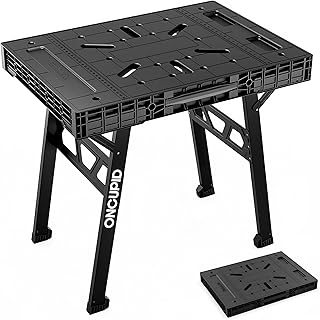
With a steel-legged frame rated to 1,650 pounds, a 34-by-25-inch top and no assembly required, this is the least fussy heavy-duty option available. Ideal for automotive work and anything involving genuine hammering, where a bench that flexes is a bench that fights you.
Frequently Asked Questions
What height should a portable workbench be?
For general standing work, 34 to 36 inches keeps your wrists roughly level with your hips and your spine neutral. Drop toward 30 inches for tasks needing downward force, like planing or hand-sawing, so your body weight does the work instead of your shoulders.
Are portable workbenches sturdy enough for real projects?
Modern designs absolutely are — several here exceed the capacity of a fixed bench. The variable to scrutinize is lateral rigidity, so always deploy the bench on level ground and engage every lock before loading it.
Can I use one outdoors?
Resin models like the Keter handle moisture and sun without complaint. Steel frames are fine outdoors too, but wipe them down and store them dry to prevent rust at the joints and hinges.
How does this relate to sleep?
More than people expect. Musculoskeletal pain is one of the leading causes of nighttime waking, and an unfinished, sprawling project keeps your mind in problem-solving mode long after you’ve gone to bed. A bench at the right height that folds away in ten seconds addresses both.
Final Thoughts
If you want a single recommendation, the BORA Centipede is the most transformative — it turns floor-level work into standing work and packs down to nothing. The Keter Heavy-Duty Folding Workbench is the easiest to live with day to day, and the Pony Folding Work Table is the one I’d choose for serious woodworking thanks to its height range and workholding. Any of the three will spare your back the kind of strain you’d otherwise be feeling at midnight.