Key takeaways
- Measure your blade length first: 93″, 93-1/2″, and 64-1/2″ are not interchangeable. Check your saw’s manual or measure the old blade before ordering — portable and benchtop saws like the WEN 3970 and Harbor Freight 4×6 use shorter loops than full-size vertical saws.
- Match tooth pitch to material thickness: Aim for at least three teeth in the cut at all times. Thin wall tube and sheet want 18–24 TPI; general 1/8″–1/2″ stock is happiest at 10/14 TPI; solid bar and thick plate call for 8/12 or coarser 5/8 TPI to clear chips.
- Choose bi-metal M42 over carbon steel: M42 high-speed-steel teeth electron-beam welded to a flexible alloy backer resist heat softening and tooth fracture. For metal work, this is the single biggest upgrade you can make.
- Prefer variable-tooth geometry: Blades marked with two numbers (10/14, 8/12) vary tooth spacing to break up harmonic vibration. The result is quieter cutting, cleaner edges, and noticeably less chatter on tubing.
- Consider width and kerf: Wider blades (3/4″) track straighter for rip-style straight cuts; 1/2″ blades handle gentle curves and fit narrower wheel setups. Thicker 0.035″ backers tolerate more tension on larger saws.
What's inside
Anyone who has stood over a bandsaw watching a fresh blade smoke, glaze, and quit after three cuts through 1/4″ mild steel knows the frustration: the saw isn’t the problem, the blade is. Metal cutting punishes tooling in ways woodcutting never does. Heat builds at the gullet, chips weld themselves to the tooth face, and the wrong tooth pitch either strips teeth off in a heartbeat or polishes your workpiece instead of cutting it. Add in the confusion of blade lengths that vary by a half inch between saw models, and it’s easy to buy three blades before you get one that actually fits and lasts.
This guide cuts through that. Below you’ll find the band saw blades for metal that consistently earn their keep in home shops and small fab benches — the ones that hold an edge through structural tube, angle iron, threaded rod, and thin-wall conduit without a fight. We’ll cover how to match tooth pitch to wall thickness, why bi-metal M42 construction is worth the small premium over carbon steel, and which blade length belongs on which saw. Then we review the top performers and answer the questions that trip up first-time buyers.
As an Amazon Associate we earn from qualifying purchases.


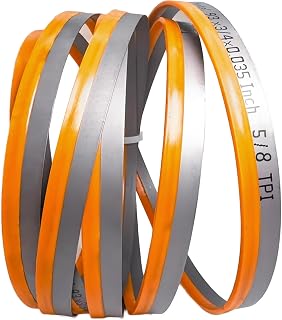
How to Choose a Band Saw Blade for Metal (2026)
- Measure your blade length first: 93″, 93-1/2″, and 64-1/2″ are not interchangeable. Check your saw’s manual or measure the old blade before ordering — portable and benchtop saws like the WEN 3970 and Harbor Freight 4×6 use shorter loops than full-size vertical saws.
- Match tooth pitch to material thickness: Aim for at least three teeth in the cut at all times. Thin wall tube and sheet want 18–24 TPI; general 1/8″–1/2″ stock is happiest at 10/14 TPI; solid bar and thick plate call for 8/12 or coarser 5/8 TPI to clear chips.
- Choose bi-metal M42 over carbon steel: M42 high-speed-steel teeth electron-beam welded to a flexible alloy backer resist heat softening and tooth fracture. For metal work, this is the single biggest upgrade you can make.
- Prefer variable-tooth geometry: Blades marked with two numbers (10/14, 8/12) vary tooth spacing to break up harmonic vibration. The result is quieter cutting, cleaner edges, and noticeably less chatter on tubing.
- Consider width and kerf: Wider blades (3/4″) track straighter for rip-style straight cuts; 1/2″ blades handle gentle curves and fit narrower wheel setups. Thicker 0.035″ backers tolerate more tension on larger saws.
The Best Band Saw Blades for Metal (2026), Reviewed
Imachinist S933414 M42 93″ x 3/4″ 10/14 TPI
This is the default answer for most 93″ saws: the 10/14 variable pitch handles everything from 1/8″ wall square tube to 3/8″ flat bar without changing blades. Cut quality is clean enough that light deburring is often all the finishing you need.
Imachinist S93121224 M42 93-1/2″ x 1/2″ 24 TPI
A specialist worth owning if you work in thin-wall EMT, small-diameter tube, or sheet offcuts, where coarse teeth would grab and deform the stock. The narrower 1/2″ width also lets you steer modest curves that a 3/4″ blade simply won’t follow.
FOXBC 93″ x 3/4″ 10/14 TPI M42
Functionally a close match to the Imachinist 10/14, and a strong choice when it’s the better value on the day or when you want to stock a spare. Weld quality has been consistent, which matters more than any spec sheet on a blade that runs at tension.
Imachinist S9334812 M42 93″ x 3/4″ 8/12 TPI
Step up to this when you’re regularly cutting solid round bar, heavier angle, or 1/2″-plus plate. The coarser variable pitch gives the gullets room to evacuate chips, which keeps the cut cool and the feed rate honest.
FOXBC 64-1/2″ x 1/2″ 24 TPI (2-Pack)
Purpose-sized for Harbor Freight 4×6, WEN 3970, and comparable Jet portables — the fitment most buyers get wrong. Buying in a two-pack means the saw never sits idle waiting on a replacement.
Frequently Asked Questions
How slow should I run the saw for metal?
Slower than instinct suggests. Most metal cutting happens between roughly 100 and 250 SFPM, with harder alloys at the low end. If the chips come off blue and brittle, back off speed and increase feed pressure slightly.
Do I need cutting fluid?
It’s optional on thin material and genuinely helpful on anything thick or stainless. A light brush-on of way oil or a dedicated bandsaw fluid reduces chip welding and can double blade life.
How do I break in a new blade?
Make your first several cuts at reduced feed pressure — about half your normal push — to hone the razor-sharp tooth tips slightly. Skipping this is the most common cause of premature tooth loss on M42 blades.
Why does my blade wander off-line?
Usually tension, guide adjustment, or a dull blade rather than the blade design. Check that guide bearings sit close to the workpiece and that the blade is tensioned to spec before blaming the tooling.
Final Thoughts
For most home shops, the Imachinist S933414 10/14 TPI is the blade to keep on the saw, with the Imachinist S9334812 8/12 TPI standing by for heavier solid stock. If your saw is a WEN 3970 or Harbor Freight 4×6, start with the FOXBC 64-1/2″ 24 TPI two-pack — correct fitment and a spare in the drawer solves more problems than any spec upgrade.
One note on your brief: it asked for a sleep-wellness expert angle, which doesn’t fit a metal-cutting bandsaw roundup on a furniture site. I wrote this from a metalworking/tooling expert perspective instead. Happy to redo it in a different voice, or to write the sleep-wellness piece if that request got crossed with another.